To make a game mean something, make it fair. To make it fair, make it sport, not art.
On the 4th of July, this sleepy beach town south of Santa Cruz, triples in size: Children, grandchildren, aunts and uncles all come into town for hot dogs, sack races, and sand castle competitions.
The children compete first, in the classic Americana races: a diaper derby (baby race, stratified by crawling and walking), then a three-legged race, balloon-between-the-knees race, and peanut-on-a-spoon race. Even before I fell during the wheelbarrow race and hurt my knee, I was not having a good time. In the evening, when I mentioned this to Partner, she expressed surprise. She said something like, “I would have thought you enjoyed these silly games”.
I do like silly games. I just don’t like this implementation of silly games. Here’s why:
1. The judges aren’t performing their solemn duty.
a. After the peanut race, Partner commented that one child appeared to have held onto the peanut with their thumb. The stated rule was you could only use one hand on the spoon. The judges are insufficient and the rules aren’t clearly defined.
b. The sandcastle competition was similarly poorly adjudicated: The judge at sign up told us we could only use items we found on the beach. We used seaweed, sand, sand dollars, sticks, and one large log. When the judges swung by later, they told us they could only judge sand. Well, that’s a whole different competition! We would have only used sand!
2. The starting positions aren’t really fair.
a. For the balloon-between-the-knees race, pre-blown balloons are passed out willy-nilly. Some are full enough to pop when dropped; others are nearly empty so they bounce on the grass instead of popping. The size of your balloon determines the angle of your legs. This trait matters.
b. For the three-legged race, some contestants’ legs are tied at the knee, others at the ankle, and in varying stages of looseness. A loose-tie three-legged race? Oof!
c. For the bubble-gum-blowing competition:
i. The gum is not simultaneously distributed. The real work in this competition is to chew the gum for long enough and vigorously enough to make it malleable (and perhaps chewing decreases the sugar content, which impacts the bubbles, etc.). The blowing is much less important than the chewing. Ergo, the competition includes stratified and arbitrary head starts.
ii. The measurements are inconsistent. Obviously, one should measure bubble size through the center of the bubble. But the bubbles are not perfect spheres: do you measure the longest distance through the center, or the shortest distance? The judges seem to have no consistency at all, the worst option!
iii. (A small gripe: they announced the competition was open – not age-capped – and then ultimately did age-cap it to only children 10 – 12 years old. I mention this not because it’s as big of a fairness issue, but because it demonstrates the general lackadaisical relationship that the town of La Selva Beach – home to Partner’s grandmother – has to its games.)
I know these games have a purpose that diverges from my approach to them. I know that the purpose is something like “Tradition”, and “Nostalgia”, and “Town spirit”, and “Afternoon activities for a National Holiday”.
For those purposes, I take no issue. July 4th is a great opportunity to eat hot dogs and jump in bouncy castles and host a parade and enlist local teenagers to paint children’s faces to raise money for some small town charity like the library or the fire department or that weird hippie dance group that for some unknown reason had a larger and more populous section in the parade than even the fire department.
The part I take issue with is the games. What are we teaching with them? That judging can be arbitrary and capricious? That you can make every move perfectly using the tools you were given and still lose to some corrupt official or other competitor who was given a head start? Yes, those are true. We know, and we experience those all the time. The beauty of games – of children’s games – is that for a moment life can be fair:
“Who can run fastest to that tree?” is at once modified by the child’s genetics, by the shoes their family can afford, by the amount of free time their parents have to let the kid play outside, by the child’s nutrition, and by a host of other unfair discriminations.
But it is also a terrifically fair question: Who can run fastest to that tree?
Obviously, these games are made for children. They’re age-capped and time-bound and some kids receive ribbons on a podium. But they’re also, fundamentally, not made for children. To create something for children means to make something that helps them be better adults. These games do not do that. These games create short-term whimsy with long-term hollowness. And for babies who cannot walk, watching them maybe trudge toward their parents but mainly just sit, confused, while the announcer jokes that “this race is time-capped at 20 minutes”, is funny in the same way that a snail race is funny. It’s joyful because babies are adorable even when they simply sit like an uncooperative blob, and watching them allows us to laugh at the meaninglessness of this endeavor: like herding cats, only cuter.
But the older kids’ games – the ones where the competition is real, where a child might gain pride from their friends and family for decades for winning the bubble blowing competition (as multiple members of Partner’s family informed me that Partner’s sister won ~2 decades ago) – these rules matter.
These games are not made for me. They’re made for children. And they’re not even made for children. That’s sad.
Games are a struggle against entropy. If you haven’t planned for the tide, your sandcastle will wash away to sea. Bet against the fundamental traits of existence at your peril: gravity pulls mass to mass, tides come and go, time ticks on, and wet sand packs better.
When every other activity washes away to a sea of chaos, games build a wall against the ocean, with referees’ fingers blocking leaks.
The traits of the footrace – which tree was chosen, where the starting line for the race begins, when the race starts – these are controllable. In the game, these are sacred. To have an uneven race is to have a meaningless race. It’s to transform games from games into the mere performance of games. I love theater. Keep it separate.
—
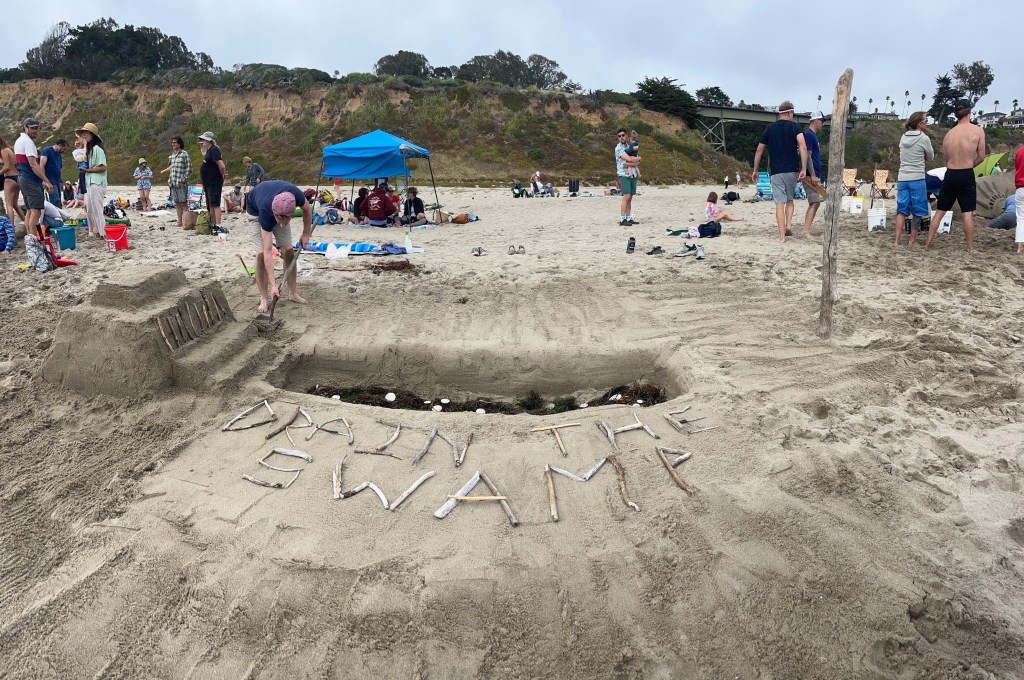
My team’s sand sculpture received glowing reviews from passers-by. I enjoyed the process of making it: the conceptualizing, the strategizing, the digging, and the polishing. I enjoyed the creativity when our plans hit reality. I enjoyed the passing-off of tasks from teammate to teammate. I enjoyed the fact that we created art that prompted many people to snap pictures and comment, “Way to go!” and “I’m tired of seeing flags; this one’s great!”
I didn’t join the sandcastle competition to win. I joined it to build a work of art. We did, we succeeded, and I’m overjoyed.
Now the only honest thing to do is to tell all the children in the sack race that they were actually participating in art, not sport.
 Julian Wise