Games as Sacred Childhood Development

To make a game mean something, make it fair. To make it fair, make it sport, not art. 

On the 4th of July, this sleepy beach town south of Santa Cruz, triples in size: Children, grandchildren, aunts and uncles all come into town for hot dogs, sack races, and sand castle competitions. 

The children compete first, in the classic Americana races: a diaper derby (baby race, stratified by crawling and walking), then a three-legged race, balloon-between-the-knees race, and peanut-on-a-spoon race. Even before I fell during the wheelbarrow race and hurt my knee, I was not having a good time. In the evening, when I mentioned this to Partner, she expressed surprise. She said something like, “I would have thought you enjoyed these silly games”.

I do like silly games. I just don’t like this implementation of silly games. Here’s why: 

1.  The judges aren’t performing their solemn duty. 

a.  After the peanut race, Partner commented that one child appeared to have held onto the peanut with their thumb. The stated rule was you could only use one hand on the spoon. The judges are insufficient and the rules aren’t clearly defined.

b.  The sandcastle competition was similarly poorly adjudicated: The judge at sign up told us we could only use items we found on the beach. We used seaweed, sand, sand dollars, sticks, and one large log. When the judges swung by later, they told us they could only judge sand. Well, that’s a whole different competition! We would have only used sand!

2.  The starting positions aren’t really fair.

a.  For the balloon-between-the-knees race, pre-blown balloons are passed out willy-nilly. Some are full enough to pop when dropped; others are nearly empty so they bounce on the grass instead of popping. The size of your balloon determines the angle of your legs. This trait matters.

b.  For the three-legged race, some contestants’ legs are tied at the knee, others at the ankle, and in varying stages of looseness. A loose-tie three-legged race? Oof!

c.  For the bubble-gum-blowing competition:

i.  The gum is not simultaneously distributed. The real work in this competition is to chew the gum for long enough and vigorously enough to make it malleable (and perhaps chewing decreases the sugar content, which impacts the bubbles, etc.). The blowing is much less important than the chewing. Ergo, the competition includes stratified and arbitrary head starts.

ii.  The measurements are inconsistent. Obviously, one should measure bubble size through the center of the bubble. But the bubbles are not perfect spheres: do you measure the longest distance through the center, or the shortest distance? The judges seem to have no consistency at all, the worst option!

iii.  (A small gripe: they announced the competition was open – not age-capped – and then ultimately did age-cap it to only children 10 – 12 years old. I mention this not because it’s as big of a fairness issue, but because it demonstrates the general lackadaisical relationship that the town of La Selva Beach – home to Partner’s grandmother – has to its games.)

I know these games have a purpose that diverges from my approach to them. I know that the purpose is something like “Tradition”, and “Nostalgia”, and “Town spirit”, and “Afternoon activities for a National Holiday”.

For those purposes, I take no issue. July 4th is a great opportunity to eat hot dogs and jump in bouncy castles and host a parade and enlist local teenagers to paint children’s faces to raise money for some small town charity like the library or the fire department or that weird hippie dance group that for some unknown reason had a larger and more populous section in the parade than even the fire department.

The part I take issue with is the games. What are we teaching with them? That judging can be arbitrary and capricious? That you can make every move perfectly using the tools you were given and still lose to some corrupt official or other competitor who was given a head start? Yes, those are true. We know, and we experience those all the time. The beauty of games – of children’s games – is that for a moment life can be fair:

“Who can run fastest to that tree?” is at once modified by the child’s genetics, by the shoes their family can afford, by the amount of free time their parents have to let the kid play outside, by the child’s nutrition, and by a host of other unfair discriminations.

But it is also a terrifically fair question: Who can run fastest to that tree?

Obviously, these games are made for children. They’re age-capped and time-bound and some kids receive ribbons on a podium. But they’re also, fundamentally, not made for children. To create something for children means to make something that helps them be better adults. These games do not do that. These games create short-term whimsy with long-term hollowness. And for babies who cannot walk, watching them maybe trudge toward their parents but mainly just sit, confused, while the announcer jokes that “this race is time-capped at 20 minutes”, is funny in the same way that a snail race is funny. It’s joyful because babies are adorable even when they simply sit like an uncooperative blob, and watching them allows us to laugh at the meaninglessness of this endeavor: like herding cats, only cuter. 

But the older kids’ games – the ones where the competition is real, where a child might gain pride from their friends and family for decades for winning the bubble blowing competition (as multiple members of Partner’s family informed me that Partner’s sister won ~2 decades ago) – these rules matter.

These games are not made for me. They’re made for children. And they’re not even made for children. That’s sad.

Games are a struggle against entropy. If you haven’t planned for the tide, your sandcastle will wash away to sea. Bet against the fundamental traits of existence at your peril: gravity pulls mass to mass, tides come and go, time ticks on, and wet sand packs better.

When every other activity washes away to a sea of chaos, games build a wall against the ocean, with referees’ fingers blocking leaks.

The traits of the footrace – which tree was chosen, where the starting line for the race begins, when the race starts – these are controllable. In the game, these are sacred. To have an uneven race is to have a meaningless race. It’s to transform games from games into the mere performance of games. I love theater. Keep it separate.

—
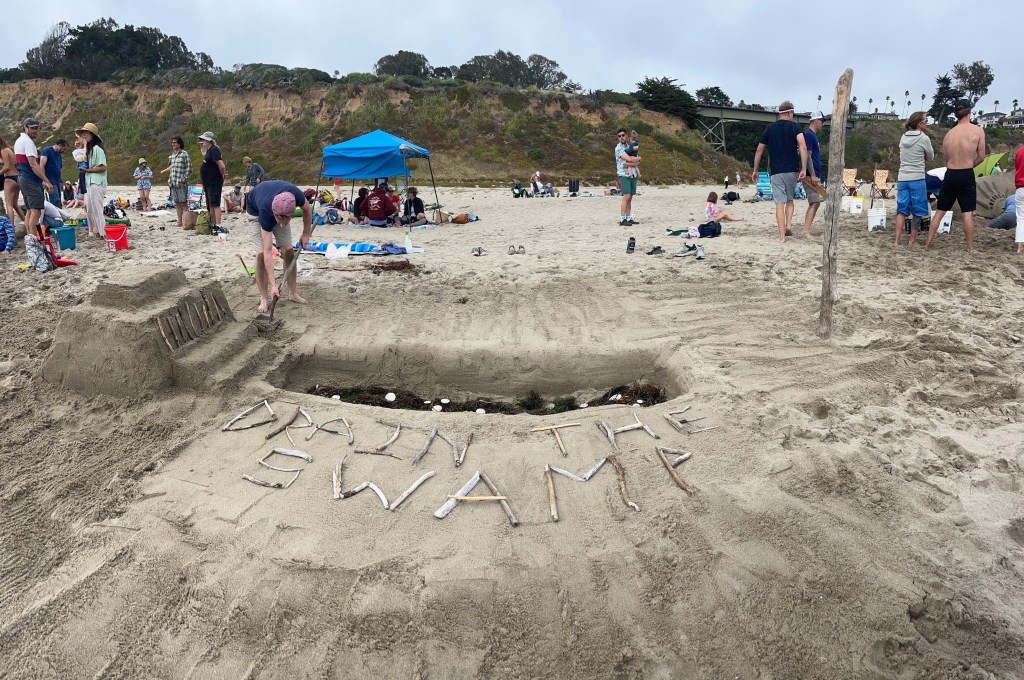
My team’s sand sculpture received glowing reviews from passers-by. I enjoyed the process of making it: the conceptualizing, the strategizing, the digging, and the polishing. I enjoyed the creativity when our plans hit reality. I enjoyed the passing-off of tasks from teammate to teammate. I enjoyed the fact that we created art that prompted many people to snap pictures and comment, “Way to go!” and “I’m tired of seeing flags; this one’s great!”

I didn’t join the sandcastle competition to win. I joined it to build a work of art. We did, we succeeded, and I’m overjoyed.

Now the only honest thing to do is to tell all the children in the sack race that they were actually participating in art, not sport.

The Bombs Bursting In Air

Ask me about my sand castle, not my wheelbarrow.

In my younger and more formative years, I could compete in a silly physical competition willy-nilly, giving it my all and sometimes winning, sometimes losing, but always having a blast.

Now I am old and crotchety, and when I compete in a wheelbarrow race with insufficient practice and without stretching, I end up with a hurt knee and a possibly torn muscle, and a vow never to participate in a competition of this sort ever again. Loud, packed, dangerous, and with no meaningful success.

My Partner wanted to compete. I didn’t care. This seemed important to her. It was above my skill set. I had some trepidation on the specific form she suggested: applying more pressure on me and basically carrying her with no weight on her hands.

We fell. Tumbled. Rolled. Bounced back up and completed.

And I.

Didn’t.

Like it.

Back when I would do this as a small child, my injuries healed much faster.

But now, in my thirties, what even is the point.

–

Also, Partner’s family and I built a sand castle. Great success! More on that tomorrow!

Win by heart attack 

To win, let the goalie fail. To let him fail, kick the ball at the damn goal. 

If you play professional soccer and you miss a shootout penalty kick high or wide, you deserve to be shot.

Penalty kicks are important. In a tied game in the World Cup elimination stage, they determine the fate of your entire nation. 

If you miss wide or high, you lose. Over. No opportunity to win. No ability for the goalie to make a mistake.

If you roll the ball toward the goal, one foot per second, as slow as a 4-year-old kicking with maximum power, you could win! The goalie could have a heart attack! Isn’t that great?

When I played middle school soccer, I played goalie. A remarkably low-skilled goalie, I might add. I still remember one moment from a game two decades ago. My team’s best player fouled the opposing team’s best player in the box, prompting a penalty kick. My coach caught my attention and gestured to me with his finger on his lip, pointing left. I immediately thought “I understand what you’re implying: I should go left. But our soccer skills are much worse than you think. Professional goalies choose a side and pray. Middle schoolers kick slow enough that we can choose after the kick.”

The opposing team’s star shot… 

And he missed! He shanked it wide! I won! Purely by being there! Did I go left? Did I wait-and-see? Doesn’t matter! I won! 

I was not a good soccer player. Don’t let people like me win. Today in the Australia vs Egypt World Cup game shootout, one of the Egyptian players kicked the ball straight down the middle… directly at the goalie… and it still went in! The goalie had chosen a side, and the ball came straight down the pipe! The guy who shot it – Egypt’s captain – even said afterwards, “If anyone was going to Panenka [chip a shot down the middle], it was going to be me!” Egypt won because Australia shot two penalty kicks high. 

Shoot. Your. Penalty. Kicks. On. Goal! 

Also, an unrelated suggestion: start every soccer game with 3 penalty kicks per side. Makes the game more interesting for one team to be up 2-1 when it starts. 

And a non-serious suggestion: if the game ends tied, add a new ball every 10 minutes. Eventually, someone will score. 

Forever the ball rolls

The machine in the San Jose airport will forever spark rich feelings of joy.

When I was a child, I watched for hours as the balls rolled, spun, twisted, and jumped, pinging the bells and conking on the wooden blocks. Seven balls – nine in the box, but always with two of them fallen to the bottom, having missed the jump or, more likely, the bounce-pass. For hours and hours, I would watch these balls. And never would I see a ball miss.

I remember the rhythm; the conk-CAH-cohnk of the green one that spins.

A while ago I considered the idea of buying up old dormant brands, then relaunching them for a new generation. But here’s the kicker: focus on the same people, not the same product. Instead of Hush Puppies shoes for a new generation of young folk, it’s Hush Puppies slippers for older people. The name was always the pitch: barking dogs meant aching feet, and the 1958 shoes promised to hush them. The slippers keep that promise at 75. It’s not Lunchables for a new generation of school kids; it’s Lunchables for yuppies.

We’re wrong when we say that old habits die hard. In reality, they don’t die. They simply go dormant, waiting for the trigger to reignite those same neurons.

But the same sound, the same rhythm, the same habits of mind: the same rolling ball machine still scratches that same itch.

The airport has moved the machine to a new location. They’ve rotated it so I now watch from the other side. Still, the sounds and the rhythm are the same. It’s nice, it’s comfortable, like an old warm coat passed down from a parent that still smells like them even after it’s washed. I found it in an old box in the back of a closet. How nice it is to feel the spark return to my eyes.

Carnelli

The goal of party games is connection. 

This evening, my family played Carnelli. It’s an association game: one person names a publication (movie, show, song, album, book, speech), and the next person names one that connects to it. Connections are legal across shared words, shared artists, or puns. Even if you’ve never heard of Moon River, you can take it to Moondance (via moon), or to Stand By Me (via River, through the actor River Phoenix).

It’s my favorite party game in a while. (Second only to Person Do Thing, which demands more focus and wants a big screen.) You get three things at once: you learn what media each other knows, you connect over shared interests and experiences, and you sing little songs together.

We started rocky. People took a while to make connections; the connections weren’t clean. But there’s a moment when a game clicks.

That click is clearest in The Mind, a silent card game where the goal is to play the next card in sequence without communicating. But it happens in every game. It’s what my father calls “having a rhythm.” It’s the sync-ness everyone feels. It’s the reason we play together.

Hermit Crabs & Kidney Donations

A spoken-and-transcribed guest-post courtesy of Partner, who caught upwards of seven hermit crabs today: 

Hermit Crab Homes

Hermit crabs grow, but their shells don’t, because hermit crabs don’t grow their shells but find them. When a hermit crab grows too big for a shell, it will find a bigger one. If the bigger one is too big for that hermit crab, it will just hang out near the shell, in the hope that some other hermit crab will come take that bigger shell and leave behind its shell. Because of this, you can get a whole line of hermit crabs: several smaller hermit crabs are waiting to size up their shell. As soon as a bigger hermit crab comes and takes that too-big shell, it will free up a slightly smaller shell, and then another hermit crab could take that slightly smaller shell, etc., trickling down. 

It’s like the kidney donation chain. 

The Kidney Donation Chain

If I wanted to give you my kidney, but you and I are not a match, we’d be out of luck unless there were two other people, one of whom wanted to donate and the other to receive, and we were a reciprocal match so could swap. But generally, there are so many factors required for a kidney to fit that a direct swap is improbable. And they only let something like two or three people form a loop because they want to operate all at once. They’re afraid that, if they do them sequentially, the buddy of the first person to get a kidney will renege on his donation at the end of the loop because his incentive to give is gone. 

Because of this structure, someone donating the kidney without needing a kidney for a friend or family member can change that loop from a loop into a line, which is really mathematically beneficial. And the altruistic donor is just giving away the kidney, no one’s on the hook for getting a kidney back to them, so there’s no risk of someone chickening out. If you choose to donate your kidney, you can kick off a chain that doesn’t just help the one person you are donating your kidney to, but can actually help all the people who exist in that chain, which can be a dozen people or more. 

BBC Earth video on hermit crab shell swaps:
https://www.youtube.com/watch?v=f1dnocPQXDQ

Info on starting a kidney donation chain, including a way to get 5 loved ones to the top of the donation line if they ever need a kidney but you already gave yours away: https://www.kidneyregistry.com/for-donors/start-a-chain/

The Coupon Book

The goal of the game is to make money. You make more money by giving some away, then charging for what stays scarce.

I’m at the second all-inclusive resort of my life. So why do I feel nickel-and-dimed?

(My family comes together for one of these every summer now, which is a lovely experience. I’m having a great time with great people. This feeling is not a particularly negative impact on my experience; I’m simply enjoying the process of analyzing it.) 

It started at check-in, when the concierge handed me a coupon book. He flagged one asterisk: the $50-off coupon for the resort store needs a purchase of at least $100. I laughed and noted I wouldn’t wouldn’t be using that one.

A coupon book. At an all-inclusive. The whole premise of the place is that I already paid, so nothing else carries a price. A coupon is a price dressed up in a faux discount. The coupon book is a store smuggled into a building labeled “no stores allowed”. 

* * *

Once I noticed the first coupon, I couldn’t stop. $50 off a single spa treatment, which made me wonder what a spa treatment costs. I found the menu advertised in the bar and scoffed: treatments start at $229. I can get an excellent massage in the US for half that, and that’s paying US labor prices, not whatever a masseuse earns in central america. 

This is couponing the Bed Bath & Beyond way: float the sticker high, then hand back a slice, so the discount feels like a gift instead of a markup you sidestepped. It’s comparison control, the price game I keep coming back to. Anchor the number at $229 and $50 off reads as generous. Nobody mentions the seller number that should orient their side of the price: their marginal cost of providing the service. 

And the asterisk gives that number away. The same way Chipotle running a 2-for-1 tells you a burrito nets more than 50%, this resort’s $50 off of $100 in the gift shop tells me the same. They’re not discounting into a loss on purpose. If they can afford to give it back, they were charging too much to begin with.

* * *

The second move is the paid upgrade, and it bothers me more, because it breaks the frame on purpose. (At this resort, that’s the “Star Class” upgrade: your room and food become slightly nicer, and you can book Star Class-exclusive dinner tables.) The whole reason to buy an all-inclusive is to delete the transaction. No prices on the menu, no small voice doing math at dinner. If I wanted the experience of paying for something nice, I would have booked a place where I pay for something nice. The upgrade sells me back the exact friction I paid to be rid of.

* * *

So why build it this way? Why sell “everything included,” then spend the week selling more?

My best guess: once everyone holds the same all-inclusive wristband, everyone wants the same scarce things. The 7pm table at the good restaurant. The shaded poolside chairs. Put a few hundred people on identical footing and they start competing, and anywhere people compete over something scarce, there’s money in tilting the field.

So the resort sells you a basic entry ticket. Then it sells weapons to both sides: the upgrade that jumps the dinner queue, the tier that reserves your chair before dawn. What you’re buying, on top of the vacation, is a position in a contest they built.

* * *

I don’t write any of this with a clenched jaw. I came here to stop running the numbers, and on a vacation the only points worth counting are relaxation, enjoyment, and connection. I’m racking those up, surrounded by people I love. I just can’t switch off the part of me that wants to see the machine.

And the machine is simpler than it looks. If something is free, someone finds the version of it that isn’t, and sells you that. If free, then freemium. Even here? Especially here.

You’re Excellent at Friendship

To learn what you’re good at, ask other people. Even better, see what people pay you for.

Earlier today, I told a friend he’s excellent at friendship. He was surprised. He’d never thought of himself that way. He asked how I knew.

Here’s how: we’d just been talking about his bachelor party, a roomful of strong, eccentric personalities, every one a distinct weirdo, many of whom would never otherwise share a room. He gets along beautifully with all of them. Holding that many particular people close at once takes real skill. That skill is friendship. He has it without knowing.

This not-knowing is common. The people who are good at a thing are often the last to know it, because unmeasured skills are tough to compare. We can check the scored ones, though even there the ego cooks the books: somehow every poker player says they’re at the 75th percentile. The scoreless skills, friendship among them, keep no count we can read. So we stay blind to our placing within them.

Take the word “driven.” I have found the people who call themselves driven to be, more often than not, the lazy ones, using the word as a permit: “I’m usually such a hard worker, so I’ve earned a little time off.” The genuinely hard worker, meanwhile, tends to grind precisely because they’re convinced they’re too lazy. Their self-image points the opposite way from the truth. The person who repeatedly calls themselves happy is trying to convince someone, either themselves or others.

So most of us don’t know what we’re good at. We learn from outside, from what others reflect back, because the trait is relative and others judge it better than we do. The blindness runs deeper than skill: we can’t see our own traits, and those same traits decide both what we’re good at and what’s good for us.

This distinction gets even tougher when adding internal emotions: I’ve been turning this over today because two companies interviewed me. One piqued my interest immediately. The other, once I learned the details, is the better fit. It’s almost exactly what I’ve already done, less of a stretch. (“I’ve done all these pieces, just not in this precise combination”, I told them.) Being more drawn to the first isn’t evidence that it’s the better place for me. Being drawn to something is how marketing wins. My interest is one ingredient. When running the ikigai exercise, “what do I love?” is one question out of four. Love is helpful. It isn’t the whole answer. Yes, everyone needs passion. But passion can’t buy food. 

Here, what I’m good at aligns with what’s good for me, but they’re disconnected from what I’m drawn to. 

The thing you’re drawn to and the label you claim are stories about who you are, and the story is selling something. Identity has a downside we rarely count.

When choosing between passion and survival; when choosing between love or life, it is the martyr who chooses love. We reward the martyr with fame and acclaim. Pity they cannot spend it.

A Sales Problem, Not a Marketing Problem

The goal of the game is to make money. You make money by selling. You sell with a playbook, not a bigger funnel.

A person I met yesterday is looking for marketing help. I think he’s wrong. 

He’d paid someone $25,000 to post constantly and drive traffic to his site. He was dissatisfied, given the large outlay (his whole company only makes a few hundred thousand dollars a year). I looked at his website. He doesn’t have a marketing problem. He has a sales problem.

What is marketing, and what is sales?

Marketing is not an intrinsic good.

To a company, money is an intrinsic good. One could reasonably argue that revenue and costs are therefore intrinsic. Even culture – which is incredibly impactful – is only instrumental, since for this particular game, the goal is money. Marketing is also instrumental: what you actually want is to sell.

Take sales and marketing to their logical extreme: 

  • A pure salesperson with no marketing is a traveling salesman knocking on doors. It’s slow and expensive, but it works. 
  • All marketing and no sales is the reverse: every eyeball on earth is on your company, but you have no way to take their money.

So what does a good salesperson actually do? Not just put the product in front of people. For something complex, like a SaaS tool, they’re handling objections, talking through integrations, working out which pain points it solves. They’re getting to the right person: is it the college IT guy, the professor, or the dean? The fundraiser, or the head of the university? Sometimes that means bouncing through a few people to get there.

Sales is also theatrical: taking someone on a journey that ends at the solution to their problems.

Sales is the funnel: wide at the top, narrowing as people move down, with customers at the bottom. People drop out at any stage; the good fits make it down, the bad fits fall away.

Marketing is different. Marketing sits above the funnel and feeds it: catching attention, nudging people toward interest.

And marketing is often much more wishy-washy (I say this as someone who’s worked in it most of my life). It’s about how we want to be perceived, how we want to relate. 

Removing people from the equation: 

  • Marketing is the ads you see on another site.
  • Sales is the checkout flow on the site. 

A sales process is a repeatable playbook for getting someone to buy. It covers:

  • Which personas actually buy
  • What they find convincing
  • What they fear, and how you assuage it
  • The pricing

A salesperson also runs field research: selling in the wild, then coming back with data.

Back to my guy

Let’s say he sells IT software to universities, through what look like channel partners, and that has gotten him to reliable revenue. If you’re a go-getter CEO who was active at your own school, with a big-enough family wired into a few other alumni networks, you can probably close three or four deals on warm intros alone.

So you think: I just need more people in the funnel, then I’ll close them. But if your process is a handful of local channel partners (one runs hackathons, another chess clubs, another debate), more volume does nothing when your hackathon guy doesn’t know how to sell. He can’t expand his close past the set of folks who he understands. Enthusiasm can take you from 0 to 1, but you need a reliable process to go from 1 to N. 

An ideal playbook, once you’ve stood up the sales team, looks like:

  • How to filter for the people worth talking to
  • Which stakeholders to reach
  • The objections you’ll hit
  • How to overcome them
  • Then the soft stuff: rapport, persuasion, all the convincing

So now, my question: 

  • What happens when I tell this guy that he doesn’t need a marketer; he needs a salesperson? 
  • Will he hire me to stand up his sales team? 
  • I bet I could do it. I’m hungry for exactly this sort of role with exactly this sort of impact. The product is one I’m interested in. I’ve done all the pieces that this role has (sales, travel, small-team hustle, bushwhacking in a novel area, coaching); this role is just combining them in a new way. 

I’ve already marketed to him. The question: Can I close the sale? 

Games Played

I saw a play today about the House Un-American Activities Committee investigation of Hollywood. I did not expect the play to increase my sympathy toward the investigator’s position. But it did. 

Before the play, my perception of the investigation can be summed up as “it was a witch-hunt”. 

After the play, my new conclusion: Yes, it was a witch hunt. But – as made clear by the Korean War – there actually was witchcraft (Communism), and there actually were witches (people who wanted to replace the US constitutional government with communism). But these people (the Hollywood actors) were not the witches. 

Finding My People

Most of success is just showing up. But showing up to the right place… 

Before I moved to New York, I told my Partner that merely by living here, I’d find work. There’s so much economic opportunity in this city that I’d harness some.

One month in, I met a former founder who hired me to ghostwrite a blog post.

Three months later (two weeks ago), a random VC firm pinged me on LinkedIn about a private-markets mixer. I signed up. Yesterday, the organizer texted to make sure I was actually coming.

En route to the club, I noticed that I smelled. So I ducked into a CVS for deodorant. Not a good start.

I entered the club at 3:51pm. The doorman made me take off my hat. Getting worse.

At 4pm, the hosts arrived. They’d expected a room more suited to their needs: an open room, not a big table ringed with chairs. Rough continuation.

Upstairs, another host told me to take off my hat again. Ugh, come on. 

For the next 90 minutes, I met mostly people in wealth management and late-stage investing. Not my areas.

But then! Someone walked in with a pep in his step, someone I immediately pegged as Interesting. I snuck my way over. He grows hydroponic ginseng for a healthy soda company. He sold his last startup, a guitar-amplifier company. Now he wants to bring this healthy soda to the world.

And another! A guy doing video-based sabermetrics for sports other than baseball. And he’s complaining about marketing. These are my people. The ones I can help.

We exchanged emails. I’ll message them about coffee.

All in all, a very successful meeting.

If you show up as your specific self, you’ll meet the people you can actually help. 

Also, I ate 4 lamb lollipops, 2 falafel balls, and 1 small slice of fig pizza. I count that as a win.

Games Played

Me at the bathroom supply store: “Are you salaried or paid on commission?” 

Salesperson: “I’m not going to share that information.” 

Me in my mind: <Commission it is.>