Why Do People Live Here?

To win, position well. To position well, realize it’s a choice. 

“Why do people live here?”

It’s a common refrain when I travel. And I travel a lot.

Between 2018 and 2025, I lived in a van, driving around the U.S. and Canada. For 4 months in 2022, I lived in Australia, New Zealand, Japan, Indonesia, and South Korea. And most places make absolutely no sense to me.

New Orleans, New York, San Francisco: I get. Austin, Seoul, Paris, Tokyo: totally. But Chicago? Kansas City? Cleveland? Dallas and Houston? Those tiny towns in Nevada and Colorado and Oregon with more elevation than people?

I’m in Chicago for a friend’s wedding. A surprise thunderstorm shook our windows. Two years ago when I visited, I heard a siren. I asked my friend: “What’s that siren for?” He said it’s a weather warning: we were about to be cold enough to be deadly.

The trains run above ground (terribly noisy), and most don’t even run all night. The weather is always either too hot or too cold. The theater and art are good, but not as good as New York or L.A. The food is tasty, but overwhelmingly unhealthy. Maybe it’s the sports?

I don’t buy that most people intentionally choose where to live based on their values and preferences.

Where & why? 

Ask people why they live where they live (I do, constantly) and most people give one of 4 answers:

  1. They were born there. (This is Partner’s most frequent response when I pose the question.)
  2. Work or school took them there.
  3. A lover took them there.
  4. It’s the nearest city to where they were born. (Partner grew up in the “big city” for her area, because it had a Walmart. This “big city”: 16,000 people.)

Who’s the actor here? 

Every answer describes something that happened to the person. Born there: the game placed you. Work took you: the company (or admissions committee) chose. A lover took you: the lover chose (or their company did). Nearest city: the game placed you, plus a radius.

Where you live is one of the biggest decisions in your life. It decides your environment, your friends, your culture, your wages, your rent, and your weekends. And it’s a rare big game where most players never even realize they’re playing. The board hands them an opening setup, and they just accept it.

I can count on one hand the friends who chose their place to live by auditioning and deciding.

Reality & possibility

How many people decide where to go? Between 18 and 30, do you explore while you can (no mortgage, no kids, career still portable)? After your kids leave home, do you think about moving?

Money, visas, family gravity: there are good reasons to stay where you live. But a lot of it strikes me as activation energy. You’re a distinct person with individual tastes. And you just happen to have been born in exactly the right place? 

I’ll take the other side of that bet.

Costs & Choices (Apr 3 2026)

My contractor asked if we wanted nice lighting.
“Depends the alternative and the cost”. 

I’m somewhat surprised by his surprise at my answer.
Like.
Sure: of course I want nice lighting. If you ask me that question in a vacuum, the answer is definitely yes.
But that question is only meaningful if it has a comparison.
What is the other option for lighting?
What are the actual trade-offs?
Is “nice” lighting one million dollars, while “normal” lighting is a buck fifty seven? 

I keep running into this situation with contractors.
I hired this contractor due to their line items.
I decided not to get a recessed niche in my shower… 
due to that shower niche being ~$2k.
At $2k, we’ll put our shampoo on the windowsill. 

My contractor – and his designer – often find this approach confusing.
It’s not that I’m unwilling to spend money.
It’s that I can’t say “yes” to a thing without even a ballpark.
And that ballpark should come with a basic comparison.
Do people not do simple economic analyses when renovating a home?
Not even a super-deep preference list, but just a simple “This light costs $100. That light costs $200. Would I pay an additional $100 for that light?”
On plenty of parts, my preference ended up being cheaper

In working with my designer, we must train each other to work well together.
One part of that is the way he proposes options. 

I hired him for his opinion and skill.
I want his recommendation – not merely to view all the options and choose myself.
And I also want his tradeoffs: what are the traits that would lean you toward this over that, and what are the summaries of other reasonable options? 

I don’t know how other people choose their elements
but I can do the simple gut check of “Would I pay $375 for an additional power outlet there?” 
That’s the beauty of money: it’s a universal comparison.
The best things in life are priceless.
For everything else, it’s a clear unit.

Celebrating My Hekoya Nature

A friend told me today about the Native American archetype of hekoya. He described it as, “When the crowd goes right, the hekoya goes left.”[1]

[1]: (Wikipedia’s further description: The heyókȟa is a kind of sacred clown… [that] symbolizes and portrays many aspects of the sacred beings… [their] satire presents important questions by fooling around. They ask difficult questions, and say things others are too afraid to say. Their behavior poses questions as do Zen koans. By reading between the lines, the audience is able to think about things not usually thought about, or to look at things in a different way.)

In the spirit of the hekoya, I shall now celebrate my oddness. Here are things that I did today [well, yesterday as of posting this] that are completely reasonable and yet most people might find odd. Go, verily, and lead a more satisfying life:

  1. Drove 4hrs with a dear friend who dropped me off and then immediately hightailed her way back, thinking little of the gift. (As she described it, “I have a lot of books [to listen to on the drive]”). 
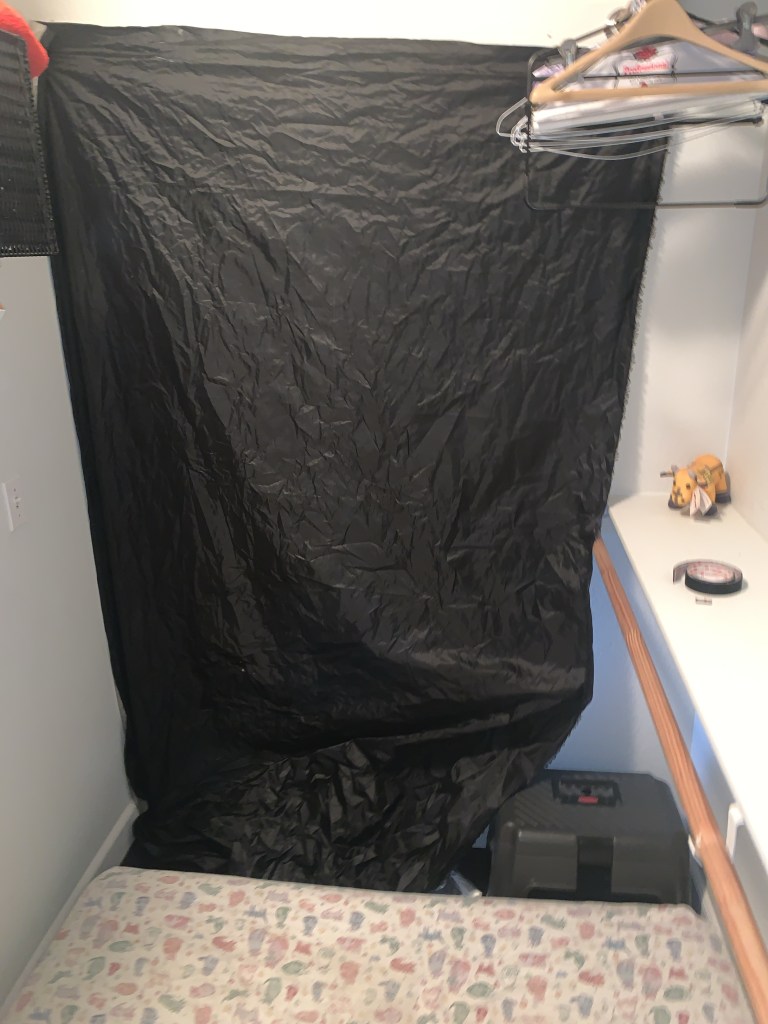
  2. Moved a bed into a closet and hung blackout curtains so I can sleep at my parents’ place in complete darkness.
  3. Bought a 65” flat-screen TV for my parents’ house, which I will only be in for ~2 months. (Gotta make your space your own!)
  4. Thought that buying a TV was weird (this thinking is perhaps more weirder than the buying… as I have never bought a TV. The only TV I have ever owned was an inherited little 15-inch doohickey installed by the guy who built out my camper van. (He used it, I assume, when he lived in the van. I used it a total of 3 times… ever… and it was… fine.). 

Pics of my new closet-room:

Now go, my children, and be the hekoya you were always meant to be.*

*: Most of you were not meant to be hekoya. Tough titties. It’s fuckin’ great.