Clown School Break Day 2: The Lost Game (¿and Found?)

In which Our Hero muses on clown/creative culture

I forgot the game.

The game is simple:

Give. Them. Pleasure.

No more.

No less.

You choose your pathway.

Jim Carrey: freedom from worry.

Eddie Murphy: deep, unshakable, cool self-love.

Steve Martin: “isn’t this ridiculous?”

Sacha Baron Cohen: “behold, the bouffon.”

Somewhere along the way,

I forgot the game.

A friend who once worked at Cirque told me my struggles aren’t moral or personal—

they’re cultural.

Theater-people culture has its own rules:

Smile and support, regardless of whether you actually like someone.

If you stab, you stab from behind—

and always with a smile.

Offer yourself to help, as a kind and generous act…

but only when it gives you more stage time.

Plans aren’t plans, either.

You don’t schedule someone—

you slide casually into their life.

Explicit agreement is too intense; the dance is in the implication.

A calendar invite for 4:30 doesn’t mean 4:30.

It means the text that comes later saying it’s now 5:30.

And the day-of update pushing it to 6.

(People actually show up at 6:20).

These aren’t gripes.

This is just culture.

In New York, people book three weeks out.

In L.A., you confirm the night before, the morning of, the hour before…

and still they might not show.

But in my current hyper-literal, emotionally-flooded state,

I couldn’t adapt to the culture

and so I lost sight of the game.

And the game is all they ever wanted:

Play

Pleasure.

Freedom from pain.

Excitement.

Delight.

Whatever I can give that gives them pleasure—

that is the work.

If you’re not playing the game,

there’s no need to play.

But if you are playing the game—

then play.

I didn’t come here for the meta.

I came to play the game of clowning.

To learn it.

And clowning,

I will learn.

And clowning,

I will play.

Clown School Day 29: Camouflage & Collapse

In which Our Hero becomes a stickbug and briefly a rooster.

My b-b-b-boring dance

Yesterday’s boring dance left me with two lingering side effects:

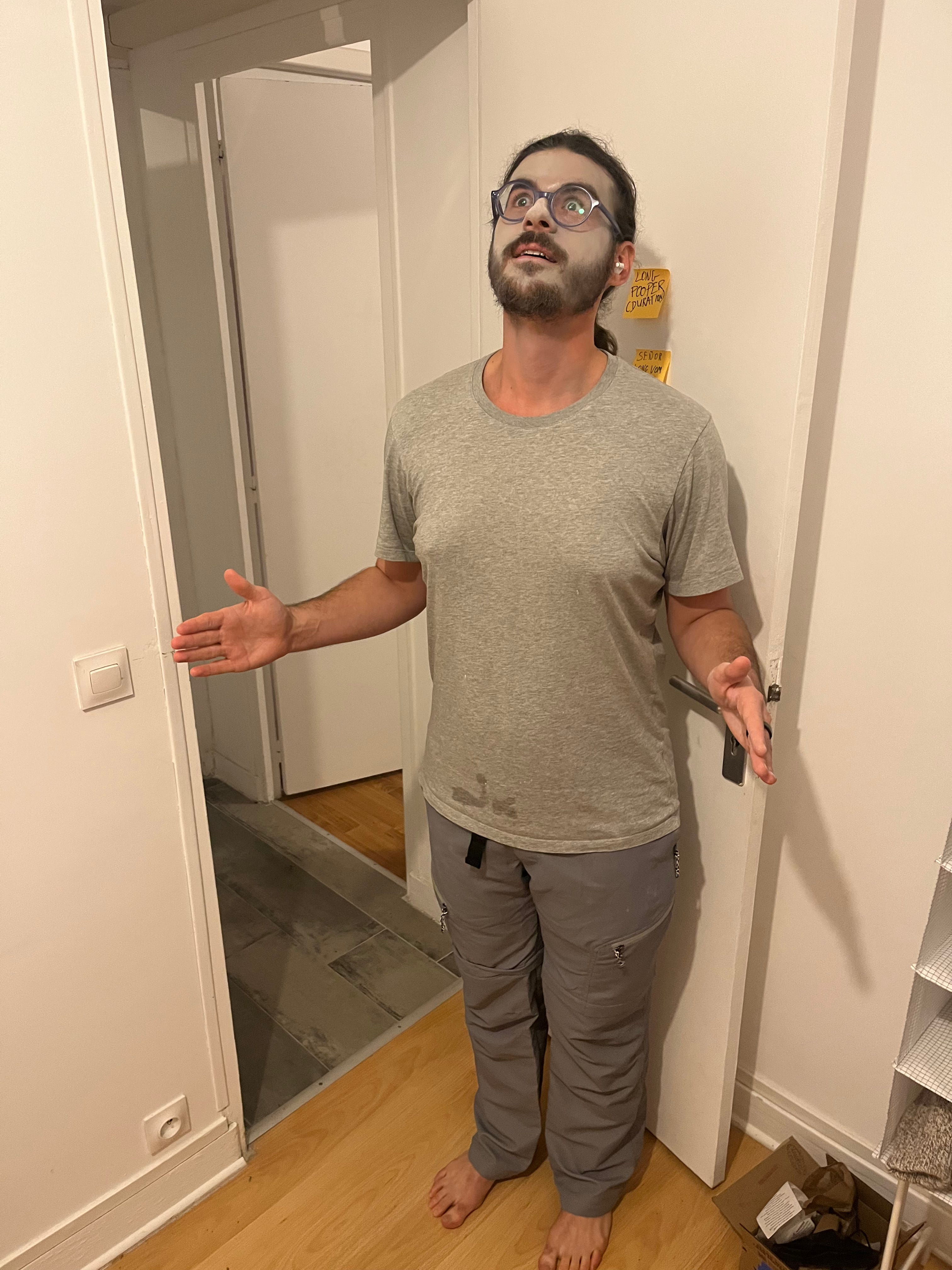
  1. I am now wearing gray facepaint and an all-gray outfit for camouflage purposes.
  2. I am suddenly much more interested in doing dumb things for others’ pleasure—which, conveniently, is exactly what clown school is for. (“Paint my face gray so it matches my outfit because I’m a stickbug? Absolutely.”) [Reader: “But stickbugs aren’t gray.” Me: “It’s for camouflage. Have you ever seen a gray stick bug?” Reader: “No” Me: “So it’s working!”]

A friend asked me today: “What exactly is Neutral Mask?”
Good question.

Neutral Mask – the course I’m currently taking – is a theater exercise using literal plastic masks—blank, expressionless, un-opinionated. We use them because:

  1. With the face hidden, you naturally grimace less. (“Grimace” = any habitual expression or tic that blocks the actor from sharing themselves with us.)
  2. You’re forced to communicate with your whole body.

A typical Neutral Mask sequence:

  1. Put on the mask.
  2. Channel some external entity—this week: animals (reptiles, savannah, big cats, barnyard creatures). Last week: elements (fire, water, earth, air, snow). The instruction is always: Find the fun of the image.
  3. Midway, the teacher bangs her drum: “Fixed point!” Students from the audience remove the performers’ masks.
  4. Performers continue and are called on one by one to give voice to their creature.
  5. If there’s not enough pleasure, you’re kicked off.
  6. If you pass, you slowly stand, taking that pleasure “inside,” transforming the creature into a character.
  7. Perform that character, always keeping the fun alive, whether through movement, worldview, or physical logic. This fun must not be ideas nor the concept of fun: it must be actual fun.

My creature: the stickbug

The stickbug mostly sits still, scanning the horizon for predators. When bothered, it:

  1. drops to the ground, or
  2. throws off a limb.

When it moves, it scurries, antennae twitching, always on alert.


My character: Simon Schticklington

Simon is entirely gray: outfit, face, and demeanor. When frightened, he collapses from sudden “heart trouble.” He also has severe imaginary arthritis: elbows locked at 90°, hips straight, fingers in rigid blade-positions forever.

He lends himself to a few games:

  1. Motor incompetence. Want a soda bottle opened? Simon will attempt it with profound sincerity and fail with even more sincerity.
  2. Fear-collapse. When scared, he drops—and because of the elbow/hip rules, he cannot stand without the heroic assistance of classmates.
  3. Projectile panic. Startle him while he’s holding something and he throws it. Today I brought a baguette specifically so I could chuck it at a friend guilt-free.

He also just looks silly. Which is good. Yesterday’s boring-dance taught me the deep wisdom of looking stupid on purpose. It’s liberating.


Today’s unexpected triumph

Today I had my biggest solo success. I entered inspired by a rooster: chest puffed, arms akimbo-ish, each step ceremonial and deliberate. They laughed. I kept the pleasure. I preened (like a gym bro). They laughed again.

I lost the balance shortly after—but for a glorious five seconds, I was clowning.

It’s good to remember that I’m b-b-b-boring. It’s good to remember that I do dumb things. People like people who admit such things about themselves.

And anyway: I’m dressed like a stickbug. 🧐

Clown School Weekend 3.2: This Place is Run by Clowns

In which Our Hero concludes that brilliance is no match for a red nose.

About once every other day, someone at clown school does something spectacularly disorganized. I sigh and say, “This place is run by clowns.”

And it is.

Clowns are not, by their nature, particularly intelligent.

It’s not that they’re stupid.

It’s that intelligence and clowning live on different axes.

An intelligent person may learn the craft faster. But the desire to clown, the joy of it, might even be anti-correlated with intelligence.

Smart people tend to want control. Clowns surrender it.

Smart people tend to want power. Clowns seek to be laughed at.

And yet, in my March course, three of the 30 Americans were Yale graduates.

Plus a single from Stanford.

Just enough prestige to make the chaos feel ironic.

Of course, it helps to be rich enough to spend a year falling on your face.

Still, it’s a funny sight I observed in Thursday’s class:

eight clowns silently arranging themselves in order of intelligence.

The clown they insisted should be at the bottom later thought this was hilarious as he has a master’s degree.

Clowning is a craft.

Most work is a craft.

Hell, even medicine is a craft.

And mastery in a craft depends less on general intelligence than on dedication

and on cultivating the right skills: openness, affability, lightness.

This is the first social hierarchy I’ve been in where people organize by skill in a single, very specific craft.

In college, you could be successful at any number of things — academics, theater, sports, journalism.

In elementary school, the options were fewer but still broad: maybe good at math, worse at English, class clown, or owned the good video games.

Here, clowns arrange by everyday charisma.

And charisma in life is decently correlated with charisma on stage.

Add to that: we’re learning charisma.

And the social life becomes pretty interesting.

It’s like a schoolyard where the only question is: how fun are you at play?