​​Clown School Day 33: Milk, Movement, and Metatarsals

In which Our Hero boils over, breaks down, and opens up.

I was milk.

Not your boring half-full breakfast glass:

I was milk on the stove that someone had forgotten about.

Warming gently, then rapidly, then dramatically.

I boiled, I foamed, I rose.

A glorious dairy geyser.

I was beautiful, exciting, energetic, light.

They loved me.

I was milking it for all it was worth.

And then I landed. Hard.

On the outside of my right foot.

The outermost digit rolled under the meat of the foot.

My milk, so recently ascendant, suddenly boiled over and ran down the sides of the pot.

Call it a turning point.

Or a turning-sour point.

Someone asked if I was hurt. I said no.

Classic milquetoast behavior.

They told me they loved my milk.

I felt genuinely glad: I’d worked hard yesterday—six hours improving myself, skimming off the emotional scum, clarifying my internal butter.

And today, between movement and improv, I stayed in the classroom to feel my feelings.

To laugh, to cry, to laugh-cry.

Just to be with myself.

A short personal pilgrimage to the Land of Milk and Honey.

No wonder my performance rose, like cream to the top.

Now I’m at the hospital.

I don’t think it’s broken.

I assume they’ll give me an X-ray, recommend some painkillers, and send me home.

A quick skim.

The triage nurse, Leo, asks if I’m a clown student.

The international ones usually are, he says.

Last year he had:

– a ruptured Australian Achilles (hi, A!)

– an American with a back problem, delivered via ambulance (hi, M!).

This year, he gets me: whole milk, 2% structurally compromised.

Leo asks where I’m from.

“California.”

He says “Alcatraz.”

I say I’ve never been.

He says it’s scary.

(It curdles his insides.)

Now I sit in the waiting room, surprisingly not souring.

Throughout this whole experience, I’ve actually felt my feelings pretty well—

and feeling them has made them less bad.

So much has to work in concert to enable walking, let alone clowning.

Bones, muscles, tendons:

a whole orchestra playing in tune.

Until suddenly the music sours
And my fifth metatarsal decides it has a bone to pick with me. (Alternate joke: “has beef with me”.)

The teacher who drove me here says I’m the first of the year.

The first!

The early bird. The early calf.

The first one to fall before the cows come home.

Diagnosis:

A fracture non-déplacée—a nondisplaced fracture of the 5th metatarsal.

Pain meds.

No weight on it.

Three weeks to heal.

A season put out to pasture.

Oddly, I’m calm.

It’s almost a relief to have a socially acceptable excuse for being bad at clowning.

(“Sorry, I should have been cream of the crop, but I was overwhipped/overbeaten and now I’ve split. Maybe I need to find butter things to do.”)

And despite the pain, I stayed with it—

full-fat presence.

I bought crutches, pain meds, and a boot from the pharmacy.

The pharmacist noted the challenge of carrying crutches while also needing crutches.

She asked where I live.

“Just across the street.”

She walked with me.

A small, wholesome kindness:

like a neighbor bringing over cookies and saying,

“Here, I brought you some warm milk for your soul.”

She knows my upstairs neighbor.

They have coffee together every day.

We bonded over our love for her cat, chausettes (“socks’ in french).
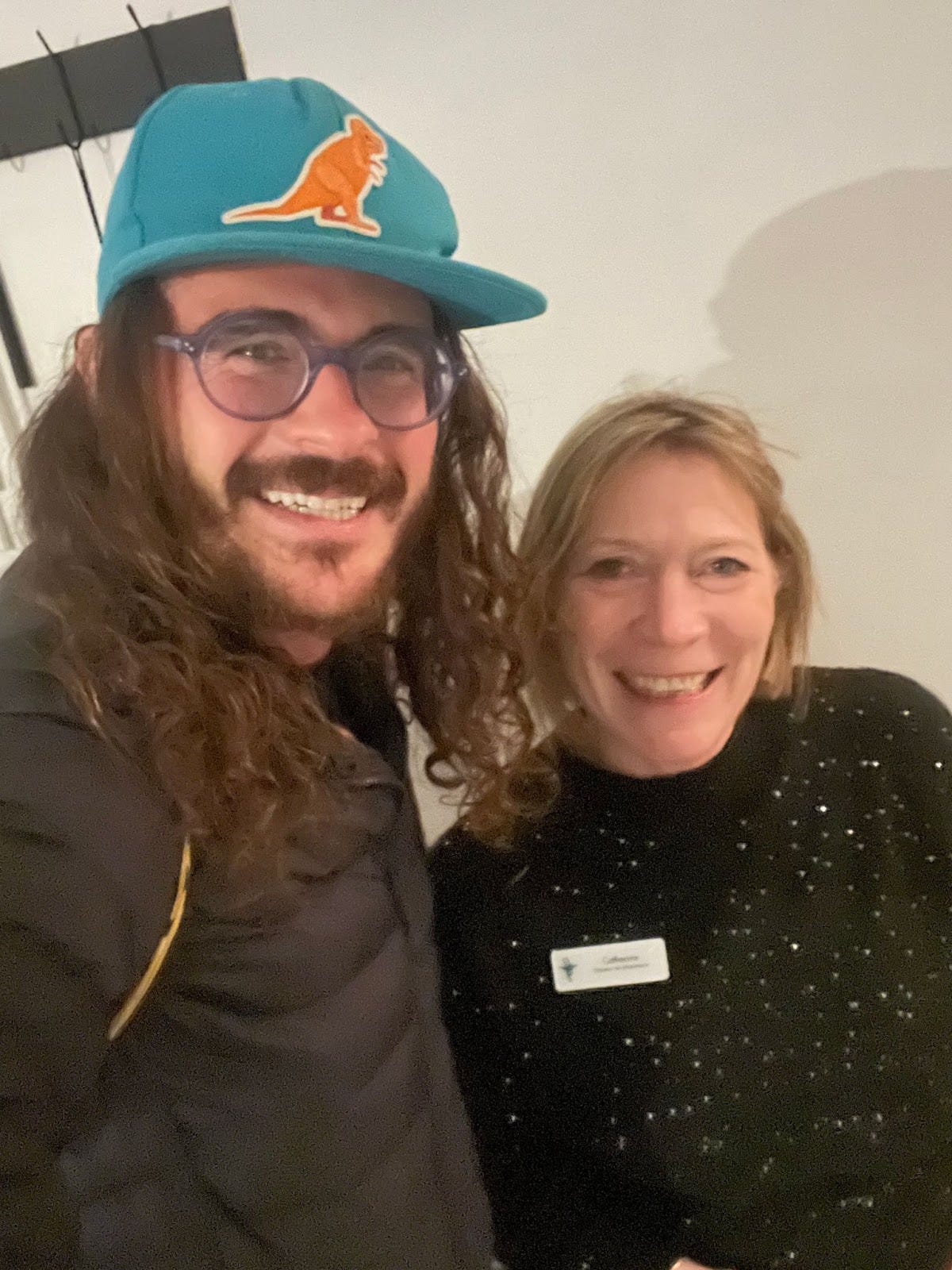
A surprising emotion: relief.

I told a friend about the injury and she asked how much of it might be emotional—

how sometimes a bone breaks when something else is begging to break.

She said when she broke a bone, it partly came from a life she didn’t love.

I get that.

My milk was already foaming over.

I wasn’t enjoying clown school.

I wasn’t doing it right.

I wasn’t satisfied personally either.

Then—splat.

Here comes God to shake it up.

And by God, I mean my own discoordination.

(Or the universe saying, “Time to churn.”)
As a friend sometimes describes about me: “Julian plans, and Julian laughs”.

So now I have a fracture.

And honestly… I don’t mind.

Sometimes the carton needs a dent.

My teacher offered to let me watch the rest of the course now and then take the actual course next year.

I’ll take them up on it.

The cows will come home eventually.

Perhaps it’s better that I watch this course.

I might have been trying too hard, mooving with too much vigor.

And at least—

miraculously—

I didn’t cry over spilled milk.

Clown School Day 26: Something is Rotten in the State of Julian

In which Our Hero wants to run away from joining the circus

Fuck all you hoes. (Get a grip, motherfucker.)

I don’t feel connected. I don’t feel like I belong. I don’t feel… part of anyone’s anything. Is that them? Is it me? Did I watch too much TV? Is that a hint of accusation in your eyes?

Mondays after class, everyone mills around forming groups for Friday’s performance. And every Monday, I feel like I’m picked last in gym. It’s not that anyone is doing anything wrong. It’s that my internal meter flips into nobody wants you. Even though I have no idea whether that’s true or not.

In Movement class, too, I somehow end up in the group of three more often than not. (“Everyone in pairs, one group of three.) Some part of me takes this as evidence. Evidence of what? That I don’t fit. That I’m the odd one out. That I’m in the wrong place even when I want to be here more than anything.

None of this is rational.
It just feels real.

I’ve asked people a few times to grab dinner or go for a walk, and the responses have been mixed. That should be normal. It is normal. But this week, the rejections land harder than they should. My brain turns each one into a thesis on exile.

And so I keep circling the same questions:

  • Is it that I don’t like them?
  • Is it that they don’t like me?
  • Or am I simply struggling to be open?

Is this why I can’t clown? Is this the same issue: some belief that if they saw me, they wouldn’t like me → so I don’t show them myself?

Head Teacher once said that even if I don’t want to perform with others, I still have to perform for the audience—to give. I keep wondering if she can see the part of me that prefers single-player games. The part that only trusts what I can control.

So yeah—Friday requires groups of 3 or 5. I still don’t have a group. I posted in the group chat. And a small, childish part of me wants to take my ball and go home.
Fuck this.
I don’t need this.
Except… I clearly do.

After class, someone asked how I was.
“I’ve been better.”
She tried to give me a hug. Kind, if a little awkward. I walked away still feeling disconnected, but I guess appreciating the attempt? That’s the weird part: even gestures of care glance off me this week.

What the fuck is going on?

They say you’ll see sadness in the eyes of a clown.
Is that because clowning attracts people searching for joy? Who else dedicates themselves to fun except those who’ve had to hunt for it? It’s the old question: Who is the clown for the clown?

For me, the work is spiritual. The connection, the nakedness, the earnestness. And right now, all of that feels out of reach.

I sobbed three separate times today. Is that sensitive enough for you, Head Teacher?

The first time was after class, when groups were forming. Historically, I’ve had terrible luck picking groups—worse than random probability—so now I let randomness decide. There’s also the small practical matter: I came here to learn to work with whoever shows up.

But still: no group. Again.

I’m clearly struggling with the social part of clown school. And it stings, because this is the place people come when they feel misaligned with the “normal” world. The circus is for the outsiders. But what happens when you feel like an outsider inside the circus?

So today, when I tried being an ostrich and got one laugh before retreating into my shell, I felt that same old instinct: run, hide, disappear.

Maybe that’s part of the training. They apply pressure and see what cracks, what softens, what finally opens.

In my case, the message I keep hearing from the teachers is:
They don’t love you because you’re not showing them you.

And fuck, that’s hard. It’s hard to show yourself when you already feel unwanted.

Anyway—
I still lack a group.
So that. Really. Hurts.

P.S. Head Teacher said my clothing looked like broccoli vomit. I believe she’s suggesting I dress differently. So tomorrow, I will. Change.

Clown School Day 25: Successful Elements

In which Our Hero’s class sets records.

Today, our class succeeded. Five of us earned fives, two earned sixes, and many of the rest pulled in strong marks. Even I received a “not bad” for one of my two performances. (The other got a zero.)

Why did today work so well? 

  • First, we were all pulling for each other. Cheers before and after each performance. We didn’t previously do this. It’s very helpful to your peers. 
  • Second, the exercise was fundamentally fun: embody an element (earth, fire, water, air). Enjoyable to do, and powerful enough to allow for layering the text gently atop. 
  • Third, the exercise was simple. Embody an element. Low stakes.

My first element was fire. One line in, I lost the text. They kicked me off for it: six hours of memorization, gone. The takeaway: start memorizing on Monday. Use sleep cycles for the memorizing. Earlier, lighter memorization beats late, intense memorization. 

My fire received these notes: 

  • “This is not fire. This is fire with petrol.” 
  • “When he starts to speak, we see something. He is sensitive. I think, ‘Ah, something is coming.’”

My second element was snow.

I began with the same image as yesterday. I watched it. I barely moved. I started saying the text (the same text as we used for fire). The teacher yelled: “Shut up!” then “Move!” then “Snow falling down from the sky!”, then repeated these three over and over. (Said one friend: “It seems funny to me that you’re asked to memorize lines but then she doesn’t actually want you to say them”.)

My favorite part was that she said “Shut up” and “You talk too much!” after nearly every sound I made—and several times when I wasn’t speaking. She’s freakishly skilled at spotting when I’m reciting text in my head. This is an impressive superpower. I need a big, strong, vivid image to overpower my love of text. Or maybe to make myself brilliant enough to be dumb: know the text well enough to forget it, but still have it when I need… #writerproblems

A few notes from the day:

  • The exercise that gives you the breakthrough isn’t necessarily the one you should perform. (I possibly should have done Earth, not Snow.)
  • When the rhythm of the lines matches the rhythm of the movement, it becomes boring.
  • What I like doesn’t always matter. The audience tells me what they like.

Head Teacher’s comments on my snow: 

  • “Not bad, but this is not snow.”
  • “You need good humor always. Something funny in your mind.”
  • “Even when you aren’t speaking, we see you speaking text.”
  • “You were sensitive.”

Teacher comments to others (because they’re funny):

  • “This is ‘theater de mi cajones.’ You know what it means? It means theater of my balls.”
  • “It’s a good image but it doesn’t arrive to us because of your shitty voice.”

Memorizing the lines isn’t actually that important. Being able to say the lines is. If you only know the first three, you can still earn great marks if you perform them well (*cough* one of my roommates *cough*).

I over-invested in learning the lines. I under-invested in being able to do the lines while doing the exercise. That’s the part I should have practiced. Or visualized. Or practiced and visualized.

Just because the assignment involved memorizing lines does not mean the assignment is to share the lines you memorized. Ain’t clowning great? 

My goal this week was sensitivity/openness/gentleness. Today showed more glimpses (I opened briefly during Fire, and on-and-off during snow). I’ll keep working on this. For now, it’s nice to be landing it more often. 

I received a zero and a “not bad.” The zero came with a comment that I was sensitive and open. Win. The “not bad” came with the same comment. I’m improving at this key trait. 

Intensity: check. Voice: powerful. Game: reliable. Impulse: alive.

Sensitivity/gentleness/openness/giving: getting there, if only Our Hero would shut up.

Clown School Day 24: Snowfall

In which Our Hero melts.

Today I finally heard it:
“You were sensitive.”

Not “You’re being a fascist.”
Not “You’re pushing again.”
But:
You were sensitive. You were open. You were beautiful.

This has been my quest for the last four or five days: trying to soften without collapsing, open without weighing down, give without pushing. So when the assistant teacher said she could tell I’d been trying to be sensitive, something in me loosened. Like the wall I’ve been kicking finally cracked.

They then called “Julian and four others” onto the stage. And somewhere in that transition, I started crying. I don’t remember the moment. The whole experience became one.

The exercise was “snow.”

The teacher gave a confusing description of snow. Something like: “It’s the kind of snow that shuts down a city.”

Which… is just a quantity of snow. That’s not an image; that’s an amount.

So I asked a question that she didn’t answer. And then I started being snow. I grabbed an image that moves me: Lorelai in the first season of Gilmore Girls, stepping outside as the first snow falls. That little gasp, the cup of coffee, the anticipatory thrill, the “I smell snow.”

That image speaks to me. So I used it.

They asked for lighter. I moved lighter.
They asked for less movement. I slowed down.
And then the crying came—like a release of walls I didn’t even know I was holding.

I felt open. Present. Immersed. And I tried to stay there as long as I could. Even after class, I tried to keep it alive. I wandered to a café because it felt like “the present thing to do.” Then I left, because that also felt present. Then I ran into classmates outside the café, so I went back in. Presence, it turns out, has a sense of humor.

Then, I called a friend.
That was hard.

It felt like I came home excited that I’d thrown a baseball for the first time—look, look, I did the thing!—and they said, “Careful not to break a window.”

Not malicious. Just… a mismatch. And when you’ve just cracked open a new emotional door, mismatches hurt more.

After class, one of the teachers said: “You were very sensitive, and very beautiful. You had an intensity—but it wasn’t bad.”

I laughed at that. I’m glad it isn’t bad, because my intensity ain’t going away.

Later, I asked the teacher, “Did I do it? Did I actually finally successfully give?”
She didn’t answer directly. She asked, “Were you sensitive? What did you feel?”

Here’s my experience:
On stage without my glasses, I am legally blind. I couldn’t see anyone.
I didn’t listen to them either. The audience was mere shapes. Just the snow and me. And once in a while, a teacher’s comment.

So if the question is “were you sensitive to the audience?”, the answer is no. I was literally senseless. Ah clown school: you ironic farce.

They don’t mean sensitive. They might mean gentle. One way to arrive at sensitive is to notice that you’re too much for the audience. Another, apparently, is to channel the perfect childhood you never had in idyllic smalltown America.

Sometimes total silence is a good sign, the teacher said. It means the audience is engaged. “A quiet room can be as good as a laughing one. No one doing this [shuffling around, moving in their seat]”.

Yaya, today, I was sensitive. I did it right, entirely without sight. Senseless, yet somehow more sensitive.

Clown school, you rascal.

Earlier in the day, I channeled a storm. They told me I looked “obsessed with the game.”
I laughed. “This was the least obsessed I’ve been in days. I literally set myself the gentle mantra, ‘This is for you[, audience]‘”. Light. Open. Giving.

The feedback wasn’t about my intention; it was about my appearance.
They saw obsessed. I must change that appearance.

Perhaps I need extra lightness to counterbalance my baseline intensity.
Some people need more power or voice. I might need 10x the gentleness.

After class, a fellow student said to me:
“Good on you for staying up there. You could have sat down.”

My brow furrowed.
Sat down?
Why would I sit down? That made zero sense.

This is bottom of the ninth and I’m pitching a no hitter.
I will remain here until you drag me off this mound.

It’s funny what other people reveal about themselves when they comment on you.

Somehow, after I left the stage, the right person knew I needed a hug. He gave me one. And, lo and behold, it was good.

All afternoon I kept trying to hold the feeling: café, walk home, phone calls. I wanted to stay cracked open. Even though it’s uncomfortable? Especially because it’s uncomfortable.

I did my first cartwheel today. I went up as the guinea pig because I wanted more than anything not to.

Somewhere in all of this, I realized:
This experience with snow is a metaphor of the friction I’ve been having with the social life of clown school.
Pushing instead of being sensitive.
Wanting to give but not meeting others where they are.
The effort to be open met with a congratulations about remaining on stage or a warning about windows.

What next?
Maybe the answer is simply: more on-stage openness.
Maybe I’ll find some new challenge.

But today, for a moment, I did it. I gave what they’ve been telling me to give.
I didn’t perform emotion.
Nor pretend.
Nor simulate.
Nor mimic.

I was open.
Light.
Warm.
Gentle.
Like the first snow
And it’s You.

Because this snow.
This tiny, infinitesimal flake of snow.
If you do it enough.
Could cover the world.

Clown School Weekend 4.2: Clowning is Serious Taxonomical Business

In which Our Hero undertakes a herculean task (probably the one about shoveling poop)

I’ve spent the past few weeks trying to reverse-engineer the game we’ve been playing at clown school.

If we think of clowning as a game, what are the rules of that game?

I’ve started building a taxonomy — a kind of manual of play — mapping what seems to make pleasure multiply on stage: impulses, generosity, major/minor dynamics, how to avoid destroying your play, and so on.

It’s still a work-in-progress (I’m sharing it with classmates to stress-test it before publishing the full version).

But the process of writing it has already clarified a few things for me:

  • The clown’s “goal” isn’t to win — it’s to maximize total pleasure (without harm).
  • Pleasure is contagious; it’s the currency of play.
  • When you’re failing, contribute to the game and share your pleasure (don’t try to be funny or clever)

I’ll publish the full taxonomy soon. For now, there’s a little taste of what’s coming — and a reminder that even codifying play is, itself, a kind of game.

P.S. If you’ve ever tried to articulate something that resists articulation, you’ll understand how funny this exercise becomes.

Or, put another way: sometimes people ask me, “What is the point of your Yale philosophy degree?” Now I can say: “I made you a taxonomy of Clowning!”

Clown School Day 3: Fixed Point

The third principle of clowning: don’t move.

That’s it. It’s not complicated. Stop moving.

Some of you are confused.

It’s called “Fixed Point”: Just. Don’t. Move.

What about this is so hard to understand?

Some of the concepts at clown school are intricate and nebulous, fleeting and momentary. Others are utterly, groundedly practical. Complicité is the former. Fixed point is the latter. Complicité is the relationship between you and your fellow performers. The earnest, authentic, deep, rich, kind-but-not-always-nice connection between two best friends that we see on stage. Fixed point is “Stop moving”.

It’s a weird juxtaposition: the ethereal with the mundane. The alchemical with the tactical. Today was about fixed point.

I don’t have much trouble with fixed point. When someone tells me to stop moving, I simply do so. “Remember the game while moving” is much more complex. What is the game? What is the game now? How has the game changed? Have you forgotten any elements of the game? Who are you playing with, and in what ways? What new games will you bring with you, thus heightening and transmogrifying The Game into a whole new game? These questions are complex. Fixed point is simple.

I get that people have different challenges. And that fixed point is important. When you tell a joke; when you make a move; when you hit the apex, you must let the audience catch up. A comedian does not simply begin the next joke right after completing the first. They may let the joke sit, even waft its embers a little. Stand completely still, then raise an eyebrow. The eyebrow is funny because of the stillness. It requires the stillness. If you want people to see you, move big. If you want people to SEE YOU, move precisely.

I just don’t have much trouble with fixed point. When to use it, absolutely: that’s not trivial. How long to do it, same deal, oof. But the physical act of stopping movement; holding still; being in balance: these are easy.

Today was fixed point. Worth learning, yes. Worth dedicating a day to? Perhaps not.

Le Jeu (”the game”), complicité, and fixed point. These have been the first three days, consecutively. Le jeu is not easy. One must always know the game, play the game, be aware of the game. The game is paramount.

Second is complicité. You can play the game without complicité. This is common in solo endeavors. A performer with no game is boring. A performer without complicité is unkind. We accept unkind people if their performance is good enough. We do not accept boring people.

Third: fixed point. It feels out of place. Like someone said “Most important, you must remember the existence of God, keeping Him in your mind and heart. Secondly, you must remember your fellow humans. And third, sometimes you must stand completely still.”

Is the tactic really that important? It probably is, as this is the world’s best clown school, and the teachers really hammer it home (i.e. they likely know better than me, so it’s likely significant even though I don’t yet understand why). Perhaps it’s to solve a common problem? But if the problem is too much action, why is the concept “fixed point”? Why not have the concept be “stillness”? It could encompass isolations. Or balance. Or very slow movements of some parts of the body while holding others completely still. That concept has depth. Fixed point is, well, less of a Big Idea and more of a tactic.

On day 3 of driving lessons, I don’t think you spend the whole day on the zipper merge. Maybe you teach all the different merges and turns. But a whole day dedicated to one maneuver?

Today we practiced fixed point and played human chess. Other students love human chess. I think it’s silly (and not the good kind). It practices the ability of jumping soundlessly. It practices also the ability of being silent when others are playing. Both are good skills. The latter is much more important. Perhaps I don’t really have those troubles. I’m unlikely to be a physical-first performer, for which jumping would be significant. I’m also not bad at silence. Perhaps some people are.

If the question were “when is it your turn to play?” That, to me, is a worthwhile game. A valuable lesson indeed.

Day 3 of clown school and already I’m a critic.

But I’m only here for around 120 days. And I wish to emerge an expert.

So now, for the next 45 minutes, I shall sit completely still. Unless, of course, I find a more interesting game.