Just because it never happened doesn’t mean it isn’t true

We were somewhere around Barstow, on the edge of the desert, when my faithful Roadtrip Companion challenged me. “Compose the opening paragraph,” he said to me, “of completely fictional history book chapter.” I did. Here’s what never happened:

Released from bondage, but no longer welcome in the land they once ruled, the exiled Klimbaugh people went west, toward present-day Kyrgyzstan and Tajikistan.

Their search for religious acceptance would frequently be met by hostility toward their unusual practices, most famously in the Great Hangings of Dushanbe. The Klimbaugh’s movements can be traced until 1400 BCE, after which most scholars agree that the pressures of their hostile surroundings, un-arable land, and lack of social acceptance drove the final vestiges of this once-great kingdom to assimilation or death.

Then I guess you won’t be pulling the plug? 

As my sister drives to Reno, I explain to her and my mother that I don’t want to be resuscitated. Nor ventilated. Nor any other life-preserving “–ated” with a low forecasted-quality-of-life.

They reject my request, which Mom communicates by saying, “I didn’t hear you…” as though pretending not to hear it will avoid it happening. I hadn’t expected that response.

Why would I rather have my plug pulled?

  1. Low quality of life for those in such a state?
  2. Comfort with the idea of death?
  3. Existence as a societal detriment?

The first and second seem unlikely: In most cases, humans adjust to our circumstances, and comfort with the idea still doesn’t make it desirable. The third seems reasonable, but assumes a low likelihood on me becoming a high-positive force again.

Perhaps the gruesome images of end-of-life patients that I saw earlier today impacted me. Perhaps in a soberer state, I’d rather live as long as possible in case medical science improves sufficiently to salvage me. If I prioritize my life, this seems the most reasonable conclusion.

In any case, my sister feels uncomfortable talking about these plans, but they’re valuable plans to have.

I was trying to prioritize them. I’ve heard tell of family members being in difficult situations because they didn’t know the patient’s wishes. A large part of this explanation was to spare them that difficulty, but they’d apparently rather have that situation than this conversation. And I don’t actually care enough to press the issue or put a legal solution in place. In case it ever comes up, whatever they choose is fine by me.

We did, however, agree on one thing: after we’re dead, dispose of us in the cheapest way possible. Now, I’d also like to add: dispose of me in a funny way. I’d like to go out doing what I love.
An Ex texts, “Marry me?”

An Ex texts, “Marry me?”

I say “You must be reading my blog.” She says no. She says she’s serious. Phrases include, “Clearly soul mates”, “White picket fence”, and “Multiracial adopted kids”.

How the hell does someone respond to that? After sufficient bewilderment, I settle on: “No thanks. Not really interested”. Later, I add, “But I suppose I appreciate the sentiment”.

After an hour of confusion, including texting a mutual friend to ask if Ex is okay, Ex tells me it was a joke. She has, in fact, been reading my blog. A joke, you say? Ha…

Ha…

I guess.

I suppose I deserve this. And I did ask for more pranks. It’s also eye-opening: this must be what friendship with me is like.

Ode to a keychain

Keychain,

Tiny desire for identity

In a cookie-cutter world.


But this one’s “so you,”

Just like thousands

Have thought before.


Original–truly novel–

Frightens the close-minded…

And we’re all close-minded.

So we stick to

The same safe deviance

As everyone else.


But it brings you joy.

What more do you seek?

What more is there?

It’s only two dollars.

Just buy it already.

Touch more: a manifesto

Starting at puberty, it becomes socially unacceptable to exchange touch with anyone but romantic partners. This is bad. Touch is calming. It’s connecting. It’s fundamental to proper growth and development. Touch should happen more. 

On a road trip with a friend, I hadn’t touched another person in a week. That’s a long fucking time. A week without touch is a cruel punishment that I wouldn’t subject on any animal. It’s not even a sexual thing – I just wanted physical contact. I asked if I could lie on my buddy’s lap. He said sure, so I did. Our conversation continued. I felt human. It was great.

Why does our society suppress touch? I understand the moratorium across gender and the requirements that touch be consensual. But why is it weird (or labeled “gay”) for guys hanging out to touch each other? We’re primates. Primates touch. Even gorillas – the biggest and strongest among us – pick nits out of each other’s fur.

I’m not sure why, but I don’t like it. I also can’t see a good reason against it, so I’m going to touch more.

When is it okay to avoid the world?

At 9:11am, the morning’s not-funniest time, I slipped 50mg of caffeine past the tape on my mouth before crawling back into the safety of my dreams. Another hour-and-a-quarter passed before my bunkmate awoke, only after which did I first leave my bed. How much of this time was spent avoiding the world?

I’m coming off a cold. Perhaps that’s why I’ve been sleeping so much. I’ve also been emotionally exhausted, overcoming a childhood trauma and rebuilding after a breakup.

My bed is warm. My bed feels safe. In it, the world feels far away. My mind moseys, wisting aimlessly from place to place. I like that safety. I like that oblivion. I live for that vacuum between conscious and gone.

I understand hypochondriacs.

I struggled through five doctors over ten years before one correctly diagnosed me with obstructive sleep apnea.

It’s subjectively difficult to tell if something’s wrong with you because corroboration requires a doctor’s agreement. If they don’t see a problem, perhaps nothing’s wrong. Then again, perhaps they’re incompetent, or perhaps you didn’t communicate it clearly. Most doctors see a lot of patients, and communicating a subjective experience to a second party is very difficult. And even if you can’t get second-party confirmation, it’s still really your experience.

I pee frequently. Frequently enough that my friends comment on it. This causes me concern. I don’t know that there’s a problem, but I suspect something’s up. I could see a urologist, but that’s a minimum of two visits at inconvenient times to someone who I’ll probably conclude is incompetent.

Some doctors are great. Most are god-awful. It’s hard to know before seeing them. I’m delaying, which isn’t the logical choice, but it’s easier than calling medical offices. I’m solving my sleep now—one issue at a time. I hope I don’t come to regret waiting.

Fasting isn’t difficult, but it is trying. 

(Context: I haven’t eaten food in the last 72 hours.)

Fasting isn’t difficult, but it is trying:

  • It’s trying to get something to eat and then not.
  • It’s trying and failing to fill the void inside you that food usually patches over.
  • It’s trying to slow down and succeeding and enjoying that success.
  • It’s trying to speak French with the Uber driver from Ethiopia and not minding the embarrassment when he sticks to English.
  • It’s dancing with the devil and winning for a step or two.
  • It’s trying to wrench up gunk from within your soul but, digging deep, not even finding a soul.
  • It’s trying to find God in the man with the megaphone and instead just achieving an intense, god-like focus.
  • It’s molding yourself like a wet ball of clay.
  • It’s trying to define a self while also trying to change it.
  • It’s trying—and succeeding—to sleep peacefully, because nothing else matters when you’re hungry.

I don’t believe in “Character Alignment.”

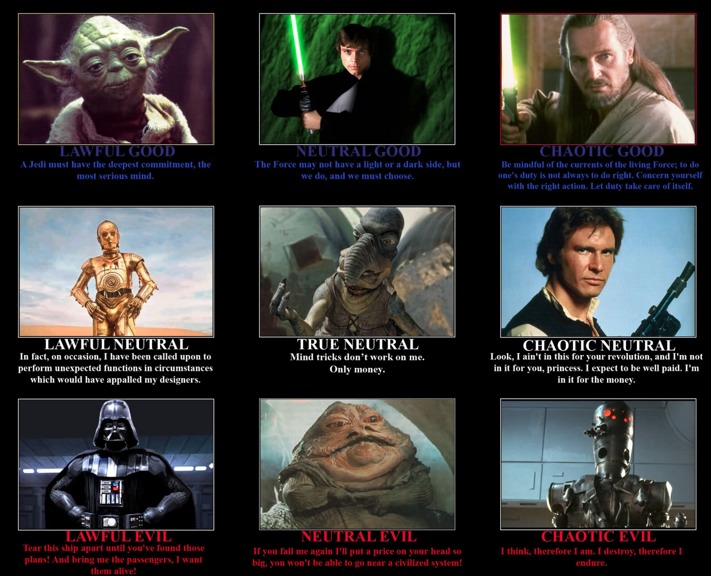
After five years of wanting, I played my first D&D game today. Upon creating my character—Pimbleton the Great and Powerful and Mighty and Strong, a three-foot-tall gnome who rode into the world on a lightning bolt thrown by Zeus and spent twenty years enslaved by a cereal company who forced him to be their mascot before rising to monarch of a race of undersea people—I was asked what his “alignment” is. This refers to a 3×3 grid, with axes of “Lawful vs Chaotic?” and “Good vs Evil?”

  • Is he lawful-good, like Superman?
  • Chaotic-good, like Robin Hood?
  • Lawful-evil, like Senator Joseph McCarthy?
  • Chaotic-evil, like The Joker?

DD-Alignment-Chart-2.jpg

I disliked this question. It feels wrong-directional. We can describe an action as one of these, but they don’t describe the whole person.

  • What about a lawful-good character whose father was killed by an orc and therefore has developed deep-seated racism against them? If she’s lawful-good in every other instance, must she also be lawful-good toward orcs?
  • Or a chaotic-evil character with a soft spot for small, furry animals? Must he suffocate every bunny he meets, simply because he beheads every human in his way?

Actions should come from who someone is, not the easiest way to classify them. There’s no such thing as acting “out of alignment.” There’s only acting in character or not.