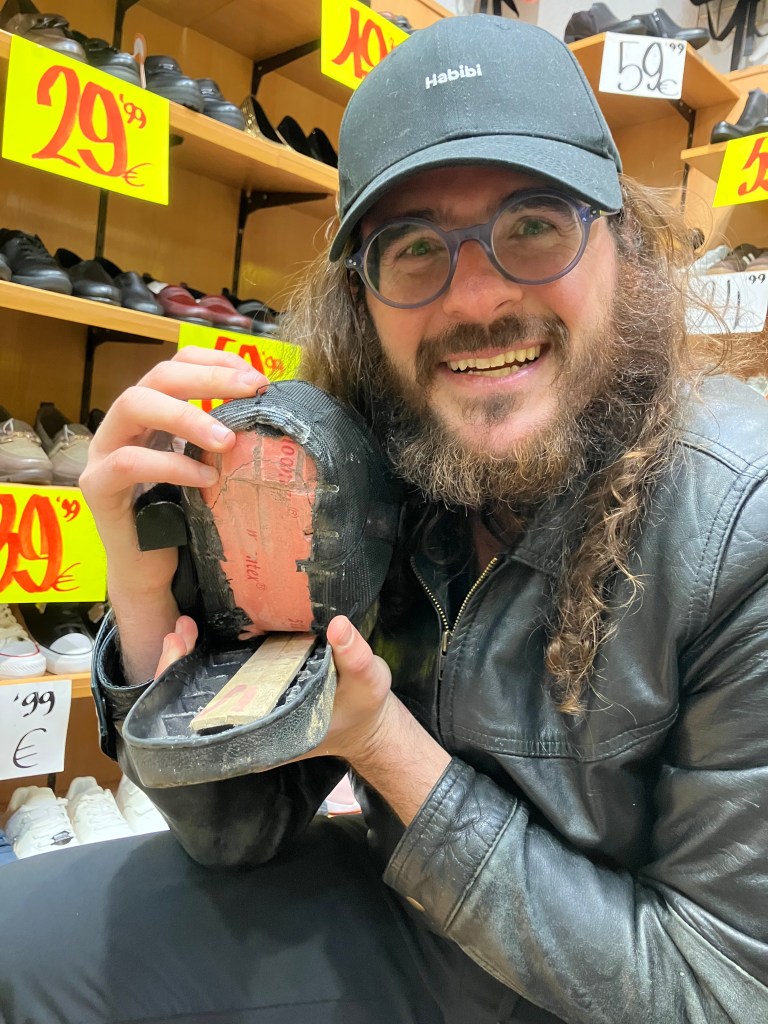
Clown School Day 14: Some Days Ya Don’t Got It

In which Our Hero fails honestly.

That’s three days in a row I’ve wanted to skip clown school.

And three days I’ve gone anyway.

Three days of long, heavy sleep:

11 hours, 9 hours, nearly 10 last night.

Three mornings waking early, wishing I could stay in bed forever.

What’s up with that?

I’m tired in a way that’s not physical.

It’s the exhaustion that comes from being seen — again and again — and still not finding what works.

The ache of caring too much about doing well, and not quite getting there.

Maybe it’s just the part of me that resists growth.

The part that wants to avoid the flop.

The part that whispers: stay safe, stay small.

But the show goes on.

So I go too.


In which two pairs of clowns succeed

I have a hypothesis about clowning: there are only two good moves.

The first is doing something good.

The second is doing something bad, and admitting it.

The second is just a version of the first: both are open, honest sharings of self.

Maybe that’s what makes someone funny: the willingness to be seen, and to be laughed at.

Open, but not grasping. Honest, but not pleading.

Just human: the funny little wriggly worm that we are.


Today, I failed.

I got exactly one reasonable-sized laugh, when I shrugged and said, “Some days ya don’t got it”.

It was the opposite of calculated, and therefore perfect.

My scene partner, though, was charming. I’m not good at charming a crowd.

One person, sure: I find what they care about and give them that.

But a crowd? That feels like crafting myself into someone they’ll love…

and that’s never been my thing.

Maybe that’s why I’m drawn to bouffon: the grotesque outcast who refuses charm, making you laugh by breaking the mold.

I don’t know how to play “charming” without feeling false.

Tall, handsome, strong, masculine — all that bland, moral ideal.

Heroes just seem so… plain.

My favorite sex-work writer once said something like, “When I do the girlfriend experience, I just give guys all the parts of a date they want, and none of the parts they don’t.”

It’s the same trick as charm: shave off the edges until only the pleasant remains.


The two American clowns who are alumni from this school that I’ve seen succeed are masters of the flop (one linked here).

They do things that don’t work, then admit it, again and again.

It’s delightful. Comic. But not powerful.

The most successful recent student, though — a Norwegian — is the opposite:

he does good things, and they work.

Maybe that’s cultural.

Maybe Americans prefer the flop because it’s relatable.

Maybe our comedy is just collective self-recognition in failure.

That’s probably why I’d rather play the fool, or the villain, than the flawless hero.


Today, two pairs performed brilliantly.

One was a seasoned clown with a German partner.

The clown failed, over and over, and acknowledged it.

The German played strong, stalwart, beautiful.

We laughed at one, cheered for the other.

Together they danced between laughter and awe:

Comic and Beauty, alternating in rhythm.

After five minutes, our teacher smiled and said, “Thank you for sharing your joy.”

I wondered how long the German had been performing — possibly decades.

And the seasoned clown has ten years under his belt, with awards to show for it.

I was glad to see them.

It helped to see the two paths clearly:

the clown who fails and admits it,

and the one who succeeds by doing good things.

Maybe both are forms of giving.

Maybe both are beautiful.

Maybe the German’s beauty wasn’t in his poise,

but in his openness — his unpushed caring,

his gentle invitation:

“I’m here. This is me. Go ahead: laugh at me.”

Clown School Day 13: Who’s The Laugh For?

In which Our Hero learns to give himself away.

Is giving giving?

We created a mob on stage. One leader, fifteen followers. The leader was in Major: loud, powerful, commanding, tall. The followers were in Minor: following along with the Major’s game.

The leader’s task: move for the group. Then, if successful, speak for the group.

Here’s the kicker:

We — the audience — could easily see when the leader was playing for others and when they were playing for themselves. Too delighted by your own words? Too much for yourself. Too fast, too slow, too complicated, too boring? All of it = no good.

It was fucking cool.

It wasn’t just obvious when a leader played for themselves: we could even separate which parts they did for themselves. Some moved for themselves but spoke for the group. Others spoke for themselves but moved for the group.

Me? I moved for the group until I started speaking. Then I spoke for the group but failed to move for them.

The magnetism of a Major doing for others was inescapable. It drew us in — as the audience — as though they were playing for us, too.

I keep wondering what “giving” really is. Is it enough that someone is giving to someone? Or must they somehow give to each person? The latter seems impossible: no one can give individually to a 3,000-person crowd. But you can give, and keep giving, and keep giving…

I thought about that today when I found myself in a spat with a friend. They argued — accurately — that I’d been laughing for myself, not for them. And they found that objectionable.

At a minimum, they were fair (jury’s still out on them being right ;). Maybe I’ve found too few people laughing for me, so I learned to laugh for myself. Whatever the reason, it’s unhelpful — on stage and in friendship alike.

That’s why I’m here at clown school:

because I’m a guarded, frightened, closed, selfish, winning-focused person

trying to open up.

It’s hard to give and share and open and keep giving in this ever-present openness.

First-year classes are often “weeder” classes — designed to weed out those who aren’t a fit. In college, I lasted one day in Theater 101 before switching to philosophy. Theater 101 was dry history; philosophy had rigor and use.

I wonder if theater students who truly love it endure that drudgery because they care so much about reaching the next level — the acting classes, the real thing.

Here, too, I’m pushing through the bullshit, the trials, the endless tests: chasing skill.

The teachers keep throwing more at you, more and more, just to see who will break.

Those who break aren’t meant to be clowns.

And maybe I’m not meant to be one either.

So I’ll grab what I can from this pressure cooker,

gather the small diamonds I find,

and fuse them with other gold I’ve picked up along the way,

to form

my own

crown of jewels.

Clown School Day 12: If Only You Knew What Makes Me Laugh?

In which Our Hero is a total grumpypants.

You only want some of my joy. You don’t want all of it.

Not the part that finds fascination in injuries at the Olympics.

Not the part that laughs when someone fumbles at a task they’ve been doing for months.

Not the part that goes for blood in silly games.

You only want some parts.

School is cultural honing: a repeated sheening and shearing and shaping of an impressionable child into the kind of person we want.

Graduate school is self-imposed honing.

Clown school is emotional honing.

Half of this school is calibration: make it light, make it pleasant, make it generous.

Half is tactical: learn the mechanics and try them out.

And the final half (yes, I know) is experience: stage time with a real audience who loves this peculiar art.

But what if I don’t want to be calibrated?

What if I like my joy?

What if I’d miss the parts of it you call cruel?

A friend recently said something that ruined my joy at watching this video (includes a severe gymnastics injury). I used to find it fascinating. Now I can hardly watch.

Is that a loss? Once I received a fascinated joy. Now that joy is covered with a patina of sadness and pity.

Why do we do that to each other: sand the edges off one another’s laughter? Isn’t there a terrible beauty in the Olympian moment: a lifetime’s work undone in one leap? It’s comic, in the oldest sense: man plans and God laughs.

The funniest part, perhaps, is the commitment to the bit. This athlete may never walk again. That’s deathly serious. But he hurt himself with flips and spins, in a contrived game, for which the prize is mainly collective fiction (a title, which brings fame and glory). Is that not fundamentally comic? For me, it’s the same humor I saw in the nod of a hotel receptionist in Bentonville, Arkansas. I commented that the front page of their local newspaper was about high school football. She nodded solemnly, explaining, “It’s very important.”

No, it isn’t.

And yes, it is.

With the receptionist, I let her continue her joy.

While my Olympic joy is now covered with dry rot.

Now, when I rewatch, I can barely locate that joy. It’s smaller now, covered in a “But you shouldn’t…”

We choose the games we play. I’ve chosen clown school.

And yet, when peers see me on the street, when they ask what video I’m watching on my phone, I hide. I make a joke. I assume they’ll hurt me if I’m honest.

It’s hard to be honest and open.

So hard. Since it’s been so aggressively sanded away.

That’s why I’m here.

Because people don’t generally value openness, or honesty, or play.

We value these in contained scenarios. But an intensely raw emotion, honestly expressed? Best put a lid on that, missy!

I generally don’t find the world a nice place. I don’t think openness is generally rewarded. People can be vicious outside the boundaries of their games. That’s why games exist: to make behavior safe.

Within a game (religion, law, sport), there’s form. There’s play. Simplicity. Meaning.

Outside, there’s a new game:

The honest negotiation between what we’re told to laugh at

and what still makes us laugh.

I’d like to laugh at you when you’re being an idiot.

I’d like to laugh at me when I’m being an idiot.

Have you considered joining me?

It’s funnier over here.

And if not,

I’ll take

my ball

and go home.

“The child not embraced by the village will burn it down to feel its warmth” —African proverb.

Clown School Day 11: The Joy of Gibberish

In which Our Hero finally speaks his native tongue

I did it! I clowned! Wahoo!!! !!!! !!!!

Here’s the sitch:

Our head teacher asks for five people who don’t speak Chinese. I step forward. She plays a Chinese song and we’re told to mime along. Then she turns down the music and says: keep going. Continue the song, in this language we do not speak.

I have been preparing for this my whole life.

I’ve always loved imitating sounds. Not faces, not gestures, sounds. The cadence of languages, sirens, shower water hitting my rubber duck. It’s always been a private delight.

Today I let it out. I imitated the music of a language I don’t know, and loved it. The audience loved it too.

It gets better.

On Friday I asked our teacher how to tell when something works. She said: you have to look at the audience and see.

I already knew that, but I needed to hear it from her.

So today I looked. I saw the joy light up their faces. One woman — the same who’d argued with me on Thursday — beamed with glee. My roommate was glowing, proud to see me not only succeed but to know I was succeeding.

And so I kept playing. Kept singing. Kept sharing that joy.


Good news: I have a skill people love.

Bad news: in America, this skill is considered offensive.

Five years ago at a rodeo in Wyoming, I was doing a southern accent for fun. My travel partner told me it was unacceptable. She thought I was mocking. Maybe she was right; maybe she wasn’t. Either way, I stopped.

Now, at last, I’ve found a place where the same instinct — my delight in sound and voices — brings laughter and connection instead of tension and fear.

Sometimes I wander around the house doing silly voices. Usually, people shut this down. But in clown, it’s beautiful.

Or maybe it’s always been beautiful, I just need the right place to perform.

🤡

[My travel buddy of the last two years would like to add this note about me: “I’ve also noticed when traveling that you [Julian] pick up the accent and speech pattern of folks you chat with. I often worry that folks will find it offensive, but, tbh, I think they don’t usually notice and seem to like it.”]

Clown School Weekend 2.2: What’s in a Game?

That which we call Our Hero, by any other game, would play as sweet.

What is a game?

A game isn’t one thing, but a cluster of traits that, in sufficient combination, make us recognize something as a game. None of these are necessary, but enough of them is sufficient to make something a game. Some of those traits are:

  • Competition and/or cooperation
  • Ability to win and/or lose
  • Use of toys, equipment, and/or pieces
  • Play
  • Fun and/or pleasure
  • Turns
  • Rules
  • A self-contained world, protected from life’s other elements
  • Practicing skills useful elsewhere

The trouble of defining game is the trouble of defining any abstract concept: when we say “X is a game,” we mean it has enough of the qualities we associate with games for our brains to light up in recognition. Hence our endless debates, like whether a hot dog is a sandwich.

Games vary across cultures because the pleasures of play vary too. At clown school, we seek a joy that’s light and friendly; in sport, the joy can be vicious, even cruel. Have you ever watched a professional tennis final? They’re clearly playing a game — but not playing games.

Defining abstractions always circles back to the Supreme Court’s test for pornography: we know it when we see it. Still, shared language demands some definitioning (now a word). And that task grows harder as meanings and technologies evolve: even “simultaneous” doesn’t mean what it once did.

I like games. Always have. And by that I mean: I like whatever fires my neurons to say that’s a game. I like them better than mere activities; give me competition or a timer, and I’m in.

So:

  1. Games are hard to define.
  2. Games share recognizable traits.
  3. I like games.

I recently stumbled upon a definition for game by the philosopher Bernard Suits: “the voluntary attempt to overcome unnecessary obstacles.” Elegant, but too narrow. It fits golf or chess, not politics or dating, where the obstacles aren’t unnecessary, just chosen. I don’t think “dating is a game” is metaphorical; I think it’s a real diagnostic description of how people behave in the world.

Ludwig Wittgenstein suggested that definitional meanings work by family resemblance rather than rigid borders. I’ve always respected the man; nice company to stumble into.

Maybe that’s why I love games: they’re how we practice living within constraints — voluntary or not — and still find joy.

Life, after all, is the longest game we play.

Game on.

Clown School Weekend 2.1: The Cleverness of Simplicity

In which Our Hero dunks on century-old cinema

Charlie Chaplin is a comedy god. I saw his magnum opus today. It was… fine?

Not great. Not exciting. Not even that funny.

One or two strong laughs — the eating of the shoe, the dancing dinner rolls — but mostly, the movie made me sad. My film-buff friend assured me it was meant to. The pathos is why it’s endured, he said.

So we watch the Little Tramp suffer. The love interest betrays him. Our Hero suffers yet again. The sadness swallowed the play. I felt too much pity and fear to laugh.

I’m certainly more of a Marx Brothers fan. I like the clever. The sharp. The witty. The possible. Chaplin, by contrast, was morose. The Marx Brothers sparred with logic; Chaplin wrestled with circumstance.

I also saw three Laurel & Hardy shorts, and liked them much more. A quest to change pants, failing in ever-new ways. Elegant clownic escalation. Need a new beat: toss a crab in the pants. Simple. Repeatable. Because it was so limited, clever.

Clever comes from doing more with less. Laurel & Hardy did more with less. So did Chaplin, at his best: when dinner guests ask for a speech, he offers a dance instead (because it’s a silent film!). Cue the famous dinner rolls.

In clowning, the game is paramount. A simple, easy-to-understand game that provides boundless fun for the time allotted. Make the game simpler. Then vary it. Expand it. Loop it. Narrow it.

With clown, I don’t want a new game. I just want another well-played round of the same.

That’s what I’m learning in clown school: the joy of the repeat.

That’s what I’m learning in clown school: the joy of the repeat.

Clown School Day 10: How to Win by Losing

In which Our Hero finally beats himself

I loved it when a classmate called me a douche. It raised a key question: Am I a douche?

To that, I had to answer yes. Because anyone who steamrolls friends at silly games is a douche. And I’d been playing silly games to win, despite frequently being much better than others.

A knight without chivalry is a douche. An assassin without honor is a douche. The powerful, when they flex on the powerless, are acting like a douche.

(He said this after I grabbed a ball he was juggling. Not a big deal. Still, a douche.)

I wrote in my notebook: Stop always playing to win. Try playing to play.

Then we started wall ball.

Wall ball is simple: hit the ball, it hits the wall, bounces once, next player hits. Compared to my group, I’m very skilled at wall ball. Last time I won the tournament (ahem, ladies 😉)

This time, I decided to try play. My game:

  1. Don’t die.
  2. Give the next player the easiest possible hit.

Using this approach, I eliminated only one person (on a challenging shot where a gentle hit might have put myself at risk). Still, I reached the finals.

At the finals, a question arose: keep playing my game, or now play to win?

I chose my game. Either he’d win, or he’d beat himself.

First to three wins.

He won the first point.

He mis-hits. All tied up.

I thunked one off the side.

He botched another.

Two-two. Next point wins.

He fired a zinger to the corner: unreturnable. He wins.

The crowd went wild.

Everyone loves seeing David beat Goliath.

I cheered too. It felt better than winning the tournament. That had been awkward. This was joy. I led the chant: “Speech! Speech! Speech!”

The victor obliged.

I don’t think I’ve ever thrown a game before. This didn’t feel like throwing. It felt like optimizing for something bigger.

I didn’t lose. I won at a bigger game.

Sometimes the point of the game is play.

In theater, the point of the game is the play.

Later, our class watched another student play a game on stage with the same man I’d met in the finals.

The student was far more skilled. My teacher said:

“When you play with someone much worse than you, you must have good humor.”

That’s why I’m here.

To learn good humor.

Clown School Day 9: Clown Fight!!!

In which Our Hero proves he’s got rubber balls

Today I pissed off a clown.

It’s better to piss off a clown than to be pissed on by a clown.

We were playing 9-square. It’s like 4-square, but with 9 squares and more chaos.

I was playing legally. The rules say you can’t block another player, but you can wander outside your square. I was the King—the occupant of the center square—but I spent the whole game standing off to the side. Because: strategy.

The owner of that square complained.

The ref said my move was legal.

The owner complained again.

The ref asked me to move.

I moved.

Then I taunted the square’s owner.

The owner complained a third time.

The next ball that came to me…

I smacked it as hard as I could at her feet.

She was pissed. The crowd gasped. She appealed to the ref, who shrugged, as if to say: He played the game hard. What do you want me to do about it?

She stormed off. Later, I caught her venting to another player, confirmed later as badmouthing: “Can you believe that?”

Here’s what I learned:

  1. When I feel someone’s playing shenanigans, I get righteously pissed. When I get pissed, I get determined. And when I get determined, watch out.
  2. My classmates will now play differently with me.
    1. The fun-first crowd will avoid my wrath.
    2. The competitive ones will know I don’t back down.
  3. I may have just become the enforcer of clown school. Neither good nor bad—just a role.

It’s no coincidence that the person I clashed with was the second-best at the game. Competitive people find each other. And when they do, sparks fly.

I respect her. She plays hard. She got the ref on her side, a valid tactic. Later I overheard her admit she’d been feeling a bit touchy today. So maybe we both just hit the limit of our light play energy.

And she got me back. In the final round, she served me a tiny, dinky little ball: barely legal, perfectly placed. I was out. No one else noticed.

Well played. Respect.

(Though I’ve since heard others reacted to her venting with a kind of “Wait, what’s she mad about?” bemusement… so maybe the last laugh is still up for grabs.)

But what is this about, really?

Is this a story about clowning? About performance? About theater?

Maybe.

In a way, 9-Square is theater: it’s a miniature social hierarchy. The King in the middle. The peasants below. Everyone clawing their way upward by knocking someone else down. Game of Thrones played with rubber balls.

In singles, you play for survival and glory.

In doubles, it becomes a romance—your fate tied to your partner’s. You win not through aggression but through sync, trust, and conservatism.

It’s a lesson in status, alliance, and timing.

And like all good clown work, it’s about how you handle the fall.


As for my reputation: some classmates already dodge competing against me. Fair. For me, winning is part of fun, but the real goal is shared joy. I just happen to find joy in playing hard. Someone has to be clown game king: might as well be me.

Clown School Day 8: Nice, Simple, Social

In which Our Hero makes a friend!

Once in a blue moon, you meet a person who feels like someone you’ve known your whole life. In my case, today’s was a trans, autistic, lesbian philosopher with eerily similar experiences to my own. Dinner started at 7 p.m. and ended at 11:30, including a long, leisurely walk around the park.

My goals at clown school are threefold:

  1. Learn the practicalities of clowning
  2. Learn the theory of clowning
  3. Make friends I’d like to spend time with after clown school

It’s nice to move forward on #3.


Notes from clown school today:

  • Blindfolded ball pickup: Walk toward a ball with eyes closed, then pick it up. The key is counting the right number of paces, then walking normally even when, near the end, excitement floods in.
  • Chair swap game: Don’t let others rattle you. Don’t move until you have agreement.
  • One structure of game: One vs. Group. A bunch of people beating up on one idiot (à la Monkey in the Middle). Perhaps funniest when all are idiots.
  • Some people are more confident than they are right. One classmate especially.
  • Idiots trying very hard at something they’re terrible at → very funny.
  • Smart people tease each other; idiots conspire.
  • Regardless of external intensity or internal emotional intense, I must still speak in a BIG, BOOMING VOICE.
  • Idiots playing smart games → lots of apologizing.
  • A conspiring group mirrors fighting over limited resources; one-on-one intellectual duels mirror fighting for extraneous desires or abstract pleasures like honor.
  • Teaching hunch: if someone ends on a mistake, they dwell on it, therefore learning faster.
  • When the major/minor switches → fixed point.
  • A “miser for pleasure” hoards joy inside instead of sharing it.
  • Loud creates an impulse. The important part is the impulse.

Clown School Day 7: First Impulse

In which Our Hero fails via simian ejaculation

“At the sound of the drum, you must make the sound of an animal ten seconds before it has an orgasm,” said our teacher, in his typical Swedish accent.

I chose my animal. I spotted others’ mistakes. I planned my route. I considered the method by which I was likely to fail. And then, when the time came, I failed. Bombed. Flopped. Crashed. Kathunked.

We were playing a game of cannibal chairs. It’s exactly like musical chairs, except your teacher is from Sweden. And when you’re out, if your animal’s orgasm is enjoyable enough, you’re saved.

Some students latch on to the impulse right away. They grab the failure and they start DOing. Prancing about the stage; braying like a donkey; mooing like an aroused cow, etc. Others take a beat. I decided I would be in the second category.

My first impulse is often fear. So I decided I’d wait. Take the second. Build the second wave instead of grasping at the first splash. First impulse is for those who ride external energy; second is for those who find it inside.

I noticed this dichotomy when a friend failed to find a chair, then walked to the side of the room, thunked the wall, and began his performance. The three seconds pause allowed him to collect himself. When he arrived, he arrived. His face was open, eyes shining. We loved him. Life saved.

When I failed, I latched onto the first impulse. I flailed. Yuck.

My first impulse was, as it so often is, fear.

My second impulse. Security. Comfort. Presence. That can be beautiful.

Another lesson I will need to incorporate.

One I have learned before.

Perhaps one day my first impulse will lack fear. Perhaps one day it will be honed enough to succeed. Until then, it is mere panic. And panic has no place in clown.