In which Our Hero puts on his big boy pants.
Everyone received a mark of zero today. Every. Single. Student. A new record. Some people earned three zeroes; some two; some only one. I loved it.
The teacher says I sometimes laugh when no one else does. “When Julian laugh, he is alone.” Fair enough. Sometimes I’m not laughing at the thing itself, but at what the thing makes me think of. Like a few weeks ago: a group tried to play a game where they became “scared” whenever someone said a word with the sound boo in it. The game was stupid; the play was bad; and the gap between the silliness of the idea and the flatness of the execution made me laugh. It was like watching someone throw themselves at the ground and miss. Delightful.
I received a zero today. I enjoyed it. I don’t care about their grade. That’s just part of the game. I’m glad I succeeded in doing some new things well.
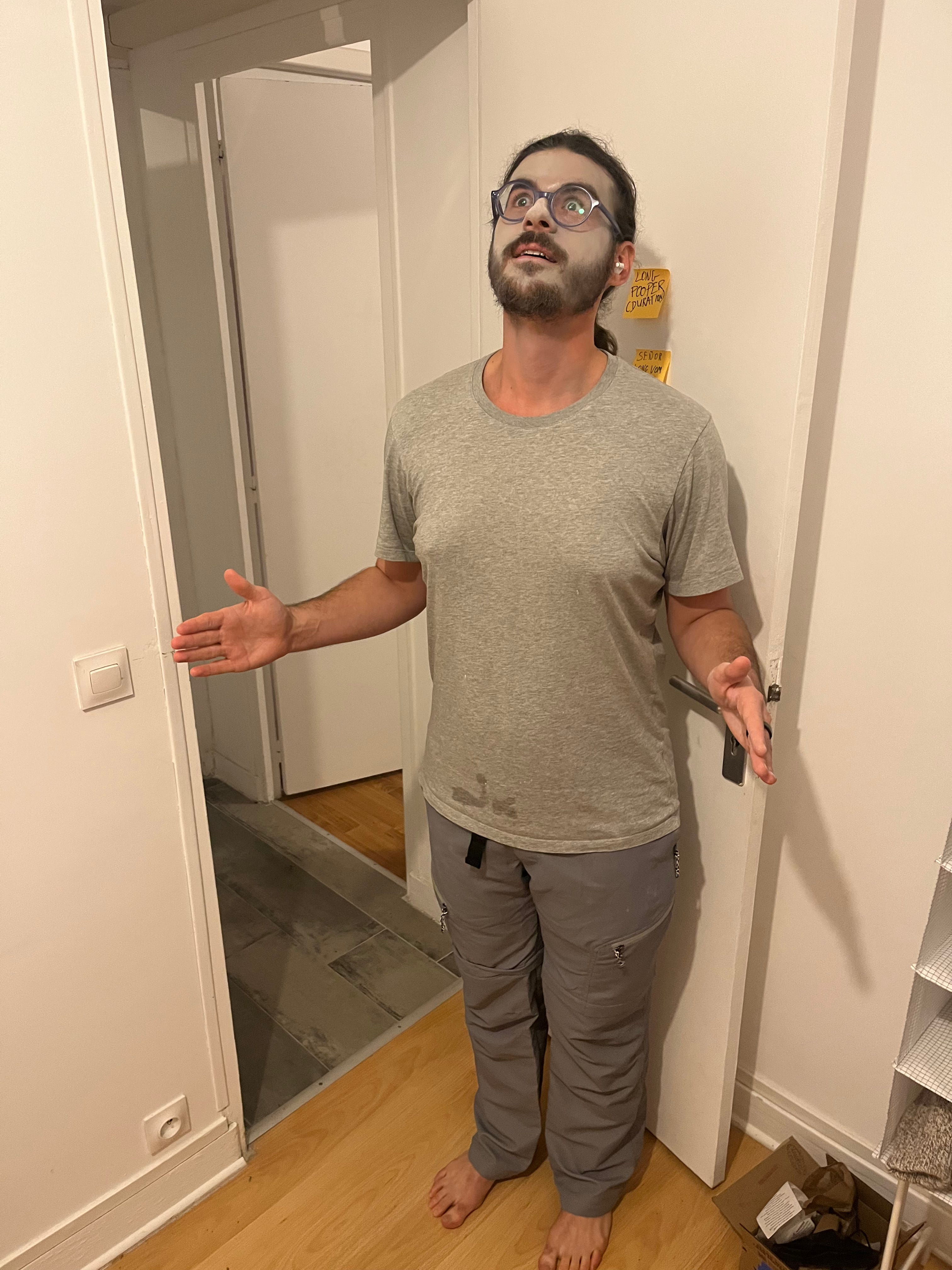
I had one moment onstage—maybe half a second—where it all clicked. Holding my hands in perfect blades (as I was a stick insect), I tried to open a soda bottle. I was having so much fun; I looked ridiculous in my all-gray outfit; the audience laughed. Then one of my partners stole the bottle away, stealing the game from me and thereby ending it.
During the summer course, I heard the head clown teacher say something like “You have found a problem. That is a very special thing for a clown. If you solve it, you will need to find a new problem and that is not always so easy.”
Still, for that instant, I succeeded. 😀
During talkbacks, Head Teacher said: “And this guy [me]. At least he is finally covering his legs.” (I usually wear shorts.) So I raised one pant leg—just a small, innocent reveal. She laughed and looked away, maybe a little embarrassed. I did the same with the other leg. She laughed again. Light, gentle, generous, giving. Success! You’re not only performing when you’re on stage. You’re always performing. [And, well, I was still standing on the stage.]
Today I took the whole class as a joke. A game. A silly thing we’re all doing together. That shift alone made everything feel lighter. It made me more receptive and open.
I found the fun and the games in her comments. I felt lightness all the way through. (Except for the time when she said I laugh alone. I felt hurt and sad and lonely for a moment there. And then I found the lightness and pleasure again 🙂
Monday was my most painful Clown School day yet. On Tuesday, I started to recover. Today, I find the whole exercise funny. Our teacher literally started class with vocal exercises of her pronouncing the word “zero”. After people performed, she sometimes said “[X person] had a good entrance…” and sometimes said “[Y person was a] total catastrophe” yet still gave everyone in that group the same mark: zero. A farcical grading system! A curve with a mean of zero and a standard deviation of also zero! Only needing one number card to hold up! How droll. What a deeply silly ritual.
One student had a few little flashes of something—tiny moments, not the whole piece—and I told her after the show. She lit up, said it was nice of me to say (and said it in the way that people do when they’re authentically touched). We’re all in this together, and a glimpse of success counts.
Somehow, when we’re in rough waters, I find the pleasure more easily than when we’re sailing smooth seas. On Monday, right after everyone’s big triumphs of last Friday, I was the lowest of the low. Perhaps this is part of why I laugh alone. I suppose there’s fun in that discrepancy too.
“What’s funny about suffering?” you may ask.
What isn’t?
—
I think we’re being trained to find pleasure under duress. A clown’s job is to bring pleasure to the audience, they have to mine that pleasure from their own world, and share it. And the world isn’t always gentle: political trouble, personal strife, illness, rough crowds. If I can find pleasure when things go well and also when things go poorly: that’s a kind of success.
They’re training us to be successful clowns. If you’re going to be a truly successful clown, you need more than one safe trick. One peak of pleasure isn’t enough. To find higher peaks and fill your bag with more tricks, you have to explore: try things, fail, fall into valleys, climb out again. Failure is how you map where the fun actually lives. The teachers are training us to fail well so we can explore more freely. The more I flop, the more terrain I get to see. And I better entertain the audience along the way.
Right now, this stick insect finds more pleasure during the poor times.
What a funny thing to be.
P.S. I watched the second-year clown students today. They were also harangued more aggressively than usual. I’m almost certain this is intentional. I approve. When something works, push it to the extreme.
 Julian Wise