A man with a hand cast approaches Partner in the Houston light rail. He points at her and points at himself as if to say “we’re both injured!”
His opening line: “are you a believer?”
Partner grunts, “Catholic”.
He tells her that Jesus will take care of her. See: he prayed and his hand doesn’t hurt.
—
Houston is a car-based city. The light rail only navigates along a few specific stretches. Therefore the main people who use the light rail are those who don’t have cars. The selection effects mean the light rail users are mainly poor or homeless. It’s the highest proportion of people talking to themselves or yelling arguments at the empty air that I’ve ever seen.
So what?
So it’s a little bit of a spiral to the bottom. The New York City subway definitely has more total homeless or poor or ghost-yellers than the Houston light rail. But the proportion in Houston dwarfs that of New York. And it feels – at least to me – much less safe. I wonder whether that causes it to only attract those without other options. So it attracts fewer riders – and fewer affluent and influential riders. And therefore the service doesn’t expand?
Houston doesn’t necessarily need a better light rail. The buses also work well enough, if you’re okay standing in oppressive heat for fifteen minutes. But it’s a notable trait of infrastructure: if you don’t invest early enough, you’re generally better off waiting for the next paradigm. The US is a car culture. Next up: personal helipads?
—
And a funny quote from Partner:
“You know what’s the funniest part of BTUs? The Brits don’t use air conditioning.”
The best part of Brooklyn? It’s near New York City.
Partner & I trained for 48 minutes each way to an event in Brooklyn.
The event: four fifteen-minute talks plus Q&A, starting at 5pm since we had to vacate the space ahead of a different event starting at 6:30pm.
Partner & I arrived at 4:40. One of the organizers said, “You guys are early. Could you come back in 20 minutes?”[1]
If you’re going to have four fifteen-minute talks, plus Q&A time, you really want to start near 5pm. See, I don’t know what they teach you in Brooklyn. But here in Manhattan, 4 x 15minute = 60 minutes. And 60 minutes = an hour.
Instead, they didn’t start until 5:20pm because, as they said, “Some people are coming from work.”
No duh. It’s Thursday. How did you not consider this?
So the talks got squished to 10mins each. And the Q&A got squished to one chunk of ~8 minutes.
And only two people put their shoes in the little cabinet despite the cabinet being labeled “put your shoes in this cabinet”. And yes, they were Me & Partner.
—
The talks were on living in communal spaces. Partner and I are interested in living with friends. We want to raise a family alongside other families, ideally in the same apartment or neighboring.
But, for us this trait is only one of our interests. For the people at this presentation, co-living is the main part of their identity.
One of the recommended processes for co-living: have a roommate check-in. Include open dialogue so different housemates can share their problems.
My problem: a poorly scheduled, structured, and run event.
[1] Partner says they said, “You guys are incredibly early.” I didn’t hear the incredibly.
Performance-enhancing drugs are great. They enhance performance, and isn’t enhanced performance good?
Look: today I felt grumpy. So Partner grabbed me a pearl tea: sugar, plus a substance the Olympics banned until 2004. Twenty minutes later I was up and rolling, knocking out work I’d been avoiding for three weeks. It got me thinking.
The classifications we give – food vs supplement vs medication vs drug vs illegal drug – are not chemically meaningful. If you eat the vitamin C that’s in an orange, that’s called eating an orange. If you take the same amount of vitamin C in pill form, that’s called taking a supplement. Yet we think about these very differently. The exact same chemical process that ten years ago was called doing drugs is now called “doctor-prescribed medication for sleep” (cannabis).
Why does our society (all societies?) have these classifications? We want to restrict some behaviors: for the safety of others, for the safety of the individual, or for reasons that aren’t about safety at all.
The biggest not-about-safety category is purity: questions of what a human is, and what appropriate human behavior looks like. So what’s with the obsession with purity?
I’m reminded of a lawyer who built a Supreme Court practice by soliciting: He would identify cases the Court might take, contact the potential plaintiffs to inform them of their potential case, and end up arguing before the Justices. Chief Justice John Roberst pooh-poohed this: “If I’m going to have heart-bypass surgery, I wouldn’t go to the surgeon who calls me up.”
But actually, wouldn’t you? Let’s run the thought experiment. A surgeon approaches you out of nowhere: “Based on the shape of your face, I know that you have obstructive sleep apnea. I’m a medical doctor. I studied at this school. I’m not some quack making things up: here are the rigorous scientific tests you can take to verify what I’m telling you. And get a second opinion, if you like.” I would think: that’s excellent.
In fact, this is roughly what happened to me before my jaw surgery. After six doctors’ worth of searching, I found Dr. Christian Guilleminault – one of the founders of the field of obstructive sleep apnea, since passed. While he hadn’t found me on the street, his diagnosis was as unsolicited as they come. He looked at my face and said: “I can tell by the shape of your face that you were a rambunctious child.”
What a funny thing to say!
He followed it up with, “We will send you in for the lab tests, of course, but I already know what they will say.” He then predicted the results, which aligned perfectly when the tests came back a few months later. That’s the doctor I want to hire!
So much of our restriction runs on purity. But purity is not itself good for the individual. Purity puts the individual into a particular game — a game they can win only by behaving in one specific way, and a game they never asked to play.
The purity game is about packaging. Take virginity, the archetype of purity: a woman who is chaste, who follows the virginal pathway, receives adulation for it. There are other pathways to adulation. Purity just happens to be the lowest common denominator (for women in a specific slice of society).
I drastically prefer informed consent. The biggest danger with performance-enhancing drugs — with drugs, period — is the unknown unknowns. You have to know and understand not only the limitations of the drug itself, but the limitations of our knowledge about the drug. We do this poorly as a society, because much of a doctor’s job is to demonstrate confidence and instill calm. They act, one could fairly say, like a con man. The onus is therefore on you the patient to work out the actual epistemology of your circumstance. It is frequently much less certain than any doctor, drug manufacturer, or therapist would have you believe.
External games like purity are other people’s scoreboard. Informed consent is your own: you, the substance, and an honest approximation of uncertainty. To enhance performance, choose the right substances. To choose the substance, know the limits of what’s known.
Today I consented, informed, to one highly-caffeinated pearl tea. Three weeks of avoidance, cleared. Enhanced performance. Fundamentally good.
At the World Cup final watch party at the Harlem Tavern, a woman waits in front of five bathroom doors. I ask: “Did you check them all?”
She says no.
I walk down the line, twisting each knob. At the third door, the knob turns. The door opens. I gesture to her to enter. She does.
What is wrong with people?
Hold that question.
On the screen, Argentina was busy demonstrating the opposite mistake. A ref draws a box, and you fill the box you’re given. Players will play as rough as you let them — and they should; that’s the correct way to play a game. Argentina filled its box and kept pushing at the sides: four yellow cards by my count, one of them on the coach, two of them on Enzo Fernández, who was sent off. They played the end of a World Cup final a man down. They did it to themselves. (For more on refs and the dark arts, see Drawing a Foul vs. Flopping.)
A bathroom line has no ref. That’s what makes it the purer game. Field notes:
The early exit. Leave before the hydration break is called, or the instant it’s called. This is playing within the rules. I left immediately and made the front of the line. Plenty of others made the same move; the line stacked up eight deep behind me.
The exit-door gambit. At the halftime of extra time, a man arrived, realized the line was a line, and was very much not into it. I watched him scan for a shortcut. Finding none, he circled around to the bathroom’s exit and went in from there. He checked whether any doors were open. He played off the visit by washing his hands — “I only came here to wash my hands, not to skip the line…” — and then stood inside, watching the doors, waiting for one to open. Cutting the line is breaking the rules, and watching it riled up a rule-enforcing Germanic part of me that wants to destroy him and everything he stands for. The rest of us waited in the line.
The empty stall. The line filed right past the accessible bathroom. On Partner’s previous bathroom visit, a dude next to her tried that door: empty. She immediately stood in front of that door, waiting for him to come out; someone else lined up behind her. Nobody had been using that bathroom, and somebody should be using the bathroom: seems like an efficient use of resources. But the second line forming back there was the wrong shape. It should be one line, feeding every door. (I have preached this queueing theology before, at Trader Joe’s.)
Which returns us to the woman and the five doors. Five doors, five knobs, all that information free for the twisting. She had checked none of them. Behind door number three: an empty room.
To make a game mean something, make it fair. To make it fair, make it sport, not art.
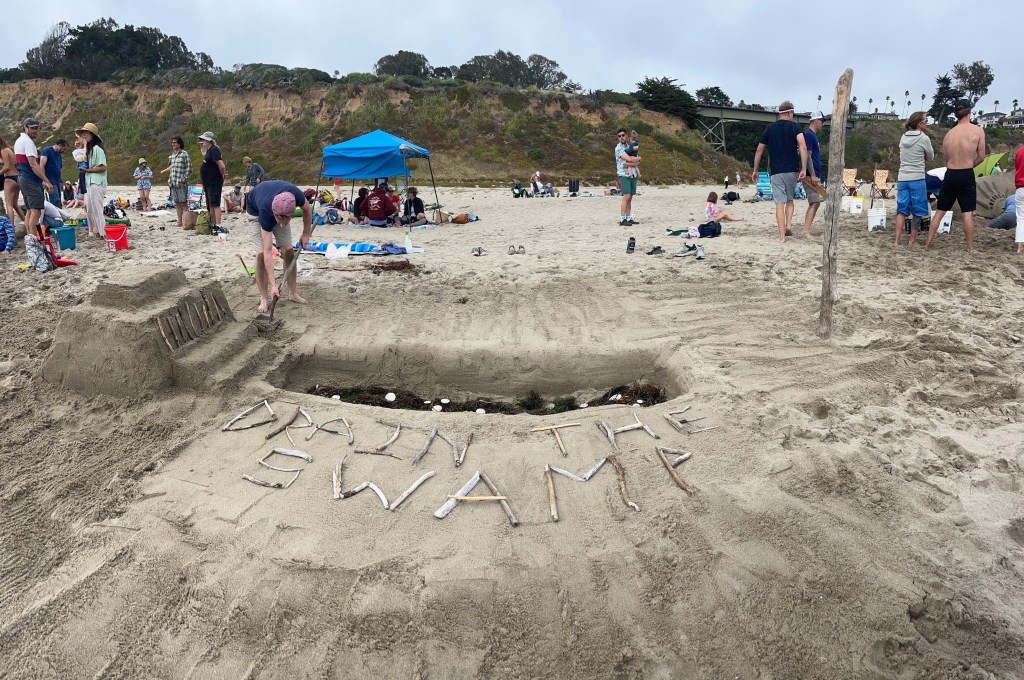
On the 4th of July, this sleepy beach town south of Santa Cruz, triples in size: Children, grandchildren, aunts and uncles all come into town for hot dogs, sack races, and sand castle competitions.
The children compete first, in the classic Americana races: a diaper derby (baby race, stratified by crawling and walking), then a three-legged race, balloon-between-the-knees race, and peanut-on-a-spoon race. Even before I fell during the wheelbarrow race and hurt my knee, I was not having a good time. In the evening, when I mentioned this to Partner, she expressed surprise. She said something like, “I would have thought you enjoyed these silly games”.
I do like silly games. I just don’t like this implementation of silly games. Here’s why:
1. The judges aren’t performing their solemn duty.
a. After the peanut race, Partner commented that one child appeared to have held onto the peanut with their thumb. The stated rule was you could only use one hand on the spoon. The judges are insufficient and the rules aren’t clearly defined.
b. The sandcastle competition was similarly poorly adjudicated: The judge at sign up told us we could only use items we found on the beach. We used seaweed, sand, sand dollars, sticks, and one large log. When the judges swung by later, they told us they could only judge sand. Well, that’s a whole different competition! We would have only used sand!
2. The starting positions aren’t really fair.
a. For the balloon-between-the-knees race, pre-blown balloons are passed out willy-nilly. Some are full enough to pop when dropped; others are nearly empty so they bounce on the grass instead of popping. The size of your balloon determines the angle of your legs. This trait matters.
b. For the three-legged race, some contestants’ legs are tied at the knee, others at the ankle, and in varying stages of looseness. A loose-tie three-legged race? Oof!
c. For the bubble-gum-blowing competition:
i. The gum is not simultaneously distributed. The real work in this competition is to chew the gum for long enough and vigorously enough to make it malleable (and perhaps chewing decreases the sugar content, which impacts the bubbles, etc.). The blowing is much less important than the chewing. Ergo, the competition includes stratified and arbitrary head starts.
ii. The measurements are inconsistent. Obviously, one should measure bubble size through the center of the bubble. But the bubbles are not perfect spheres: do you measure the longest distance through the center, or the shortest distance? The judges seem to have no consistency at all, the worst option!
iii. (A small gripe: they announced the competition was open – not age-capped – and then ultimately did age-cap it to only children 10 – 12 years old. I mention this not because it’s as big of a fairness issue, but because it demonstrates the general lackadaisical relationship that the town of La Selva Beach – home to Partner’s grandmother – has to its games.)
I know these games have a purpose that diverges from my approach to them. I know that the purpose is something like “Tradition”, and “Nostalgia”, and “Town spirit”, and “Afternoon activities for a National Holiday”.
For those purposes, I take no issue. July 4th is a great opportunity to eat hot dogs and jump in bouncy castles and host a parade and enlist local teenagers to paint children’s faces to raise money for some small town charity like the library or the fire department or that weird hippie dance group that for some unknown reason had a larger and more populous section in the parade than even the fire department.
The part I take issue with is the games. What are we teaching with them? That judging can be arbitrary and capricious? That you can make every move perfectly using the tools you were given and still lose to some corrupt official or other competitor who was given a head start? Yes, those are true. We know, and we experience those all the time. The beauty of games – of children’s games – is that for a moment life can be fair:
“Who can run fastest to that tree?” is at once modified by the child’s genetics, by the shoes their family can afford, by the amount of free time their parents have to let the kid play outside, by the child’s nutrition, and by a host of other unfair discriminations.
But it is also a terrifically fair question: Who can run fastest to that tree?
Obviously, these games are made for children. They’re age-capped and time-bound and some kids receive ribbons on a podium. But they’re also, fundamentally, not made for children. To create something for children means to make something that helps them be better adults. These games do not do that. These games create short-term whimsy with long-term hollowness. And for babies who cannot walk, watching them maybe trudge toward their parents but mainly just sit, confused, while the announcer jokes that “this race is time-capped at 20 minutes”, is funny in the same way that a snail race is funny. It’s joyful because babies are adorable even when they simply sit like an uncooperative blob, and watching them allows us to laugh at the meaninglessness of this endeavor: like herding cats, only cuter.
But the older kids’ games – the ones where the competition is real, where a child might gain pride from their friends and family for decades for winning the bubble blowing competition (as multiple members of Partner’s family informed me that Partner’s sister won ~2 decades ago) – these rules matter.
These games are not made for me. They’re made for children. And they’re not even made for children. That’s sad.
Games are a struggle against entropy. If you haven’t planned for the tide, your sandcastle will wash away to sea. Bet against the fundamental traits of existence at your peril: gravity pulls mass to mass, tides come and go, time ticks on, and wet sand packs better.
When every other activity washes away to a sea of chaos, games build a wall against the ocean, with referees’ fingers blocking leaks.
The traits of the footrace – which tree was chosen, where the starting line for the race begins, when the race starts – these are controllable. In the game, these are sacred. To have an uneven race is to have a meaningless race. It’s to transform games from games into the mere performance of games. I love theater. Keep it separate.
—
My team’s sand sculpture received glowing reviews from passers-by. I enjoyed the process of making it: the conceptualizing, the strategizing, the digging, and the polishing. I enjoyed the creativity when our plans hit reality. I enjoyed the passing-off of tasks from teammate to teammate. I enjoyed the fact that we created art that prompted many people to snap pictures and comment, “Way to go!” and “I’m tired of seeing flags; this one’s great!”
I didn’t join the sandcastle competition to win. I joined it to build a work of art. We did, we succeeded, and I’m overjoyed.
Now the only honest thing to do is to tell all the children in the sack race that they were actually participating in art, not sport.
To win, keep the game going. To keep the game going, drink what you’re given.
At 11:15am this morning, I asked my brother-in-law to set a 30-minute timer. I then sunscreened the tops of my feet and I entered the kiddie pool. My nephew (just shy of 2 years old) was playing squirt with my father. Squirt is played as follows:
One player (the toddler) hangs on the water squirter in the kiddie pool. Sometimes he moves.
That’s it. That’s the game. If you think that’s not a game, you’ve probably never played with a toddler.
Our next game was more active. My nephew rotated the water squirter to hit me. I flapped my arms up in the air and emitted a “wah!” noise reminiscent of Waluigi from the Nintendo games.
After water-squirter-based games, my nephew wrapped his arms around a beach ball, then tried to pelt me with it. He failed. He cackled. He chased it down. He repeated.
It was around this time that my sister (Nephew’s mother) said something to me from outside the pool. I asked her to repeat it. She said, “We’re not watching him”, implying I was in charge of this tiny tot’s life, surrounded by 9 inches of murder-liquid.
Whoa. Big responsibility.
Nephew found a truck. His truck. His dumptruck. He filled it with a green cup. He dumped it out. He repeated the cycle.
Finally, we struck upon the game of the day: Nephew fills the green cup with water, then holds it out for Funcle (me) to drink. Funcle mimes drinking the cup, using only his mouth (no hands!). Nephew cackles. Nephew fills the cup again. This time, Funcle grips the cup using his lips. He drops the cup with a “blah!” sound, imitating the sound of a blub-blub fish.
Repeat this game for 15 minutes.
You might think this game gets boring.
It does not.
At 11:45am, my brother-in-law told me my alarm had gone off, prompting me to check on Partner. I tagged in Oma to ensure the Nephew stayed safe, checked on Partner, and returned to the kiddie pool after learning Partner was on her way down.
The games continued.
Have you ever reminisced about something from a mere 9 hours ago?
A spoken-and-transcribed guest-post courtesy of Partner, who caught upwards of seven hermit crabs today:
Hermit Crab Homes
Hermit crabs grow, but their shells don’t, because hermit crabs don’t grow their shells but find them. When a hermit crab grows too big for a shell, it will find a bigger one. If the bigger one is too big for that hermit crab, it will just hang out near the shell, in the hope that some other hermit crab will come take that bigger shell and leave behind its shell. Because of this, you can get a whole line of hermit crabs: several smaller hermit crabs are waiting to size up their shell. As soon as a bigger hermit crab comes and takes that too-big shell, it will free up a slightly smaller shell, and then another hermit crab could take that slightly smaller shell, etc., trickling down.
It’s like the kidney donation chain.
The Kidney Donation Chain
If I wanted to give you my kidney, but you and I are not a match, we’d be out of luck unless there were two other people, one of whom wanted to donate and the other to receive, and we were a reciprocal match so could swap. But generally, there are so many factors required for a kidney to fit that a direct swap is improbable. And they only let something like two or three people form a loop because they want to operate all at once. They’re afraid that, if they do them sequentially, the buddy of the first person to get a kidney will renege on his donation at the end of the loop because his incentive to give is gone.
Because of this structure, someone donating the kidney without needing a kidney for a friend or family member can change that loop from a loop into a line, which is really mathematically beneficial. And the altruistic donor is just giving away the kidney, no one’s on the hook for getting a kidney back to them, so there’s no risk of someone chickening out. If you choose to donate your kidney, you can kick off a chain that doesn’t just help the one person you are donating your kidney to, but can actually help all the people who exist in that chain, which can be a dozen people or more.
Info on starting a kidney donation chain, including a way to get 5 loved ones to the top of the donation line if they ever need a kidney but you already gave yours away: https://www.kidneyregistry.com/for-donors/start-a-chain/
Most of success is just showing up. But showing up to the right place…
Before I moved to New York, I told my Partner that merely by living here, I’d find work. There’s so much economic opportunity in this city that I’d harness some.
One month in, I met a former founder who hired me to ghostwrite a blog post.
Three months later (two weeks ago), a random VC firm pinged me on LinkedIn about a private-markets mixer. I signed up. Yesterday, the organizer texted to make sure I was actually coming.
En route to the club, I noticed that I smelled. So I ducked into a CVS for deodorant. Not a good start.
I entered the club at 3:51pm. The doorman made me take off my hat. Getting worse.
At 4pm, the hosts arrived. They’d expected a room more suited to their needs: an open room, not a big table ringed with chairs. Rough continuation.
Upstairs, another host told me to take off my hat again. Ugh, come on.
For the next 90 minutes, I met mostly people in wealth management and late-stage investing. Not my areas.
But then! Someone walked in with a pep in his step, someone I immediately pegged as Interesting. I snuck my way over. He grows hydroponic ginseng for a healthy soda company. He sold his last startup, a guitar-amplifier company. Now he wants to bring this healthy soda to the world.
And another! A guy doing video-based sabermetrics for sports other than baseball. And he’s complaining about marketing. These are my people. The ones I can help.
We exchanged emails. I’ll message them about coffee.
All in all, a very successful meeting.
If you show up as your specific self, you’ll meet the people you can actually help.
Also, I ate 4 lamb lollipops, 2 falafel balls, and 1 small slice of fig pizza. I count that as a win.
Games Played
Me at the bathroom supply store: “Are you salaried or paid on commission?”
Salesperson: “I’m not going to share that information.”
The goal of the game is to survive. You survive by earning a living. You earn a living by choosing the corner, not perfecting the song.
His sign reads “food for my baby and / my family can you help / me with a job / God bless you”, and hot damn can this guy play violin.
The last time I saw a violinist of such emotional expression, I located her on instagram, spotted she was recently married, and messaged her anyway to ask her out. She did not respond.
This guy stations on Broadway between 88th st and 89th st, outside the shuttered retail store beside the Wells Fargo. He plucks. He strums. He fingers. He twangs. He draws a crowd.
The crowd contains a woman sitting on her walker, her caretaker, a woman of about 60 who offers me a tissue when she hears me sniffle, and Yours Truly. Not a bad crowd for a horrendous location.
Five children pass with their two adults. They stop. The male adult says “this is Mozart”.
When passing through Lisbon, I met a local trumpeter. He asked where I live. I told him New York. He loves New York. He can earn $800 or $900 per day in 3 or 4 hours of play, he told me. He played on the east side of Central Park, by the fountain where the summer sailboats swim.
This violinist, in 15 minutes, made maybe $5. $20 per hour is not the rate you’re looking for, my guy. You want a spot with greater throughput.
Just as musical skill does not determine a musician’s popularity, musicality does not determine a busker’s success.
A busker sells music. And like any retail in New York, location matters. But his store is even more tailored.
His sign asks for a job. He doesn’t need a job. He needs to make this one work.
He plays a few classical pieces, then a jewish one. He might know he’s on the Upper West Side (a Jewish hub). I wonder if he knows something I don’t know. I don’t think he does. But how would I know?
I thanked him for decorating my space via a $3 venmo donation. I had just spent $3 on 18 ounces of blackberries. The least I can do is contribute an equivalent amount of thanks to him.
Hold up: he’s now looping. I’ve heard this song before. From him, like 10 minutes ago.
Are these his only songs? His only moneymakers? Does he loop the same 10-minute concert? That would be very New York of him. My first time living in New York, I donated to a guitarist in Central Park when he played a song of emotional resonance to me. I only realized when I returned the following day that he plays that same set on loop because my song has emotional resonance for everyone.
Most of the donations come from passers-by, not from the crowd. The crowd helps: without us, fewer would stop and listen. But this guy is good enough that he would grab attention even if I weren’t here.
Around 15 minutes in, the battery on his backing track died.
Location and preparation: not his strengths. Violin: absolutely.
I once spitballed with a friend the idea of A/B testing homeless beggar signs. What works, where, for whom.
The problem with that business, aside from the ethical qualms: an unreliable workforce. Data collection and reliable money collection: not good.
I wonder how much I could make as a beggar in NYC. If I cosplayed and A/B tested. What is a beggar but an emotional street performer? This violinist creates beauty. The beggar creates pity. A clown creates joy. French beggars prostrate themselves. American ones open doors to Dunkin Donuts in hopes of capitalizing on the reciprocity.
I bet I’d enjoy A/B testing different begging in NYC. And by “begging”, I include street performing in general. Be a psychic one day, a debater another, a jokester a third.
The performer’s baby watches videos on a cell phone. Its mother (presumably his wife) swipes. The king’s kids just call him dad.
After the performance, the audience member with the tissue introduces herself as Vicky. Vicky tells me if she were eating the blackberries I was eating, she would have spilled them all over herself. I offer her a clamshell of blackberries. She declines. I tell her about my favorite fruit vendor, where they’re only $1 per 6oz clamshell. Vicky tells me the performer is conservatory-trained, from Venezuela. Everyone around her becomes successful, she says. She tells me the violinist used to play a block south. Now he’s here. Vicky asks for my information and I tell her about my trumpeter friend. I approach the performer to scan his Venmo. Vicky tells the violinist I have something to say. I ask him, through a translator: how did he choose this place? He tells me he lives in the Bronx. I say this street: how did you choose this street? He says by walking (which I interpret as arbitrary). I tell him that my buddy the trumpeter used to play at that location in Central Park and made $800 in 3-4 hours. Vicky says she’ll miss him.
I wonder if I’ll ever see him again. I’d like to. But if I don’t, is that better?
A beautiful experience and the shame that exiles it.
At Burning Man about 10 years ago, two friends asked if I wanted to join them for an intro-to-flogging workshop. I accepted. We trudged across the dusty playa to a tent filled with straps, crosses, benches, and massage tables: the sort of image you’d expect in a BDSM dungeon on TV, except all these were dusty and out in the open, not locked in some basement.
The leader started his talk. He’s a massage therapist, he said, and he thinks of flogging (and BDSM in general) not as an activity about pain, but as a massage with tools. Just as you can create physical experiences of excitement or relaxation or healing in someone’s body using your hands, so too can you create those experiences using tools.
Fair enough.
He asked for a volunteer, asked the volunteer if they had any sensitive areas or pain, and began to demonstrate. His demonstration started slowly: gently bringing blood to the surface, arousing some awareness of the area without any pain. It accelerated: increasing the intensity or the vigor or the speed (sometimes all three at once). He took the volunteer over her edge. She winced. He eased up, comforted her, ensured she felt safe, and continued. The key, he said, was that people have the capacity to go much farther than they believe. Sometimes, we just require a little help.
After the demonstration, an assistant asked us to pair up. The attendees were an odd number, so my group was a group of three: me and my two friends (a man and a woman who were romantically dating and would go on to marry around five years later). First, the man flogged the woman. Then the woman flogged the man. Then I asked the woman if she would like to be my recipient. She agreed. The man interrupted by telling me, “Actually, you’re going to be flogging me.” I did, then we switched, and he flogged me.
I loved it. Adored it. The experience of relaxed sublimity equates only to the perfect calm felt under a heavy blanket or, I presume, a cattle squeeze chute. If you’ve ever loved a hot sauna or a vigorous workout or the endorphins of a long run, you’ll probably like an expert flogging.
Most people don’t talk about this experience. When a BDSM-inspired scene comes on the TV, they avert their eyes or switch channels. We shame kink and the people who like it. No one who has ever been flogged could get elected president.
That makes me sad. Very sad. It was a beautiful experience with wonderful people, the sort of deep and connective touch we share too infrequently.
Thinking about that experience prompts a sad longing in me: the sort one feels when recalling a long-forgotten friend: our life paths diverged and a decade passed, but I would like to snuggle up with them again.