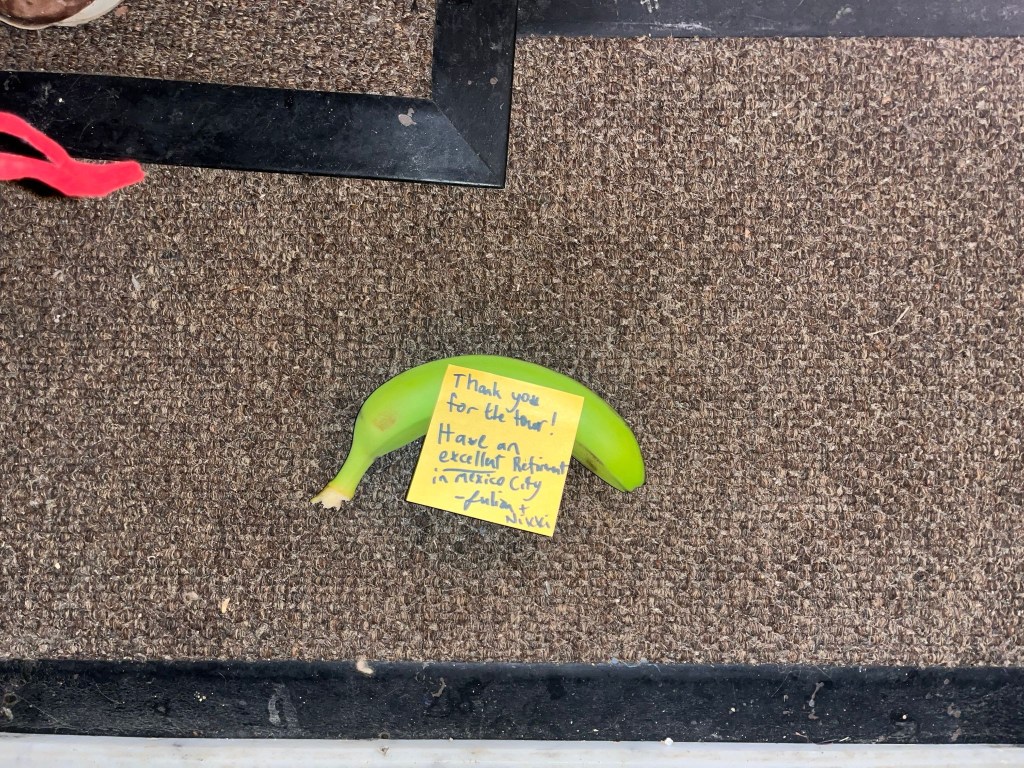
A Fastidious Belarusian (February 3 2026)

In which danger is underfoot. 

Neither of us robbed the other. 

We easily could have. 

We met in the dark recesses of the internet. I expected him to bring the device to the bank where we were meeting. It seemed a logical place for us to exchange the goods. I had enough cash on me to complete the swap. We should at least be in the ATM vestibule, with cameras to ensure our safety. 

On arrival, he lacked the merchandise. Told me we needed to walk to his apartment, 3 minutes from the bank. Aware of the potential danger, I entered first the aluminum cage of his elevator and then his apartment. 

He had the immaculate house of a subtly nefarious weapons expert. He showed me the two boxes: not just the device box, but the shipping box, too. The item, unboxed, sat still nearby. He diligently showed me step by step how to use its key functions. 

By the end I even believed him when he said that his new model – which he bought for four times the price he was selling this one to me – doesn’t satisfy him any better than this old one. 

At the end, I packed up the device and handed him the cash. He offered me an extra piece of bubblewrap to protect it. 

But I forgot one key piece. While standing near the elevator, he popped out of his apartment, waving it with a knowing smile and laugh. 

I will almost certainly never see this man again. But for a moment, we were friends. Co-conspirators, even. 

I never learned his name. 

And that, my friends, is how I acquired a robot vacuum. 

Jennifer and the Fridge (Feb 2 2026)

In which community helps carry the weight. 

The last time Nikki rode in the trunk of a car, we were hitchhiking through central Germany. This time, it’s to keep the fridge upright. 

We found Jennifer through facebook marketplace. She posted a mini fridge for $55. When we arrive, she explains: “I originally posted it for $90,” she says, “and there was a bidding war.” 

She says this as though it clarifies how we got here when in reality it only muddles my understanding. 

Jennifer asks for help carrying her trunk downstairs. Nikki obliges; I carry the fridge. When we get to the bottom, Jennifer offers to drive us to the subway instead. We heartily agree. 

Forty-five minutes later we’re stuck in traffic behind school buses with Hebrew letters on the side, all doing their daily rounds despite it being Sunday. Jennifer tells us about her life and dreams: 

  • She always wanted to live in a loft apartment that doubles as an arts space. Today she moves her stuff out of someone else’s arts loft. She’s not making much art these days. 
  • She lived for a while in rural northern California, managing a “farm” and “driving hash around”. 
  • She raised her son by herself. He’s sixteen now and “I homeschooled him myself” for five years. When I ask for details, she says “More like unschooled. But hanging around me is a whole lot of learning”. 

As Jennifer drives us down [name] street in Bushwick, she points out all the Hassidic jews nearby. “That hat probably costs $3000,” she says, and “Don’t do business with people who say ‘more or less…’” 

“Good for you,” Jennifer says upon learning I’ve bought my own apartment. “Do ya mind if I ask what you do for work?” 

I pass this question to Nikki. 

“He’s a clown school dropout,” Nikki says. “And I am a bioweapons expert.” 

“Modern day hippies.” 

— 

We only end up carrying the fridge down two flights of stairs, up two flights of stairs, and down one avenue block (those are the long ones). We stop five times. Had Jennifer not driven us, the carrying itself would have taken us an hour. Instead, we received a tour of Bushwick. 

On the final stretch, Nikki pauses a few times for grip strength issues. Her strength itself is just fine: it’s a problem of her finger strength giving out. (Fun fact: grip strength is the most sexually dimorphic trait.) Two high school boys walk past us. They look for a bit too long, clearly demonstrating curiosity. After they pass, Nikki says “I’m thinking about asking someone for help carrying this to the light.” 

Six months ago, Nikki was lifting weights at a gym in Reno when she realized she couldn’t re-rack her weights (due not to a strength issue but their height). She flagged down some men in the gym, only realizing after asking that they were standing around chatting because they were firemen called in for something job-related. They ribbed each other about who was going to help her, then clearly enjoyed being useful. 

So far, we’ve lived in New York for 4 days. I look forward to the day when Nikki asks the passing teens immediately. I look forward to the day when I do too. Because we helped carry Jennifer’s trunk downstairs. That’s what New Yorkers do. 

Jennifer has always wanted to live in a loft apartment. And today she is moving out of her arts space. 

We found her through facebook marketplace. She posted a mini fridge for $55. When I messaged her, she said “First person to confirm they can pick it up at 3:30pm gets it!” I immediately texted back “Confirmed: I can do 3:30. Where is it?” 

En route, I tell her we’d love for the fridge to be at the ground floor. “You mentioned you could bring it down the stairs. I’d appreciate that.” She replied: “No. I mentioned i am strong enough to.  You will need to carry it down.” 

When we arrive, feelings are slightly tense, presumably because of the recent request-rejection. 

My partner wonders aloud whether people who feel compelled ot make art do so because they have something they need to communicate that can’t be easily communicated with language. 

I do think many of them feel unheard. 

Going Places (Jan 28 2026) 

In which Our Hero voyages through space and time

Theo works nights at the front desk of the only hotel in this small French town. He works days at the car dealership, cleaning cars. He also works days on his talent management company. He wants to build the ROC Nation of France. He is 23 years old and wants to retire by 40. He prefers the American work ethic to the French one. I tell him to make sure to increase his hourly wage, not merely his number of hours worked. 

“You sleep when you can.” 

The businessman in the neighboring airplane seat says he lives his life out of suitcases, in identical rooms in identical towns. He changes time zones frequently: today Munich, tomorrow Mumbai. After years of struggle, he gave up on circadian rhythms. He sleeps when he sleeps and works when awake. One day, maybe he’ll have a partner. I wonder how old he is. 

Ilian is 21 years old, on an airplane for the first time. He’s snapping pictures out the window as the plane lifts off, and sets his phone to record video when he’s sleeping. “Comme un gros oiseau”, he says. Today he goes to Iceland. Next year, to Switzerland. Also on his list: Japan. I tell him Japanese pork was my surprising highlight of the cuisine. He doesn’t eat pork. “You’re Jewish?” I ask. His eyes widen in what looks to me like repulsion. “Muslim,” he corrects. He shares with me a breadstick he brought for the trip. We exchange phone numbers. When I return to Paris, we’ll go to a museum. Maybe one day I’ll tell him I was raised Jewish. 

— 

Somehow I became 32. I don’t remember 31 from 30. I can’t parse 29 from 28. I suddenly understand why my father takes a moment to isolate what year an event happened. “It was nineteen … (pause) eighty … (pause again) seven,” he’ll say, and then be proud he pinned it down. 

Six years ago I didn’t want kids. Five years ago I didn’t want a life partner. Four years ago I started taking exogenous sex hormones. Three years ago I flew to Australia to escape heartbreak. Two years ago I met my now-partner. One year ago I still lived in a van. 

Tomorrow, I buy a home. 

And the day after? 

Mugged in a Crowd

On a muggy New York summer afternoon, only One Man is fool enough to wear a sweater. He’s attractive in a grungy, Brooklyn sort of way as He leans against a lamppost, cool and calm despite the summer heat. I’m walking south only a few blocks from Times Square when He locks eyes with me. He springs to attention. His opening line: “Give me money, Gypsy.”

There are twenty people within arm’s reach, yet I’m suddenly alone. I’ve never before been called a gypsy, and while I don’t know its associations I suspect it’s intended aggressively. I mutter something noncommittal. His face looms closer to mine: “Give me money for the holocaust, Gypsy.” His sentence betrays a lack of historical understanding, yet I suspect this fact irrelevant to our circumstance.

When I had first spotted Him leaning against the lamppost, I had clocked the precisely-styled single braid dangling beside His head as attractive. Now, I see it more like a distraction on the end of a spear.

I say something that equates to “leave me alone”. The words I choose are imprecise and confused. I only slept 30 minutes last night. But my words, like His, communicate mainly in tone and posture.

“Give me five dollars,” He elaborates. “Give me five dollars for the holocaust!”

I tell him I don’t carry cash.

He’s angry I wasted His time. His right arm pulls back, then shoots forward: a punch. I instinctively pull back my right side, meeting His force with less resistance.

A few New Yorkers turn and comment. It’s not every day you see violence in vivo. Yet no one does anything. Why? Maybe because there’s nothing to do. We could call the police and wait for them to arrest This Fellow, but what would that accomplish? The best argument I can imagine is akin to “it’s your civic duty to get someone like this off the street”. But if that’s true, then why am I the only person I ever see picking up litter as they pass it in Central Park?

Growing up, angry kids told me on at least three separate occasions that one day someone was gonna punch me in the face. I’m now 30 years old and this prediction has not come true. Somehow I think this altercation doesn’t count.

Five minutes later, I arrive to my afternoon date. I tell her this story. She says I was mugged. I agree: it was at least an attempted mugging.

His punch left a bruise, but I’m more struck by my nonchalance. Still now, a day later, I don’t feel afraid. At no point – not even now – was I concerned for my safety. Maybe I deeply understood This Guy. Maybe I knew I’d be fine. Maybe I knew this to be the cost of engaging. Most New Yorkers avoid eye contact with strangers; I’ll meet the eyes of anyone equally bold.

I wish Colin Jost’s memoir had made me want to punch him in the face…

because then at least it would have made me feel.

[Context: Colin Jost hosts the “Weekend Update” feature on Saturday Night Live, was a former head writer on that same show, is currently engaged to Scarlett Johannson, and recently published a memoir entitled “A Very Punchable Face.”]

Our society tends to idolize the successful. That’s glaringly obvious, not profound, so here’s the importance: what do you mean when you say “successful”? Because looking at his life from the outside, one could accurately say ” Colin Jost is successful” in the standard American way. But dear lord, does he have an inner life at all, let alone a rich one?

You’re not supposed to speculate about someone’s inner life based on observed behavior (thanks, Scott Adams (creator of Dilbert)), but a memoir typically dives into the psyche of the author, articulates what it’s like to be them, and helps you come out the other side with some sort of emotional connection. No, not every memoir does that. Some are just stories of amusing anecdotes that the author has strung together for want of an additional platform to be heard… And that’s the problem.

Here: let me give you an example:

  • Let’s say you were dating Time’s Sexiest Woman Alive 2006 & 2013 (the first woman ever to win the award twice).
  • And Jimmy Buffett once saved you from drowning.
  • And your mother was a firefighter on the ground when the second tower collapsed on 9/11.

And you strung those stories together. Shouldn’t it have emotional appeal?

It’s like the only emotionality I felt in the whole book was that one specific section about 9/11, because it was sufficiently gory and scary and intense and Big to overcome any blockers that Colin had put up… not because it had any human emotion whatsoever.

I teared up during that section for the denotative facts, despite Colin’s method of telling it, not because of it. I’ve overheard conversations on the street that have turned my head with more emotionally-evocative lines. It’s like Colin wrote the equivalent of a Michael Bay anecdote when he should have written a Woody Allen (i.e. something that Feels).

I don’t mean to insult Colin Jost; he seems like a nice person (and may different priorities than me), but to my taste, niceness only gets you so far. I’d rather someone were an authentic, direct, honest asshole than a pretentious nice dude (Colin’s form of “nice” seems like the one frequently found in the Catholic church, and one which I’m not even sure it’s accurate to call “nice” because it’s closer to “polite” and this politeness very frequently actually leads to the opposite of being “nice” or “kind”, such as when he’s about to drown but doesn’t want to disturb another group’s nearby surfing trip so he covers up the fact that he’s nearly drowning, and what if he actually drowned? wouldn’t that be like the least nice thing to do—to demolish someone’s family surfing trip with the sight of your bloated corpse? (a true reference from the book; the family on the surfing trip was Jimmy Buffett’s.)).

I’m deeply saddened to have read a book that includes a memoir about “Parisian teens throwing tomatoes at me, then I throw a bicycle over the fence that surrounds the Musée d’Orsay, and then I hide from the French cops in my hotel room with Scarlett Johansson” (paraphrase) and have the whole thing read precisely as emotionally bland as that summary that I just wrote in this here sentence. Go read that sentence again, then read the relevant section (the antepenultimate chapter, “Tomato, Potato”), and I’ll be damned if this two-bit summary doesn’t have about the same amount of emotional depth, of human connection, of evocative, stomach-pulling impact as the original. And that’s sad. That’s sad. That’s really, really sad. It’s sad in the sort of way I can’t share in this review because it’s the sort of sad that you feel when you look at an old person who’s drunk their life away and ask “what if you had learned to cope properly when you were young?”. It’s sad in the sort of way that it’s sad that such a large section of now and future human populations will never, ever, ever look to the heavens and see the Milky Way or stars. It’s sad in a profoundly sad way that parallels my sadness at my inability to communicate directly to you just how sad this sadness is, and how it reminds me that we, as individual humans who do not share experiences, are at our cores forever alone.

Listen:

We can train a person to do repeated, fancy tricks at expert levels to satisfy specific societal needs. And that’s nice. Sure. It’s a pretty cool skill. But it also feels fundamentally disrespectful of what it is to be human. It misses out on really existing in this universe, a universe that has been thusfar insufficiently explored. It ignores what it feels like to have someone lack agency because they’re so scared they can’t look inwardly at themselves to see the fetters that bind.

Colin Jost’s memoir made me first and foremost sad: sad for Catholics, sad for people who grow up to hate their emotions/feelings/explorations of self, sad for people taught to trust some external force instead of their instincts, and sad for myself because I’m sure there are areas of myself I have insufficiently explored due to some of that good ol’ inter-generational trauma. Jost’s memoir isn’t even intending to be a sad book; that’s the sad part: it’s meant to make you laugh.  

There’s a point in my stomach—to the left and below my sternum—where my Emotional Authenticity lives (no joke). There’s no special sauce or divinity or whatnot to that place; it’s simply a spot that helps me feel myself. When I notice that spot, I connect with some aspect that’s much closer to Oneness or Honesty or God or Accuracy or Freedom or Truth than I usually feel. And that specific spot is where I happen to feel it. And I found that spot after going to PTSD therapy for a few months, then finding a specific shamanistic ritual, and then spending hours and hours and hours and hours over years and years feeling Lonely and Grieving and Crying In The Shower (and the like). And that, my friends, is what we call The Work. It’s The Work of being human, of stripping away what we think is true and getting closer to what’s actually, truly, truly true. It’s learning about Me and You and Reality and What Exists and Where We Are and Where We’re Going and all sorts of other capital activities. That’s My Quest and I’m damn proud of it. And I’m glad different people are on different quests but I still can’t in good conscience read a book like Colin’s—even one where he implies he likes his life—without thinking “I don’t think you know what Life is.”.

An alternate option: maybe Colin is right. Maybe the Right Job is the one where he laughs every day for fifteen years. Where he fritters away the time in a way that feels satisfying but that (to me, at least) seems sad. Maybe the Right Choice for Colin is having a plurality of his memoir-worthy adult stories start with “I was really drunk…” (paraphrase) and end with the moral “sometimes I do stupid things and am clearly still traumatized by my upbringing, family history/background, (former) religion, etc.” (again, paraphrase, but this moral it’s the basic message of like every story, from the time he almost drowned because he was to unwilling to admit he had gotten himself in a spot of trouble while surfing; to the time when he broke his hand because he was unwilling to admit his own physical inability to punch with proper form; to the time he shit his pants; to the time he was too unwilling to cause a fuss when hosting the Emmy’s and therefore hosted what by all accounts (including his own) was a boring and poorly-done Emmy’s (entitled “Worst Emmys Ever”)). My only respite (glint of hope?) from these morals is that he’s consistently seeing problems in his former behavior and improving them, which is the point and I’m glad he’s doing it, but he’s also missing the point: the point of all these morals is not the denotative ‘I made this mistake; look at me’ learning he seems to think it is (and which would prompt some growth), but the underlying principles and structures of behavior/thinking that create the same mistakes over and over and over again. Colin, if you’re reading this: no amount of funny story or chuckle of ‘Oh, I’m always like that’ will actually arrive you at the necessary honest self-viewing for you to heal and grow into a bigger, more satisfying and more accurate life. Look at Dennis Rodman and Jim Carrey as examples. Or Patton Oswalt or Dave Chappelle. It’s the difference between living a life and killing time, and I don’t know if you know you’ve been killing time.

There’s a sadness in the heart of many most comedians, myself included. I just analyze it. I poke it. I approach it and really, truly try to understand it. I use it to ask how society works and why I—and the world—am the way I am. I wonder what happened to me and dive in when I’m afraid. (Except when I don’t dive in because I’m afraid… which we all do from time to time, and The Work seeks to minimize.). There’s a Scientific Method that’s respectable from pretty much everybody in this capacity and it seems like Colin Jost has just never done it. He’s worked and worked and worked to achieve the things he wanted, but can he articulate why? What’s the point of having a national desk in front of millions of people if you don’t have a purpose to achieve with it? If there’s no point, why do it at all? For a Harvard dude, he’s shockingly surface-level. Compare him to Conan, another fellow SNL writer and Harvard Lampooner, and you see night and day. Conan cares about Comedy itself, about Making People Laugh, about Entertainment (all Big Things)… Colin cared about getting a job, then about getting on SNL, and then about hosting Weekend Update (a bigger, better–his dream job)…  that’s the difference: If you care for The Art, you’ll find ways to achieve it; if you care for your job, you’ll always fall flat. (This comparison is unfortunately a tad reductionist; these are my impressions from reading Colin’s memoir and listening to a huge amount of Conan’s podcast; I believe they’re accurate, but necessarily lacking nuance (because I, unfortunately, can’t observe their inner life).)

Conan still has, to this day, Howard Stern’s favorite interview because it’s one in which Conan speaks about his depression, questions how his comedy functions in relation to his depression, and voices his worries about whether medicating himself would make him less funny. Colin can’t do that… at least I think he can’t, because a memoir is itself like the most emotionally evocative art form (short of nude self-portrait), and Colin 100% completely missed the emotional mark. (If he can do that, it makes me concerned why he didn’t here: he would have had to decide that actually honestly opening up in our current age of technology and social movements would be worse—far worse—than just publishing a memoir that is the emotional equivalent of eating popcorn. But I don’t think that was Colin’s intent: throughout the book I’m continually berated by the perception that he does really truly keep trying to do Big things; he wants to do Important things that Matter, etc., and that leads me to the conclusion that if he knew how to be emotionally open he would, because he’d see the connection between “great memoir” and “emotional connection” that’s so patently obvious). I’m reminded of David Foster Wallace’s review “How Tracy Austin broke my heart” for the similarities in what Jost’s memoir implies about the state of both himself and our current world:

It’s really, truly, profoundly sad that someone who our society dubs “successful” can have such a vapid existence. Is this really the best of our generation? A top comedian—the one hosting SNL Weekend Update and head writing for what is still our nation’s (the world’s?) biggest comedy broadcast—completely lacks in internal substance. That’s. Really. Sad. It implies that the vapidity of everyday life has infested comedy, which is itself sad, and then that sadness globs onto comedy itself, so we’re left with comedy now becoming sad, which is sad turtles all the sad way sad down, which is even sadder than the sad fact that me sad-reading this sad guy’s sad memoir about his “comedy” life where he “comedy” stars on a “successful” show and then “successfully” becomes “successfully” engaged to “successful” Scarlett Johansson is not successful nor comedy at all but just another terrible and heartbreaking example of how growing up Catholic traumatizes someone.

But it’s not exactly precisely that, because Conan O’Brien also grew up Catholic, and look how he turned out… Still traumatized, yes, but so much more self-aware (and so much more  emotionally vulnerable). So what it is it? Is it the family stifling? Is it the lack of real, intense world challenges (because the worst that Colin ever had to go through is some time spent unsure how he’ll pay rent in New York City? Is it instead that he has actually suffered in real ways (which is probably, statistically true, if only based on his age and the existence of his 9/11 story) and simply lacks the self-examination and Work to articulate them well and/or feels a terrible, crippling fear that honestly sharing real stories with readers (instead of, say, “the time I pooped my pants” (real story; paraphrased title)) will somehow be bad for his life/career, not good?

While the unexamined life may still be worth living, the inauthentic or dishonest or inaccurate or lying life is worse than nothing because we’re social animals and life is a team sport. Whether you’re a cog in your own wheel or you’re a cog in someone else’s or you’re just some tiny ant carrying a boulder up a Great Big Cosmic Hill every day so you can let it roll down again to repeat your Quest, you’ve got to look at the world and say what it is because if you don’t, how will we know? (And also because the truth you seek is probably parallel to one you’re withholding from others.)

There’s one great moment of self-awareness in this book that jumps out as insightful and clever and aware (and which moment on retrospect is really just an average level of awareness, but its being surrounded by non-awareness makes it seem more aware, much like how one would observe a diamond to be shinier if said diamond were surrounded by horse poop). (Not that the book is horse poop; the book is merely awareness horse poop.):

It’s the moment when Colin says, in a footnote, “I want to make it very clear that this list of notes [requests for changes to upcoming sketches] provided to the SNL staff by NBC censors is not exclusively notes they gave to me because I don’t want people to read this and think I’m racist/sexist/homophobic/[other similar categories] and therefore to ‘cancel’ me.” (paraphrase). That’s it. That’s our big ol’ nugget of self-awareness, and it’s not even self awareness qua self awareness per se; it’s only self-awareness because you read it and think “there’s a guy who sees where he fits with respect to one specific national trend that clearly (and justifiably) frightens him”, but we don’t think, “there’s a guy who knows something about Himself or Society or Profundity or Existence”; it’s merely “this guy sees a thing and is afraid”, which might be the single simplest emotional state for a human an animal of any kind. That’s the only emotion that comes across in this book: Fear. *Sigh*. Fear of authenticity, fear of emotion, fear of society, fear of loss… The big one-two punch, blockbuster ending (the epilogue; the last pages of the book; the final point Colin leaves the reader with…) is Colin saying “Maybe I’ll leave SNL someday because I want to dive deep into one topic instead of staying shallow in many by doing standup/sketches/movies all at once… and maybe I won’t” (paraphrase). Wow. *Sigh Again*. That’s not an ending; that’s a waffle. That’s worse than the fact that your last chapter is “this one time bugs planted eggs in my leg” (paraphrase) instead of, say, something that matters.

Look, kid, Colin, dude: could you please just lock yourself in a room and think? Maybe draw a bath and talk to yourself aloud. Try sitting alone and being uncomfortable. (Not the punish-yourself Catholic Church uncomfortable, but the explore-yourself uncomfortable of recovering from the Catholic Church.) Set aside a day to be just with yourself: no internet, no food, no people, no alcohol. (Fasting helps most people introspect: I’d suggest only drinking water on this Colin-Internal day.) Ask questions. Wait for answers. Ask more questions. Keep wondering. And if you start crying, let yourself cry (because that’s what you seriously, clearly, really need). Feel man, just feel, and grieve for your past. Because reading your book made me so, so sad for the lack of grieving you’ve done. I’ve thought a few times about Steve Martin while writing this review; his memoir Born Standing Up clearly shows self-reflection: there’s one section where he says “I’m going to give you the juicy bits that you want now, because that’s something that has to happen in a memoir” (paraphrase), and then he gives us some juicy bits, and then he says “I’m not going to tell you any more because those are mine” (paraphrase). It’s a beautiful understanding of The Memoir, of its Art and Function and Place and Form, and it clearly shows Steve knows how he wants to go about the world. This is a man who performed to sold out stadia, then dropped it entirely to become a top-billing actor, and then dropped that to, to switch to the… banjo? Because playing the banjo is right for him.

Colin, homie, ol’ buddy ol pal: I don’t get the impression that you know what you want. And knowing what you—yes, you, Colin Jost—want is the single most important question you will ever answer. And not knowing it—not giving it the depth and curiosity it deserves—will leave you and your descendants as hollow shells. You’ll drink on special occasions “because that’s what people do”. You’ll constantly wonder if there’s More. (There is.) You’ll blip into the comedy sphere before fading away, never to Matter because you weren’t relatable, because: To be relatable an audience must connect emotionally with you, and for us to connect with you, you must be available, and to become available, you must first feel your emotions, and then—only then—can you open yourself up to the world. Emotional awareness is nigh step #1 to Seeing The World and Communicating What’s True. (At least it was for me: Emotional Awareness, and, well, duh, Logic. (Also Introspection and Patience and Slowness and speed. And Science and Experiment and…)

I feel drained after writing that bit. This whole review feels really intense, like it’s a Great Big Commentary on more than my feelings about one book: it’s A Great Big Commentary on America and Religion and Isolation and Loneliness and Trust and Censorship and Fear and Shame as seen through American Comedy. Also because Scarlett Johannsen is apparently engaged to Colin Jost (of which interesting details are impressively avoided in a shockingly un-self aware way—so impressively-poorly-avoided that I was curious for a moment whether it was intended as a satire but I don’t think anyone could pull off that level of satire except for, say, Steve Martin if his choice to devote his life to the banjo was itself a big Andy Kaufman-esque practical joke on the world, but I don’t think people actually do that in the world, well except for Andy Kaufman and he’s almost certainly dead) and I find that relationship between ScarJo and ColJo particularly jarring because she was one of the first women I ever swooned for (and therefore the woman after whom I named my highschool tennis rackets), and to see my perception of her (emotionally accessible, malleable, and aware) with my perception of him (basically, like, the opposite…) is like watching clay feet stand on top of feet that I didn’t know were clay because I thought they were just like normal feet but it turns out they’re some sort of leprosied clay, and now both of their pair of deformed, taloned hands try to touch the sky but don’t realize they’re in the middle of a film shoot in the desert that’s actually just a series of bright lights oven-baking clay, and when those lights turn off the pair crumbles to dust.

Perhaps I’m reading too much into this, but damn it Colin, your book makes me sad. I’m sad for you, Colin, and I want to help.

[Actually, though: after a half-decade of suffering through an old PTSD, I found two specific modes of therapy that finally helped. I’d be happy to share them with anyone who wants; reach out anytime: let’s heal the wound world.]