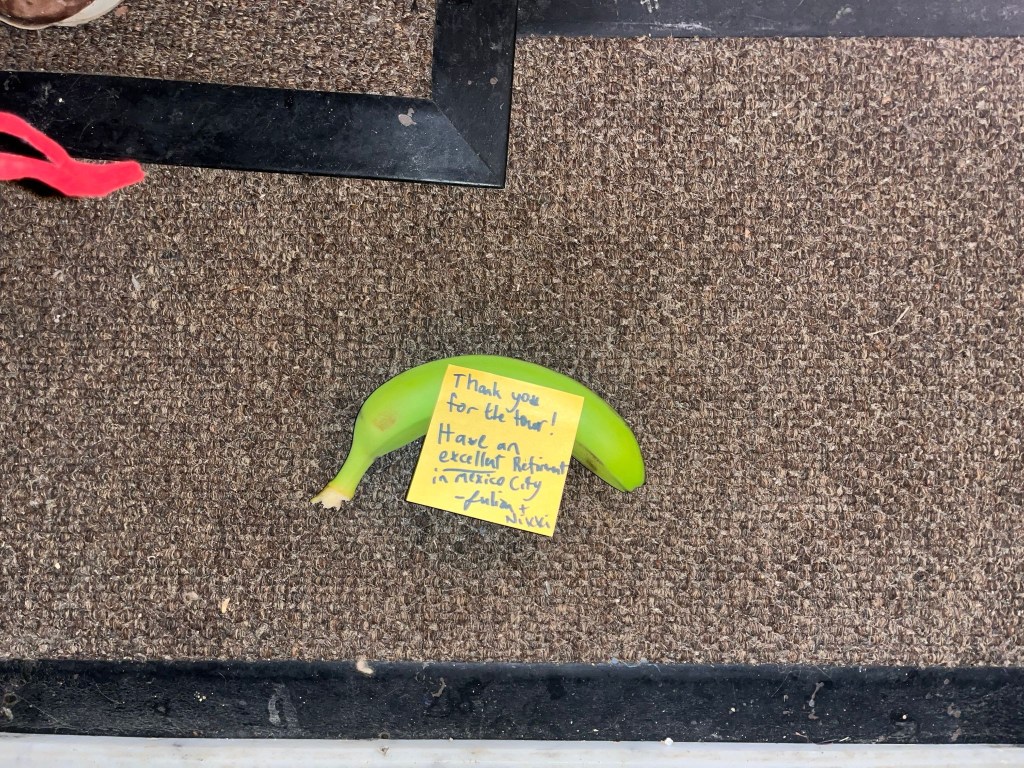
Clown School Break Day 17: Do or Do; There Is No Cry

In which Our Hero discovers discipline. 

One key internalization from this past weekend:
How you feel doesn’t have to dictate how you act.

This is one of clown school’s most important lessons.
You’re tired? Headache? Angry? Upset? Depressed?
Irrelevant. Curtain’s up in five. You perform.

The difference between a good standup and a great standup isn’t the height of their best sets — it’s the quality of their worst ones. The question isn’t “How are you feeling?” but “Can you still deliver?”

Clown school drills this into you.
Every day you step on stage.
Every day you play the game.
Every day you work. Show up. Try. Fail. Try again.
It’s consistency as craft.

A clown has to be able to turn it on — sometimes more than any other performer.

This came up today with a woman I met in the O’Hare waiting area. She’s a professional Twitch streamer trying to stick to a schedule, even on the days she doesn’t want to go live.
But here’s the twist: those reluctant days, she says, are often her best streams.

I don’t know if that’s true for me — whether my best work surfaces when I least want to make it.
But I do know this: I still make it.

Because success, more than anything else, is about behavior, not feelings.

Clown School Break Day 16: Cooperative Games

In which Our Hero remembers the audience and the performer are on the same team.

Today I didn’t buy a painting.

I could have.
There are worlds in which I walk out of that studio holding a canvas, or at least a print. I like his work. It’s good enough that I’d happily see it on my wall. I also, frankly, think this guy could be very successful. And while I don’t know anything about investing in art, I do know that he does good work. 

Instead of buying, I did something arguably more valuable: I gave him one mental shift that might change the way he sells forever (hard-won after nine years of being a creative freelancer myself). 

The shift was this:

  • You and the buyer are on the same team, trying to get to the sale together.

Most artists don’t think that way. They imagine selling as hoodwinking, convincing, persuading. Commerce as a low-grade con.

But when I exchange $20 for a meal, two true things are happening at once:

  • I am saying, “I’d rather have this meal than this $20.”
  • The seller is saying, “I’d rather have this $20 than this meal.”

We both win. That’s the point.

If someone wanders into your studio already 50% likely to buy your painting, wouldn’t you both be better off if a sale happens?

That’s what my friend was missing. He felt like he was pushing against the customer, trying to “get them” to buy, and he hated it. Instead, he should walk next to them, shoulder to shoulder, helping the buyer cross the line they already half-want to cross.

Sales, at least for an honest artist, is a cooperative game.

Clowning is the same game

This is also the part that many performing artists (including clowns) forget: the audience wants you to succeed.

When we audience members sit down for standup, for a play, for a clown show, we’re not secretly hoping it’s terrible so we can be right about humanity’s decline. We might predict it will be bad, but given the choice between:

  • “I knew it would suck,” and
    “It blew my expectations out of the water,”

almost everyone would rather be wrong and delighted.

Even the pessimists would rather go home saying, “Honestly, it was great.”

So performance is also a cooperative game:

  • As the clown, you are the leader.
  • The audience is your team.
  • The “sale” you’re closing together is shared pleasure.

You’re not dragging them, hostage-style, toward your weird art. You’re inviting them into something – pleasure – they already came to find.

This, unfortunately, is not my default setting.

Competitive games vs cooperative games

I am more experienced with competitive games than cooperative ones. Poker, for instance, is the opposite:

  • There, the goal is to hide.
  • To show nothing.
  • To give away as little information as possible while extracting as much value as possible.

Clowning is about the inverse:

  • Openness instead of secrecy.
  • Generosity instead of extraction.
  • “Let’s enjoy this together” instead of “Let me get the best of you.”

One of the purposes of clown school (for me) is to re-train this reflex. To make cooperation feel as natural as competition.

Right now, the questions I’m wrestling with include:

  1. How do I lead the team gently?
    Guide the audience without shoving, nudge without bullying, care for each teammate without over-focusing on any one.
  2. How do I actually lead, instead of hiding behind stronger personalities?
    Be the tip of the spear, not the person comfortably in the second row.
  3. When I’m with a partner on stage, how do I treat them as a collaborator instead of a combatant?
    Remember that “winning” is making the scene sing, and that often occurs when you’re playing harmoniously. 
  4. How do I remain open when uncomfortable?
    Oftentimes, I’m shutting down. And that… is not… helpful. 😦 

These are not just stage problems. They’re life problems. Which brings us to the cocktail party.

When I forgot we were on the same team

At a cocktail party today, I met a few people I genuinely liked. Smart, funny, curious. The kind of people I’d happily see again.

They asked about my relationship status. I told them a technically-true (and engaging), but far-more-boring version.

Here’s what I told them: 

In college, I was interested in a girl who was dating a woman. A friend told me she only dated women, so I filed that away as “ah well, not for me.”

Ten years later, we reconnected. It turned out my friend had been wrong:

  • She does not, in fact, only date women.

And here’s the part I didn’t share – not because it’s shameful, but because it’s intimate, and intimacy is precisely what I tend to withhold when I get scared: 

  • At the time of meeting her, I was taking exogenous estrogen. I had grown breasts. My emotional life was much closer to that of a woman than a man. 

So even if she had only dated women, I still might have qualified.

That’s the good bit. The twist ending. The painting on the wall I could have offered.

Instead, I hid it. I offered the flat version. And therefore, the next bit that I added – when I later tried to connect – didn’t land. I’d already collapsed into myself, ending the cooperative game. 

I protected information, staying “safe”.
But they weren’t my opponents. They were potential teammates. We were building something delightful together. And that collapse — the retreat instead of the play — is exactly the reflex I’m trying to rewire.

(To be clear, the issue wasn’t that I “should have” told strangers something deeply personal. It’s that I noticed myself collapsing inward even though both they and I wanted to play, to connect, to stay in the cooperative game.)

The update

So: today I didn’t buy a painting.
I also didn’t honestly sell myself.

In both cases, the correction is the same:

  • Be in situations where we’re on the same side. 
  • Remember we’re on the same side.
  • Act like the game is cooperative.
  • Offer the real story, not the safe one.

When I become excellent at those in daily life, I’ll be a better clown.
And when I become a better clown, maybe I’ll finally remember, in the moment, that we all walked into the room wanting the same thing:To leave having created shared pleasure.
And in that pleasure, created Value.

Clown School Break Day 15: The Lightness Advantage

In which Our Hero learns that ease is its own form of status.

The skills of upper-class social engagement and the skills of clowning: shockingly similar.

Can you keep it light—even when the topic isn’t?
Can you remember the game? That this is a game. That life is a game. And the more you remember it’s a game, the less you’ll feel poked. The less you feel poked, the less likely you’ll commit a faux pas.

When meeting someone new:
Can you stay present? Open? Emotionally available? Can you find pleasure in what they’re saying, find pleasure in yourself, and entertain yourself while entertaining them?
Do you make eye contact instead of studying the floor or the ceiling?

Can you jump to the new game quickly?
Roll with the punches without letting irritation leak? Or if you do get irritated, can you metabolize it quietly so others don’t feel it?

In short: are you easy?

Even shorter: be social soy sauce: enhancing whatever flavor is already present.
Do not be social tofu (merely a warm body), nor wasabi (adding too much kick), and certainly not ginger (an entirely unrelated taste altogether).

Some people don’t need to be easy. They have structural reasons to be included—money, skills, status, connections. Their mere existence provides value.

If you have those advantages, you can afford a little heaviness.

But if you lack them, ease becomes an important asset.

I met someone today who was surprised to learn a fairly large fact about her husband.

I get that.
It’s also foreign to me.

When one (A) has enough happening that there’s no need to narrate every detail, and (B) is so deeply present with others when actually together, the result is fewer facts shared and more connection felt. This is an instance of putting the text on the game.

Perhaps these people live such driven, full lives that they don’t need to lean on each other for conversational ballast. They’re satisfied by the things they’re doing. Their overlaps shrink. Their presence expands.

Maybe this is why the skills of social ease and clowning feel so linked for me. I had to learn lightness. I had to learn the game. I had to learn to entertain myself, then others, and to orient toward warmth and pleasantness.

Other people don’t always need those skills. They build companies, hire teams, command rooms, confer opportunities. What do I confer? Stories. Emotional resonance. Connection.

I’ve lived as a writer for the last decade. I’ve flown around the world, lived in a van, written books, attended clown school, played competitive pickleball, lived as an œstrogen-powered life form. These things made me interesting, but they did not give me structural advantages to hand out.

What I offer is not leverage. It’s wisdom. Presence. Delight.

So it sure as hell helps if I’m light.

Airy.
Gentle.
Easy.
Fun.
Funny.
Generous.
Kind.

This makes it possible to add me to your car, to your dinner, to your team. It makes me someone who lightens your load, even when you carry me on your shoulders.

But when I’m heavy?

Well.

🎈

Clown School Break Day 13: Revealing my Hand

In which Our Hero finally plays the writing game, not merely performs the genre.

Yesterday’s post set a record in responses. So I found myself asking:

Why did people like it?

If we assume it wasn’t merely well-written form, it likely was one of these three traits:

  1. I wrote about two games I know extremely well. (I played poker as a method of money-making previously, in the pre-solver Jurassic period.)
  2. I compared two activities everyone recognizes, even if only through cultural osmosis. (Everyone knows what a clown is. Everyone knows what poker looks like.)
  3. I accidentally wandered into a space my sister claims is my superpower: the philosophy of games.

Two months ago she called to tell me I had a gift.

She’d asked for help diagnosing an unspoken social game at her workplace, and when I broke it down for her, she said:

  • “You could be the expert at this. Not ‘an’ expert — the expert.”

For clarity: philosophy of games ≠ game theory.

I’m not a game theorist and have no ambition to become one. (Though one of my closest friends is probably top hundred in the world at the practical application of game theory.)

Instead, I love:

  1. games
  2. what games do to people
  3. how humans use games
  4. the mechanics and sub-mechanics inside games
  5. the social physics that games create
  6. the playing of games
  7. fun

This has always been true. As a kid, I invented strategies in schoolyard games so effective that fellow students rewrote the rules the next day. As an adult, I earned second place in the Hoboken Open pickleball tournament, which is exactly as prestigious as it sounds. In college I studied philosophy to understand the rules of our life’s game (hint: start with Aristotle).


But here’s the truth:

Yesterday’s writing, to me, felt bland.
I haven’t been having many fresh clowning insights.
I’m on break from clown school because of a broken foot.
I haven’t been around many clowns — except myself.

So instead of writing about clowning, I jotted down what I thought were painfully obvious observations.

And two people found them profound.
Compelling.
Insightful.

Why?

Clowning offers two simple rules:

  • give the audience what they want, and
  • follow the fun.

One mistake people make is assuming “what they want” means “repeat the product.”
But that’s not it — at least not entirely.
If I reposted yesterday’s essay verbatim, nobody would care.
This exaggerated example makes the point:

The audience doesn’t want the same product.
They want the same emotional experience.
The same arc.
The same sense of discovery.
The same journey.

Maybe one reader liked my emotional growth.
Maybe another liked the simple clarity around two games they’d only ever observed from the outside.
Maybe someone else just enjoyed seeing me think.

Writers know this:
readers fall in love not with the thing but with the transformation.

Van Gogh didn’t sell paintings until his letters were published.
Until people could see his suffering.
Until his bed wasn’t just a bed but the first possession of a poor, unraveling man.
Stories create meaning.
Meaning creates attachment.

And that’s why
Starting today, I’m going to include writing about hormones.


Yesterday I talked for an hour with my parents about my four-year experience taking œstrogen.
It was medical, emotional, biological, and sociopolitical.
It reshaped my values, which reshaped the games I chose to play.
It rewired my physical and emotional landscape.
It altered my comfort with strangers, my sense of risk, and my appetite for play.

I was on œstrogen when I decided to go to clown school.
I was back on my natural testosterone when I actually started the school year.

That contrast was… intense.

My desire to play poker changed with my hormonal profile.
My social ease changed too.

On œstrogen, my fluency with strangers soared: top decile of my life.
Now that the ease has dropped, I’m having to relearn it.
And with that comes fear.
Not melodramatic fear. More like the fear of an aging driver noticing their reaction time isn’t what it used to be:

  • “I used to be good at this. What if I’m not anymore?”

But here’s the secret about fear:
It’s freezing.
But it’s also your friend.
If you don’t embrace it and step through it,
You’ll always be under its power.

This was as true yesterday — staring down an A6s decision on a 4-6-7-A-K board facing a river jam — as it is about my long hesitation to share my hormonal story.

In that hand, I should have called.
In this life, I should speak.
Not because you’re entitled to know. You’re not.
None of this is “your business.”
But I chose to be a writer.
Which makes it my business.

Said differently:
I chose this writing game.
Time to stop playing it like a wimp.

Clown School Break Day 12: Poker vs Clown

In which Our Hero manages his emotions (and plays poker because, with a broken foot, what else are you going to do?)

If clowning is about managing your emotions in service of giving pleasure, then poker might actually train part of that muscle. The emotional management is enormous.

Earlier today I lost three spots in a row.
One I misplayed slightly.
Two were just unlucky.

I assumed my strategy wasn’t working.

But it was.

I do this in clowning, too: I try a thing, it doesn’t land, and I immediately abandon it. But that’s rarely the answer. Sometimes you need to push the thing farther. Sometimes you pivot to a different game. But the one thing you don’t need to do is collapse inward and quit. You don’t just give up and take your ball and go home.

Instead, check your fundamentals.

In poker: Is this still a good game? Am I playing well?
In clowning: Have I found the game? Am I playing it?

Yet the two arts couldn’t be more opposite.

Poker is about hiding.
Showing nothing.
No emotion, no tells, no generosity.

Clowning is the opposite: openness, earnestness, authenticity, giving.

Poker is selfishness.
Clowning is generosity.

At one point today I was down $650. I kept playing because I was playing well—and because, in theory, I’d been winning the whole time.

That’s another key difference: poker has theory.
Clowning has only practice.

Poker’s truth reveals itself over hundreds of thousands of hands.
Clowning’s truth reveals itself instantly.

If everyone’s laughing at you at the poker table, you’re the fish.
If everyone’s laughing with you on stage, you’re the clown.

I was also especially open with my family today. That was nice 🙂
Time and place, boys. Time and place 😎

Clown School Break Day 11: Poker?

In which Our Hero hardly knows her. 

I played poker profitably today.

Once my comfort and confidence arrived in, everything clicked. First I made a $10 mistake. Then a $50 mistake. Then I found an edge and optimized the hell out of it. And I ultimately walked away $445 richer.

A poker pro friend, after reviewing one of my hands, put it perfectly:

“This hand is not GTO-approved at all haha, but sounds like you found a spot to hammer.” (“GTO” = game theory optimal)

I like to hammer. It’s fun.

Was this more fun than clowning?

Maybe.

Probably?

When I think back to the times I’ve “succeeded” at clowning — the moments of actually opening myself to the audience — I enjoyed those less than I enjoyed today.

However.

I’m not at clown school for myself. Not really. I’m there to learn (1) to be open, and (2) to play well with others. These are skills I want to develop for other people, not just for me.

And when you zoom out, which is the kinder pursuit: clowning and contributing to others, or playing poker to funnel money into your own pocket?

Clowning, clearly (at least to me). Poker is generally net-negative in pleasure: studies show that in most people the pain of losing outweighs the joy of winning.

But right now? I don’t care.

And that’s… telling.

Maybe it suggests my calling is less likely clowning than a poker-adjacent path. 

When I chose clown school, I was emotionally compelled. Drawn. Obsessed.

I’m still very interested — especially in bouffon next term — but I’m also open to this new signal.

Maybe my sister was right when I first told her I was “choosing between a one-month clown course and the full year.”

She said: “When have you ever committed to a year of anything? But if you did, it would be clown school.”

It would be very funny if I only did part of the year.

I’m such.
A.
Clown.

Clown School Break Day 9: The Missing Signposts

In which Our Hero chuckles that no one is coming to explain anything.

Clown school gives no guideposts.
No emotional map.
No “You’ll feel terrible during Neutral Mask, but it gets better during Melodrama.”
Not even a simple “We beat you down because it makes you better.”

Instead, they teach.
And we endure.

I’m not the first person to go through this course. This version of the school has existed for 25 years; Gaulier has been teaching for 50+. There must be a method behind the madness. So here are my hunches:

1. Presence as pedagogy

Clowning is about now, not before or after.
Emotional signposts would implicitly validate the idea that your current feeling matters, or that suffering is part of some arc.
But in clowning, only the present matters.
You aren’t promised redemption later; you just have to deal with what is.
“I don’t care what else is going on. Find pleasure and share it.”

2. Stress inoculation

Clowning demands emotional manipulation—of yourself and the audience—under pressure.
If you can’t do that while confused, scared, or humiliated, how will you manage when there are thousands (or millions) watching?
Not knowing why you’re doing something is part of the training:
you have to stay open and playful even when you’re lost.
“You’re lost and confused? Time to clown!”

3. A filter, not a cushion

It’s a weeder course.
If you’re not meant for this world, or if the suffering feels unjustifiable, you’ll remove yourself.
Not with an official expulsion—but with exhaustion, frustration, or indifference.
The lack of emotional guidance is part of the sieve.
“I don’t like how intense school is.” “And you think professional theater is for the faint of heart?”

4. An accidental design flaw (or feature)

The teachers are clowns, not pedagogy nerds.
They’re masters at teaching clowning, but not necessarily at building meta-frameworks or emotional scaffolding.
Signposting requires stepping outside the art to label its structure—
which is the opposite of presence.
So maybe the absence of guideposts is deliberate.
Or maybe it’s just what happens when clowns teach.
“🤡”

5. A disrespect for logic

One of the teachers has told me to stop analyzing.
They said it’s not doing me any favors.
That analysis will not lead me to better clowning.
If that’s true… whoops.
<Cue the banana peel>


For what it’s worth, the course is structured brilliantly: Le Jeu → Neutral Mask; Simon Says for weeks; harsh critique without directions.
Are the missing signposts a bug or a feature?
I suspect it doesn’t matter.
Not-knowing is part of the training.

But it’s also part of the suffering.

And maybe that’s the whole point.

Or maybe it’s not.

We’ll probably never know.

Clown School Break Day 8: Selfishness

In which Our Hero… is selfish?

A friend says my attending clown school is selfish.

A second friend concurs.

The second friend, at least, says it without judgment. They think it’s a selfish act, but not necessarily a bad one. (I didn’t ask the first whether “selfish” = “bad,” so I can’t report on their view.)

The second friend is a professional poker player. I asked if studying poker is selfish. They said no. I asked why. They gave reasons like: “it keeps my mind sharp,” “it teaches me skills I use in other areas.” I pointed out that clowning does the same. Just swap “understanding randomness and variance” for “learning to connect with others and bring them pleasure.”

I’m surprised people find clown school selfish. I don’t find it more selfish than acting school, sales training, or learning accounting. Maybe slightly more selfish than learning to be a plumber. Definitely less selfish than being a momentum trader or a poker player.

I get that performers are self-involved. Sometimes self-obsessed. But selfish?

The job of a clown is to bring people pleasure. Joy. Happiness. Are the best in the profession—Jim Carrey, Sacha Baron Cohen, Robin Williams—selfish? That seems unfair.

So what do people actually mean when they say “clown school is selfish”?

They might mean something like:

  1. “Clowning doesn’t contribute much to other people.”
  2. “Julian will get more personal joy out of clown school than he’ll generate for others.”
  3. “Clown school isn’t contributory (either because clowning isn’t, or because clown school won’t lead to clowning).”
  4. “Clown school interferes with more contributory things you could be doing.”

Here’s how these land:

1. “Clowning doesn’t contribute much.”

I’m dismissing this outright as a misunderstanding of what this school teaches. This school teaches how to find pleasure in order to share it. You can believe pleasure is unimportant, but if you believe it matters, clowning is clearly contributory.

2. “You’ll get more out of this than others will.”

This becomes a comment about skill.
If I will always be a bad clown, then yes: clown school would be more self-pleasure than other-pleasure. But that assumes failure as destiny. I’m earnestly trying to learn these skills. I want to be good at play, connection, and generosity. Multiple people—people with no incentive to flatter me—have said clowning seems like a particularly great fit for me. I think so too.

3. “Clown school won’t lead to clowning.”

This is the critique I take most seriously.

My goal isn’t to become a professional clown per se: it’s to become a better performer, a better player, a better connector. I want to learn charisma. I want to learn to bring joy not just onstage but in everyday life. I want to learn to play for the sake of fun rather than optimization. I want to play well with my nephew. I want to play well with future kids of my own.

If I’m truly seeking personal enrichment more than professional clowning, then yes, one could call that “selfish.” But personal enrichment that increases one’s capacity to love, play, and be present seems… not exactly a moral failing.

4. “Is clown school the best use of your time?”

Honestly? I don’t know. A year is long. (Well, seven months of actual school.) But I’m not locked in. Students drop in and out. There’s one course in March I’m particularly excited about. For the rest, I’m open: if more-contributory opportunities appear, I’ll take them. If someone offered me a full-time job tomorrow, I’d consider it. (And, notably, I applied to one recently.)

At the moment, my time is quite unoccupied. I’m writing for one company, and that leaves plenty of space. So: clown school.

I want a family someday. I want kids. Cultivating lightness and play feels deeply aligned with the values I want to bring into a home. And I’m at a turning point: many friends are settling down. If not now, then when would I ever have the time to go to clown school? When else would learning to stay light during stress be so valuable?

I was bumming around the U.S. in a van.
I was working half-time, sometimes quarter-time, vaguely searching for more.
Given that reality, filling the time with something joyful and growth-oriented seems… pretty reasonable.

But if someone wants to hire me for something more productive, I’m here for it!

(Finally: when pressed, the poker friend admitted he couldn’t clearly articulate what he meant by “selfish.” He guessed it was closest to number 3, but also said his inability to articulate the position probably means it’s weakly held. That’s reassuring. I thought this assessment was more associational than well-considered. Still, it’s good to check.)

[P.s. I’ll share this write-up with the first friend, too. They might have a whole different analysis of how the selfishness works, in which case I’ll jot up a part 2 🤓]

Clown School Break Day 7: Manufacturing Pleasure

In which Our Hero demonstrates the void is optional.

Today I managed to manufacture—or maybe discover—some pleasure.

After a generally empty day (and I hate empty days), I was riding in the car feeling mildly dissatisfied when it hit me: I could change this. And the moment I realized that, I actually did. Suddenly I wasn’t dissatisfied anymore. I wasn’t stuck in that void of nothingness. I felt…pleasure. And that was nice.

Clown school is teaching some real skills! 😀

I was driving with a friend who kept trying to play with me. I rejected the first three or so times. Playing with other people is still hard, especially when I’m dissatisfied. It’s so much easier to play alone.

Which is unfortunate, considering I can’t play games alone until at least January 7th.

(I made a self-binding bet before I broke my foot. And now…well, here we are.)

So therefore:

Time for me to find new occupations for my ample free time whilst my foot heals.

(Or should I say “heels”?)

It’s nice that bored dissatisfaction isn’t mandatory, even if you’re bored.

It’s nice the game is still in me.

Perhaps some day I will learn to share it with others.

For today, at least this is nice.

Clown School Break Day 6: What Does the _____ Say?

In which our hero echoes (echoes, echoes, echoes).

Apparently I’m good at vocal impressions.

That’s cool.

That’s fun.

I’ve been doing them for years.

The first one I ever mastered was my cousin Lawrence, who speaks like a college-professor walrus with an abiding love of donuts. A classic.

Then, at some point, people told me that doing other people’s voices was rude.

And then recently, a travel buddy pointed out that I unconsciously slip into people’s accents when I talk to them. It’s not intentional—I just mirror their sound.

It’s nice to realize I have an actual skill.

And that my joy leaks through in the process.

Fittingly, the first thing I did well in clown school was an impression: I imitated the sound of someone singing in Japanese. The room laughed. The teacher approved. It worked.

America is too uptight about accents.

Doing impressions isn’t inherently offensive.

Relax.

Completely unrelated: I feel noticeably worse when I eat carbs—less emotionally present, more buzzy and numb.

I think diet will have an impact on my clowning.

Says a friend: “Maybe the challenge is to feel present and emotionally in tune regardless of what you’ve eaten or how you’ve slept or whatever”

And that’s fair.

But also, isn’t one generally better at life when one is living aligned with what one wants?