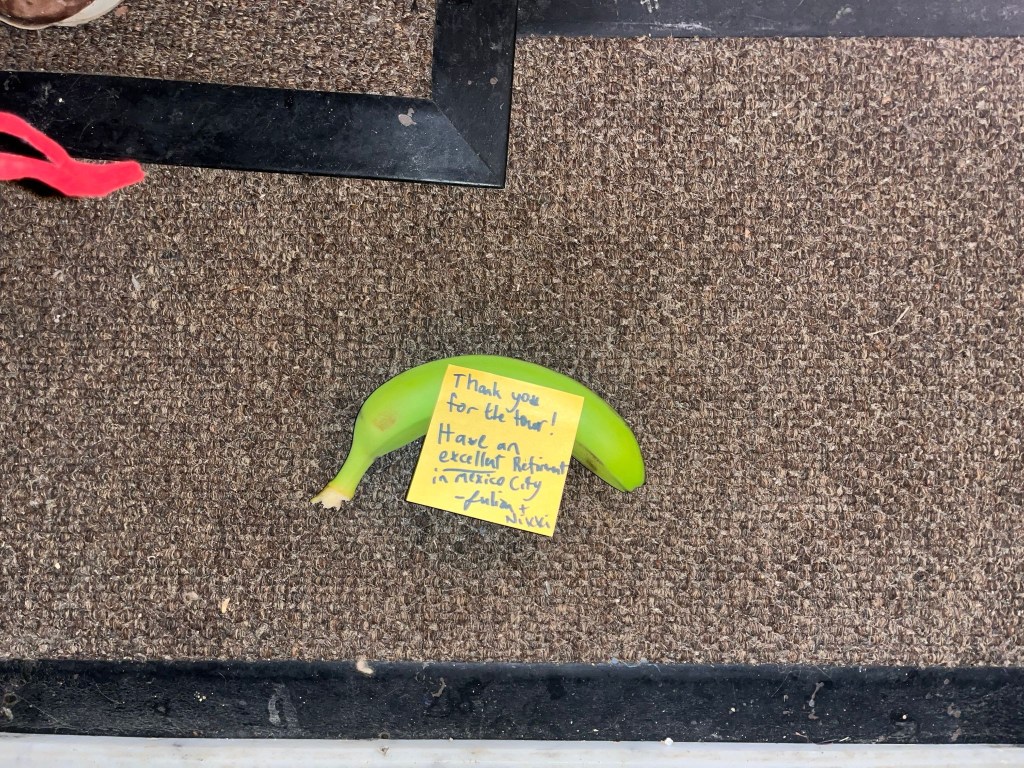
Clown School Break Day 31: To Universal Acclaim

In which Our Hero smiles at the received positivity. 

A friend of my father’s recommended a game today. She reads my daily blog and, since she knows my love for poker and my interest in cooperative games, she linked over a cooperative poker game. Today my family played it. We had a blast. A new favorite. One for the ages. Such glee.

We sent her a video indicating our excitement. She’s glad we’re glad. We’re glad she’s glad. She’s glad that we’re glad that she’s glad. Etc.

I’m glad my daily blog is having such positive impact. With dozens of daily readers, I’m clearly having a positive impact. And the fact that I’ve received recently a bunch of unexpected positive feedback suggests I’m doing something right. I’m also glad that I have people around me who would tell me honestly if they thought something negative about it. But they don’t, so everyone must like it.

It’s a game about accurately ranking your poker hands compared to the other players’ hands. You win or lose as a team: either your whole ranking is accurate or it’s not. Play is simple: you rank preflop, then on the flop, turn, and river. Only the river rankings matter: if they’re correct, you all win. If they’re not, you all lose.

A few lessons:

  1. It’s hard to navigate small discrepancies. 8,7 vs 8,6 is nearly impossible to distinguish if no 7 or 6 comes on the board.
  2. Personal proclivities abound. One person’s confident grab of the top rank preflop means only pocket tens or better, while another’s may be Ace-9.
  3. Have fun. This means A) When a conflict arises, diagnose it accurately (was the problem really on the river, or did this stem from preflop?); and B) when you feel uncomfortable, say “I feel uncomfortable”. It’s shocking how well people respond when you simply say “I feel uncomfortable”.

I’ve been writing a daily blog about clown school. I suspect (but don’t know) that plenty of my peers read this blog. As yet, no one has said “I feel uncomfortable”. That’s nice. Guess I’ll continue 🙂 

Clown School Break Day 24: Clowning is for Babies

In which Our Hero shares a lack of pain.

My sister’s sixteen-month-old child has not yet learned that life is more pleasant when one defecates intentionally in prescribed locations. Instead, he saves time and effort (and I admire his efficiency) by pooping wherever and whenever inspiration strikes.

After completing this task, he begins to smell.
It is not a pleasant smell.
It gives one the impression that all disgust responses originate here.

To rectify (pun!) the situation, one generally places him on his back and swaps out his undergarments for fresh ones, with some cleansing wiping in the middle (pun!).

He does not enjoy being on his back.

Would you enjoy being held on your back by beings eight-plus times your size?

In response to this dissatisfaction, I’ve learned to change his undergarments while he’s standing. This satisfies the basic needs. But sometimes the environment is not conducive.

Such was the case this afternoon at the park.

We – my father and I – flopped the nugget onto his back.

His face screwed itself into a pre-wail.

I noticed something in myself: calm. Comfortable ease. I found it, then sent it his way. His pre-wail ceased. He looked at my face.

I knelt above the boy-child’s head, my face upside-down over his. He gazed at my scruffy visage; I gazed down at his soft, pudgy one. It didn’t take effort. Just a gentle internal returning-to-the-calm.

He did not find this enchanting. (For roughly four seconds during the change, he looked away.) But it was sufficient.

I am not, perhaps, more entertaining than a stubbed toe is painful.
But I can be more engaging than a sudden flop onto one’s back.

At clown school, the second-years play a warm-up game with a baby.

They appear on stage one by one. They make a face or a sound or some small action. The teacher plays either a baby crying or a baby laughing. They continue. The question is simple:

How long can you keep the baby laughing?

I’ve wondered for a while whether that’s the goal of clowning: reach some pre-culture, fundamental-to-all-humans level where your pleasure arrives into any audience, underneath their higher-level reasoning. 

I do not yet have the skills to make this baby laugh on command. (Except via the super-secret hack of foot tickles.)

But I do have the ability to Turn On The Calm.

And that

can be

enough.

Clown School Day 35: Time for Me to Fly

When Our Hero closes a door, He opens a window.

All three teachers agree: I should not attend the second half of this course.

That’s nice.

I wasn’t enjoying Neutral Mask. I wasn’t looking forward to Greek Tragedy. Friends have commented worries about my emotional health and about whether the school’s pedagogy implements brainwashing tactics. Perhaps it will be nice to have time off.

One of the main teachers says I analyze too much. Instead of analyzing, they say, I should “sit in the feedback.”

I’m not so sure.

When I sit in feedback, I misread it. When they told me my costume looked like “vomited broccoli,” I thought they were literally insulting the outfit. A friend later suggested it was meant to get under my skin — a non-literal pedagogical tactic.

But how am I supposed to incorporate something non-literal without analyzing it?

If literal doesn’t mean literal, then…?

And anyway, who wants to sit in vomit?

The head teacher asked me a question today. I wasn’t performing on account of my fractured foot, so another student took my slot. She looked at me and asked:

“Was your replacement excellent, or could you have done better?”

I said, “I don’t want to answer.”

The class booed.

I felt confused.

I asked her to repeat the question. She did. I said, “I don’t think it was excellent, but I don’t think I could have done better.” Then I named two specific weak points in the scene.

She said, “It’s good to know your level.”

And I agree. I wasn’t being self-pitying or self-judging — just honest about where I’m currently at.

I’ve had trouble with complexity here. A few days ago, we had three mistakes to resolve, and when I chose one hug, one kiss, and one Swedish handshake, I sensed tension as though people thought I was trying to be unnecessarily cute. And that’s literally 1+1+1=3. Complexity seems to be frowned upon. So what do I do when I’m tasked with following the fun, and sometimes find complexity fun?

At coffee today, a classmate realized Los Angeles is on the west coast rather than the east, and mentioned she formerly thought Africa was the world’s biggest country. She’s also had much more success than I have in recent class sessions.

Maybe I’m expecting something different from these clowns than they have to give. I’ve watched people forget a promise five minutes after making it. I’ve watched them make complete 180s in real time. Perhaps an excellent clown is so right-brained they exist only in the present moment.

Regardless, they’re great clowns.

I’m gonna miss them. 🤡

I’m excited to have some time away.

In January, a friend arrives to the school. That’ll be nice. We’ll take a course together. Probably live together. It’s good to bring a friend. 😀

I asked the assistant about switching classes; she said it’d be good for them administratively. So I might as well try it for one course: Melodrama. After that comes Bouffon, then Vaudeville. A change of pace. And if it’s still rough, I’ll know it’s not the section.

As for the newsletter: I was supposed to be on winter break from clown school for six weeks (Dec 13–Jan 25). Now it’s nine weeks. I’ll continue writing daily for two reasons:

  1. It keeps me fresh.
  2. It’s the sort of person I like being.

​​Clown School Day 32: Fear & Loathing

In which Our Hero gently invites his classmates to find pleasure in their fear.

[I wrote this earlier today, before a long and insightful conversation with my roommate. By the vacillations of clown school, I’m not sure how much I still endorse or will endorse tomorrow. How’s that for a cop-out? 🤡]

Another shit day at clown school. I should frighten other students more.

Listen:

Earlier today we were playing dodgeball. Someone on the opposing team had the ball and motioned toward me. I ran away, bumped into a teammate, and she let out a startled little yelp, plus an admonishment along the lines of “come on guys, it’s a game.”

Later in that same match, I leapt to grab a ball, robbing the opposing team of a catch, like stealing a home run but dodgeball-style. A player said, “Chill out.” The first person would probably call themselves unathletic. The second, not very competitive.

Okay.

Sure.

What of it?

Sidebar: clown school is populated far more by theatre nerds than athletes. I’m probably the best all-around athlete in my class—not the strongest or tallest, just the one with the most hunger to win and the actual ability to put that into reality. So why is it not showing up?

After her yelp, I shrank back. I became smaller, gentler, duller. I had less fun.

But realistically? A little bump between teammates in dodgeball is not a big deal. No one fell. No one got hurt. It was a collision between two moving bodies in a game whose entire premise is hurling projectiles at each other

The recent American neurosis of “don’t cause anyone fear ever” does not help me here. Hurting people would be bad. Frightening them? Not inherently. If two people bump into each other while playing dodgeball, the appropriate move is some sort of affectionate “eh, no worries love”. 

But I’ve been avoiding frightening people. And it’s getting in the way of my clowning.

The first time I truly succeeded on stage was when I FINALLY LET LOOSE. A demon burst out of my sternum and shat poop-colored rainbows across the stage.

The teacher told me to tone it down, apologize, and bring the same energy with more sensitivity.

The second time I started from a light, airy emotional place: gentle by nature, and the power followed.

Today the feedback is that I lack impulse. And the truth is: I felt it. In the afternoon class, I wasn’t powering with impulse at all. I was stuck in my head, nitpicking the pedagogy (correctly, but uselessly). I couldn’t find pleasure in anything.

I hate being in this oscillation space.

My roommate disagrees with my whole “frighten them more” instinct.
He thinks I’m conflating playing intensely with playing to win (and that playing to win will necessarily not maximize group pleasure).
He says I lack a lightness—a tiny joke kept in the back of my mind.

And maybe he’s right. On stage today, I lost the game. I forgot the game.
I played it well for a few minutes. Then I forgot it.

Never forget the game.

Look.

When I do have impulse, people get scared. That’s the truth. I’m intense. When I try to win at dodgeball, people get quiet and the light, floaty vibe evaporates. Today I had the ball, and an opponent squared up. I pump-faked twice. Then I whammed him.

During that exchange, the room went silent. The airy part of the game vanished.

Did it become another kind of fun?

Is it not fun to watch two gladiators square off? To see combatants toy with another in a spirit of agreed-upon play? Isn’t that a form of respect—acknowledging we both have power and we’re choosing to use it?

Maybe the audience wasn’t laughing. Maybe they were leaning in. I don’t know. Maybe I’m justifying. 

Maybe I should scale it: go hard against the skilled players, soften against the less-skilled. A consent-based approach to dodgeball. (Unless I’m the last one alive. Then it’s win, win, win.)

I don’t know whether it was pleasant to watch me whang that guy. I imagine it was.

I’m six feet tall, bearded, and frequently voracious. Of course people are scared of me. Underneath any coverings I add (silliness, friendliness, gentleness), they may always feel some amount of fear. 

But maybe their fear isn’t a reason for me to shrink.

Maybe their fear is something they get to deal with.

Because otherwise, I become small and boring. I lose my impulse. And that is absolutely not fun for me.

Fear without safety is fear. Fear with safety is exhilaration.

I guess I need to give people that safety.

To clearly show this is a joke.
This whole thing is silly.
Show them in a way that’s obvious to them: I’m not taking myself too seriously: the thing I’m doing is a joke.
And that way, when you fear me, you also feel safe around me.
And that way, even though you fear me; even though you respect me and my intensity, you love me.

Would you rather I be too much or too little?

Right now, at school, too much. They can work with too much. Too little just gets kicked off. 

In general: Dumb question. 

Nurture the fun.

Clown School Day 31: Absolution & Airflow

In which Our Hero sleeps, sins, and seeks salvation.

At the end of this week, I’m a quarter of the way through this program. That’s wild. Three times as much left as what I’ve already done. No wonder it feels like I’ve lived six different emotional lifetimes.

I told my sister today about our daily Simon Says game. It’s brilliantly constructed. It’s also deranged.

Here’s how it works: when you make a mistake, you must seek absolution. You get to choose your method of redemption. The menu: 

  • Hug
  • Kiss
  • Swedish handshake
  • Nothing
  • Or… torture

If you choose “nothing,” nothing happens. If you choose “torture,” one of the teachers (or a friend, if you prefer) faux-tortures you in front of the class. If you choose one of the other options, you turn to a peer and ask, “Can I have a [hug/kiss/handshake]?”

If they say “yes,” you receive absolution.

If they say anything else—literally anything: “yep” is interpreted as “go to hell”—you get tortured.

My sister was horrified. Honestly, same. The first time we played, I felt like I’d accidentally joined a cult that prioritizes whimsy over human rights. And yet…it works. The faux-torture weirdly brings us together. There’s something intimate about placing your fate in someone else’s hands and trusting they’ll either help you or throw you to the wolves. (And, sometimes we just choose the torture directly: our Assistant Teacher is an exquisite tickler.)

My sister asked why people don’t always say “yes.”
Partially because we’re learning how to ask and receive asks well. So if you ask poorly (not loud enough; emotionally closed; selfish), your odds plummet.
And partially because, well, that’s the game.

Last night, for the first time in ages, I slept well. Deeply. My room traps CO₂, so I’ve been sleeping poorly. Last night I cracked open both the window and the shutters. Oxygen: acquired. Primitive problem, elegant solution.

I don’t have much to write about today. My energy feels softer, steadier.

One woman in class has been struggling to find a lower, more powerful voice. Our assistant teacher stood behind her and performed a kind of gentle, low Heimlich maneuver while she screamed “FUCK YOU, [Head Teacher]!” at full volume. It helped. Theatre is strange medicine.

We also explored two new “substances”: oil/petrol/gasoline and superglue. I’m tired of this exercise. Some classmates love it; I don’t. Maybe that’s the point: finding joy in an approach I don’t naturally love. I can learn it. I just don’t yet.

I found a partner for Friday’s scene. The task: play contrasting characters who always agree. Hot, fast, smoky oil in perfect harmony with gentle, falling snow: two beings that shouldn’t coexist and yet do.

It might be funny. It might be a disaster. That’s clown school.

My goal this week is simple and impossible: be sensitive, be open, be gentle: with my partners, with the audience, with myself. I’ll do the exercises, but the real work is internal.

Do I have pleasure?
If so, am I sharing it with the audience?
If so, am I sharing it with my partner?
Am I playing together, or am I playing alone?

Clown school is hard.
But at least I slept.
And maybe—just maybe—I’ve solved my CO₂ problem.

That would be nice. 👍

Clown School Day 24: Snowfall

In which Our Hero melts.

Today I finally heard it:
“You were sensitive.”

Not “You’re being a fascist.”
Not “You’re pushing again.”
But:
You were sensitive. You were open. You were beautiful.

This has been my quest for the last four or five days: trying to soften without collapsing, open without weighing down, give without pushing. So when the assistant teacher said she could tell I’d been trying to be sensitive, something in me loosened. Like the wall I’ve been kicking finally cracked.

They then called “Julian and four others” onto the stage. And somewhere in that transition, I started crying. I don’t remember the moment. The whole experience became one.

The exercise was “snow.”

The teacher gave a confusing description of snow. Something like: “It’s the kind of snow that shuts down a city.”

Which… is just a quantity of snow. That’s not an image; that’s an amount.

So I asked a question that she didn’t answer. And then I started being snow. I grabbed an image that moves me: Lorelai in the first season of Gilmore Girls, stepping outside as the first snow falls. That little gasp, the cup of coffee, the anticipatory thrill, the “I smell snow.”

That image speaks to me. So I used it.

They asked for lighter. I moved lighter.
They asked for less movement. I slowed down.
And then the crying came—like a release of walls I didn’t even know I was holding.

I felt open. Present. Immersed. And I tried to stay there as long as I could. Even after class, I tried to keep it alive. I wandered to a café because it felt like “the present thing to do.” Then I left, because that also felt present. Then I ran into classmates outside the café, so I went back in. Presence, it turns out, has a sense of humor.

Then, I called a friend.
That was hard.

It felt like I came home excited that I’d thrown a baseball for the first time—look, look, I did the thing!—and they said, “Careful not to break a window.”

Not malicious. Just… a mismatch. And when you’ve just cracked open a new emotional door, mismatches hurt more.

After class, one of the teachers said: “You were very sensitive, and very beautiful. You had an intensity—but it wasn’t bad.”

I laughed at that. I’m glad it isn’t bad, because my intensity ain’t going away.

Later, I asked the teacher, “Did I do it? Did I actually finally successfully give?”
She didn’t answer directly. She asked, “Were you sensitive? What did you feel?”

Here’s my experience:
On stage without my glasses, I am legally blind. I couldn’t see anyone.
I didn’t listen to them either. The audience was mere shapes. Just the snow and me. And once in a while, a teacher’s comment.

So if the question is “were you sensitive to the audience?”, the answer is no. I was literally senseless. Ah clown school: you ironic farce.

They don’t mean sensitive. They might mean gentle. One way to arrive at sensitive is to notice that you’re too much for the audience. Another, apparently, is to channel the perfect childhood you never had in idyllic smalltown America.

Sometimes total silence is a good sign, the teacher said. It means the audience is engaged. “A quiet room can be as good as a laughing one. No one doing this [shuffling around, moving in their seat]”.

Yaya, today, I was sensitive. I did it right, entirely without sight. Senseless, yet somehow more sensitive.

Clown school, you rascal.

Earlier in the day, I channeled a storm. They told me I looked “obsessed with the game.”
I laughed. “This was the least obsessed I’ve been in days. I literally set myself the gentle mantra, ‘This is for you[, audience]‘”. Light. Open. Giving.

The feedback wasn’t about my intention; it was about my appearance.
They saw obsessed. I must change that appearance.

Perhaps I need extra lightness to counterbalance my baseline intensity.
Some people need more power or voice. I might need 10x the gentleness.

After class, a fellow student said to me:
“Good on you for staying up there. You could have sat down.”

My brow furrowed.
Sat down?
Why would I sit down? That made zero sense.

This is bottom of the ninth and I’m pitching a no hitter.
I will remain here until you drag me off this mound.

It’s funny what other people reveal about themselves when they comment on you.

Somehow, after I left the stage, the right person knew I needed a hug. He gave me one. And, lo and behold, it was good.

All afternoon I kept trying to hold the feeling: café, walk home, phone calls. I wanted to stay cracked open. Even though it’s uncomfortable? Especially because it’s uncomfortable.

I did my first cartwheel today. I went up as the guinea pig because I wanted more than anything not to.

Somewhere in all of this, I realized:
This experience with snow is a metaphor of the friction I’ve been having with the social life of clown school.
Pushing instead of being sensitive.
Wanting to give but not meeting others where they are.
The effort to be open met with a congratulations about remaining on stage or a warning about windows.

What next?
Maybe the answer is simply: more on-stage openness.
Maybe I’ll find some new challenge.

But today, for a moment, I did it. I gave what they’ve been telling me to give.
I didn’t perform emotion.
Nor pretend.
Nor simulate.
Nor mimic.

I was open.
Light.
Warm.
Gentle.
Like the first snow
And it’s You.

Because this snow.
This tiny, infinitesimal flake of snow.
If you do it enough.
Could cover the world.

Clown School Day 23: Everybody Wants a Little Slice

In which Our Hero measures how much to give.

For a good time, bring a cake to a gathering of friends. Cut slices for each person. Ask how big they want. Invariably, they’ll say “Just a small slice,” or “Just a little one.”

Then, if you move the knife slowly and ask them to “say when,” you’ll find each person’s little slice is different. In some cases, it’s twice the size of someone else’s small slice.

When they say, “Just a small slice,” for whom are they speaking?

They’re not communicating in your language. If they were, small would mean the same thing.
Instead, they’re saying something like: “I’m signaling that I’m not greedy.”
Or: “I’m allowing myself pleasure, but a restrained version of it.”

Maybe I’ve always found moments like this confusing. Maybe because I’m autistic. Maybe because I never learned the unwritten grammar of appetite and permission. Maybe because the cultural norm to be small and not enjoy yourself is dumb.


On stage, the same puzzle repeats.
How much of myself is the right-sized slice to offer?

I have a great and powerful energy in me. I can give a lot. I have given a lot. My teammates, my teachers, and I all agree: when I was fire today, I burned.

But still—I didn’t burn for them.

Fuck.

I have so, so much pleasure. So much deep, physical intensity.
And goddamn it, how do I transmit this to you? So far, I’ve tried: 

  1. Give it directly. Too pushy.
  2. Increase my own pleasure. Too self-contained.
  3. Recommendation from friends: play with oscillation—me-pleasure, then share; me-pleasure, then share again.

Complicating factors:
(1) I can’t see on stage (I can’t wear my glasses with the neutral mask).
(2) I don’t find myself beautiful.


The teacher’s aid begrudgingly gave me her speculation today (directness like this isn’t really part of the pedagogy). She said she senses that I have beliefs about how I’m perceived, and that my behavior on stage is an attempt to offer those perceptions, then shatter them. Which isn’t the same as showing myself—it’s showing my idea of myself, or how I imagine others see me.

Maybe she’s right.
When I was beautiful, they loved me. Subtle. Gentle. Open.
I remember it dimly: tears streaming, face unguarded, giving.

I want to find that again.
Tomorrow, I’ll try.

When the Head Teacher told me I was insufficiently sensitive, she began with: “Not bad.”
And when I raised my hand to ask a question, she added:
“When you have done something good, it is better not to ask questions, no? It is better to think about what you have done.”

Maybe I’m harder on myself than they are.
Or, as a friend put it:
“It’s nice to know you’re harder on yourself than the teachers are.
It’s nice to know you’re not just failing over and over.
Or at least that you’re failing over and over—but it’s working.”

Tomorrow, instead of trying so hard to give that I push,
I’ll try so hard to open that I break.
And I’ll give that to the audience.
Maybe they’ll love it.

Clown School Day 22: Storm Warning

In which Our Hero mistakes force for generosity.

Today I was a storm. A mighty tempest, raging.
I had INTENSITY. I had GIVING.
But… I was pushing.

Well, shit. I keep hearing this feedback, don’t I?
One classmate keeps being told he looks like a gorilla who needs a banana, so at least my comment wasn’t that.
But still: pushing.

Yes, pushing. Pushing. PUSHING!!!
The thing I do in all too many areas of life.
I want X to happen, so I force it into existence.
I want to avoid Y, so I shove it away.
I don’t really nurture things. I don’t calmly cultivate.

And when I perform with such intensity—without either (A) checking in with the audience, or (B) easing up enough to wink that it’s all a game—people find it frightening.

Maybe that’s the problem.
My performance curve—intensity vs. time—starts high and just stays there.
But it should breathe: rise, relax to dip slightly, rise higher, dip again.
We don’t want someone who punches full-force out of the gate.
We want someone who plays with us, gently escalating.

I demonstrate competence, but not alignment.
And that feels familiar.
Maybe I’m just not well-aligned.

I don’t like authority.
I don’t trust institutions.
I rarely side with the masses.
So people don’t trust me?
Am I fundamentally out of sync?

It’s odd to feel both like a lump of clay being molded, and an alien dropped into a land with a new language.

Clown school does weird things to your psychology.
I’m doubting a lot—really a lot.
Questioning my preferences, my desires.
Wondering where my heart and my head line up.

I’m not used to being part of a group.
After decades of being ostracized from them—since kindergarten—I now both crave belonging and violently resist it.

Here, I must give to the group.
I chose performance as a solitary act: me and the audience, a controlled parasocial exchange.
Turns out: no.

Clowning is about relation. Taking and giving.
And I’m trying to give so hard.
I just want them to like me.

But I’m not actually likable when I’m like that.
Because a truly likable person doesn’t need to be liked.
They simply are kind, generous, and light.
They offer themselves, and we like them for it.

It’s telling that my first thought was, “I should do an impression of that kind of person.”
Because underneath it all… I don’t think I am one.

Maybe that’s the real problem.

“Hey, therapist: I’ve got a topic for us!”

Clown School Day 20: Le Jeu (Game) Over

In which Our Hero becomes Our Zero

“When Julian enter, was he with [scene partner] or was he alone?”

Audience: “Alone.”

At least I’m consistent.

(That’s a crap joke, but I’m keeping it.)

I’ve now attended two classes here.

Both had a final presentation.

In both final presentations, I received a mark of zero.

Zero is a bad mark.

It means:

  • You were boring.
  • You weren’t even interesting enough to get specific notes.
  • We could not see your pleasure.
  • You were not beautiful.
  • We do not love you.
  • Goodbye.

The Week

Monday: We received our assignments. I chose a partner I liked — skilled, smart, fun.

Tuesday: We rehearsed and found a stupid little game we loved.

Wednesday: We showed it to a trial audience. They couldn’t see the game. So we added another on top.

Thursday: We played again. We had fun.

Friday: We talked through our plan. Then, right before going onstage, my partner suggested a new one:

“Milk the opening if it works. Only go to the game if we need to.”

The drumbeats sounded. Our turn.

We entered.

The audience laughed once.

I thought, Aha! They’re laughing at me!

(Still kinda true: I set up something he executed.)

I did it again. No dice.

My partner panicked:

“We need to do the game!”

And before we even played the game, we were kicked off.


The Problem

I loved rehearsing with him. Genuinely. It was a highlight of my week.

But when I entered the stage, I didn’t open myself. I didn’t share with the audience enough pleasure of being on stage.

And so: I wasn’t lovable.

I’ve only opened myself once on stage. People found me beautiful.

How do I get back there?

Is this lack of openness also a problem in my relationships?

Am I in the wrong place, doing the wrong thing?

Is this biomedical?

Will clown school eventually teach me to play well with others?

Right now, I feel like a lonely, isolated lump of clay.

An ugly one.

It’s not fun to feel like an ugly lump of clay.

Maybe if I did therapy for an hour every day, I’d get better at opening myself. Then I just do that on stage, but lighter.

If the hypothesis is that success comes from being open and light and generous, then at least the openness part is something I can train on my own.

Once my father leaves on Tuesday, I’ll try that.

I’m not leaving yet. The clay’s still on the wheel.

It’s really. Not fun. To be clay.

💩

Also, two students told me they thought Head Teacher was unfair — that I’d actually been beautiful. I trust the opinions of the expert few over the uninformed many. Still, something relaxed in me when I heard that. This must be why people commiserate.


Comments About Me

“Who do we like? We like [my scene partner].”

“You are not beautiful.”

“Do we love him? Not at all.”

“When Julian enter, was he with [Scene Partner] or was he alone?” Audience: “Alone.”

“Zero, zero, zero.”


Learnings

  • Start with the fun part.
  • Stick to the plan. You made it for a reason. (Definitely don’t abandon the plan shortly before going on stage.)
  • Learn that it’s pleasant to be open.

My French classmate learned this. Others have too.

So why the hell is it so hard for me?

I even had a potentially fruitful relationship recently undermined because of this non-openness.

Do I like this? Am I choosing contexts that reinforce it?

After class, one of my peers said:

“I feel joy when I open myself on stage.”

He meant it kindly. I appreciated it.

I just don’t fucking know how.

This isn’t about wanting to. It’s a skill gap.

And it’s funny — my teacher said I’m best when I’m subtle and open, not when I’m pushing.

And now all I want to do is push.

So maybe I should just… give up?

That can’t be right.

Fuck if I know.

A friend who knows me very well commented on these last three lines: “fuck off. Don’t you play better when you’re down 2 and 0? Congrats, you’re now down 2 and 0.”

This must be why people share their emotions.

Clown School Day 16: Crying Beautifully

In which Our Hero is the Major

It’s nice to be celebrated for crying.

The exercise is simple: receive the ball from your friend → thank your friend → declare with the vigor of a leading actor, “[Loved one], look at me: I’m the major!”

Most people fail for being too small: instantly kicked off, banished forever, like too-polite ghosts. In the summer course, I had been one of those, kicked off after one word.

Not wanting to befall this fate, I powered hard in the other direction.

After receiving the ball and thanking my friend, I turned to the audience, pulled out all the stops, and loosed a booming “YAYAAAAA!!!”

Students flinched in fear.

Head Teacher provided me lines to repeat back:

  • “I’m sorry, Yaya, for frightening you with my shouting.”

Then, Head Teacher dialed me in:

  • Softer
  • More open
  • Gentler
  • Less pushing
  • More subtle

When I had all the mechanics correct but was still missing joie de vivre, Head Teacher asked me who in the class I would want to kiss me. I chose a girl in the front row. Head Teacher asked, “Do you want another?” I said no, one is enough.

Then, whenever I spoke the text with all the mechanics correct but insufficient relaxed openness, Head Teacher signaled this classmate to kiss me on the neck. Later, classmates told me the kiss had opened me up: It stopped me from pushing so hard. I was, perhaps, trying to be liked. If I just sit back and show people who I am, it turns out they find me beautiful.

Eventually, as I opened up, tears began to fall. Not just mine. I saw tears in at least one audience member’s eyes.

What is this releasing? Is it a sadness or a joy or a wonder or a beauty? Is it the physical manifestation of pain being shared?

It reminded me of two events:

  • One, crying in my parents’ shower seven years ago. I had just ended the most significant relationship of my life and was scouring my gut with steel wool, knocking off barnacles attached from that pain.
  • Two, at Burning Man around that same time. Watching the Temple burn, I mourned the end of that relationship and grieved the pain it had caused me.

The first happened in private. The second happened in public. And bawling at Burning Man, surrounded by fifty thousand people, the funniest thing happened:

Everybody kept trying to help. Some offered a tissue; others provided a shushing noise. Well-meaning people, but they were soothing their own discomfort, not mine. Mine wasn’t discomfort. Mine was comfort for the first time in a decade. My tears were the powerful release of pain. And others, in wanting to help, tried to pull me back into their pool of internalized pain.

I’ve had a philosophy since that experience: people who are grieving should be allowed to lead. Sit with them; offer them your kind presence; maybe a hand to hold if they want to. But let them lead. Even that hand-holding is more likely to be top-down controlling than actually helpful and kind. Let them take care of themselves. You are there to serve.

Here, on stage, it was nice to finally be rewarded for my raw, open emotion. To show that rawness and have it accepted. Not just any rawness: it had to be loving (directed at Yaya) and relaxedly pleasurable (from the kiss). But still, a context in which to share my experience. To share my feelings. To share my pain.

If you have deep pain, we’ll accept that here — so long as you offer it as a light, open gift.

Four minutes on stage. One of three people who cried during the exercise. Described as a “breakthrough” by a fellow student.

It’s intoxicating.

Satisfying.

Nice to be alive.

And delightful

to be celebrated

for being myself.

Yaya, today, I was the major.