Mellow and Dramatic (Jan 26 2026)

In which Our Hero mellows in the drama 

Today was the first day of the second term. I’m not there. I’m in Etampes, four minutes walk from the school. I walked earlier today by the train station cafe that doubles as the student haunt. Yet I’m not there. Do I miss it? 

Today my mother and I dawdled down a classic Parisian street. Over lunch we swapped plates four times so we could experience what the other was eating. An Eastern European tourist offered us alcohol at Jim Morrison‘s tombstone. A California native gushed his worries about American politics 10 feet away from Molière corpse. 

This evening, my housing purchase was confirmed. After 8 years nomadic (homeless?), it’s time to put down roots. My partner ordered a bed for the empty apartment. I ordered locks for the doors. We’re buying one way flights like we always do, only this time they’re to home. 

The clown course I’m missing is melodrama. A fellow student once told me that melodrama is about stretching moments. What should be a five second stroll becomes ten minutes of dramatic, hyper-experienced anguish. 

Today stretched. From sprinting for the train to dashing through loan documentation, I was hyper present. Focused. Immersed. 

That’s one of the goals (or is it *the main goal* of clown school). Presence. Giving. Moving forward. 

I don’t miss melodrama. 

I’m excited for my life. 
Ease is what you make it (Jan 24 2026)

In which intense and easy coexist 

At the start of today, I expected an easy day. Farmers market in the morning, then relaxing in this little medieval town, perhaps with a stroll around the lake.

But when I’m with my family, things happen!

My mother – who was up until 4am last night – walked for ten miles around Paris today. “Because today is so nice and tomorrow will be cold and rainy”. 

We sped through the annual scallop festival; sauntered winding streets in the outdoor flea market, strutted down the jardin des tuileries, and basked under the calmest place I’ve found in France (a particular library room near the Louvre).

We ate four of my favorite French foods: tomme de brebis, galette, a particular raclette wrap, and carbonara at the best Italian restaurant in Paris. (You may think carbonara is Italian. But if in France, doesn’t that make it French?)

Le jeu changed over time. From find caffeine to find food to find the most outrageous item being sold to people-watch to make the train. 

(We made the train home, despite it leaving in 20 minutes and Google telling us the walk would take 22 minutes.) 

If this were my everyday, I’d be exhausted.

Exhausted,

but happy.

😌

A Homecoming of Sorts (Jan 23 2026)

In which? In Étampes! 

Back in Étampes, the land of the Clown School. My mother and I are visiting for ~5 days. 

My mother asked me what it’s like to be back.

My answer, in anecdotes:

  • At the airport, waiting for the bus, my mother and I talked about our travels to France: hers through Portugal, mine from Spain. Perhaps its the German genes we share, but both of us have trouble with those local cultures of queueing. 
  • When the corner baker popped up from behind the counter and saw me, her eyes widened and her cheeks shined. “I thought you were gone,” she said. I told her about my broken foot and leaving for the holiday. She told me, “Before you leave, you must tell me!”
  • My mother asked, “What should we get in our croissant?”. I replied, “Oh you silly Americans. We are going to the best croissant in the whole town. We will eat it as it is.” And we did. And it was good.
  • “I’m glad I’m wearing my boots, because this is muddy!” (I don’t own boots.) 
  • The two cheeses in the fridge, untouched for 1.5 months, had me wary. One ages for 24 months before it gets to me; the other spends its adolescence stewing in musty caves, which are selected because they harbor fungicidal mold. Perhaps it’s no surprise they’re both not only edible but delicious.
  • The outer crunch of the baguette; the smear of blue cheese; the dollup of black truffle pâté; the slice of iberian ham. If I lived here, this would be my every day. When I lived here, this was my every day.
  • Three — now four — times, my mother and I have said “It’s so great to be with you.”

The Gruffness of Manhood (Jan 21 2026)

In which Our Hero has a ball 

Testicles should never be handled gruffly.

I met a man today who does exactly that.

A professional urologist, he receives testes on Wednesdays and Thursdays.

He begins with a long-winded explanation of two treatment options, each of which contradicts something he said previously. Then he gives vague instructions about how to sit on the bed, and panics when you do it wrong. 

Two days ago, I asked if I could see him in the morning. I would already be in the area at 9:30 a.m. I would rather not wait around until 5 p.m. The scheduler said I was lucky to get an appointment at all.

Fuck you, I thought. I’m paying for this. You’re a fertility clinic. You should have a urologist on staff. You’re not doing me a favor: this is your job. (This is my general experience with this clinic.)

Eventually, he slaps cold ultrasound goo on my balls and takes out the wand. He peers at the screen.

They look normal. No shit they do. He seems surprised. Has this man never seen a huevo before? 

And then, the best part: 

He cleans them.

There is something deeply satisfying about a gruff old man cleaning your testicles with visible irritation. No tenderness. No ceremony. Just the job, done thoroughly and against his will.

A small, immaculate fuck you.

I don’t respect doctors merely because they’re doctors. Many of them I respect less because they are. Authority that demands deference without earning it irritates me. 

So when a man who has done nothing but steadily lose my respect cleans my testicles—however gruffly—it brings me joy.

Squeaking By (Jan 18 2026)

In which Our Hero enjoys a capital day. 

Dipping churros into chocolate, I could feel the blood throbbing in my left knee.

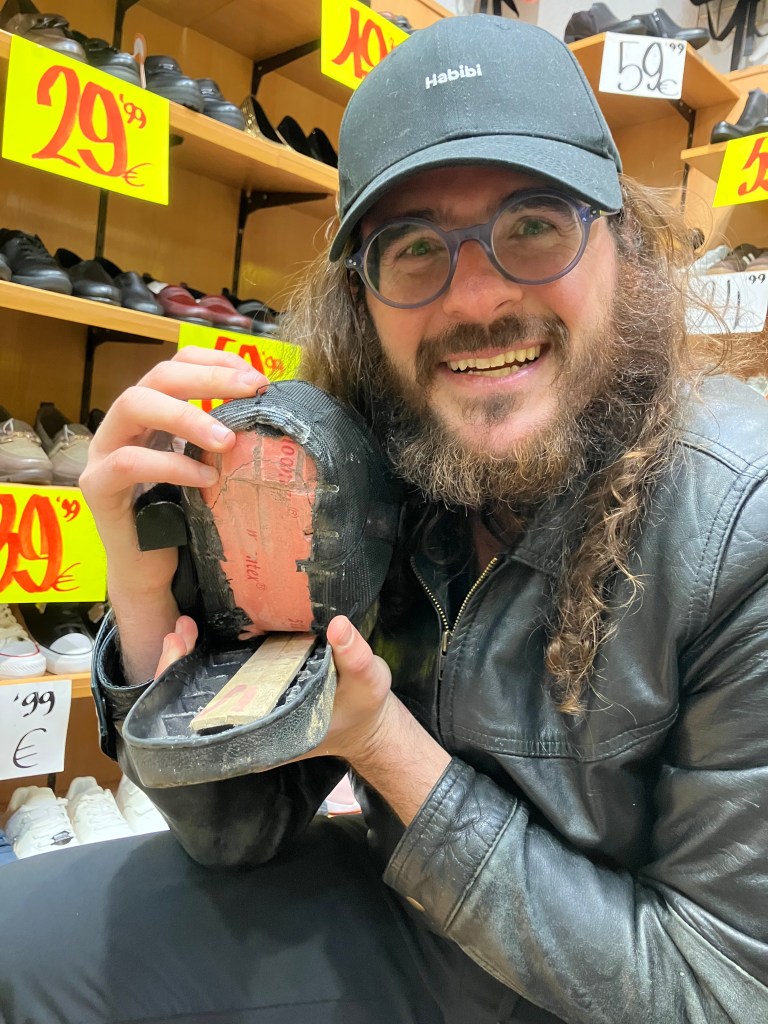
After walking 26,986 steps (13.34 miles) on a mostly-still-broken foot, inside a surgical boot that was actively coming apart, it was time for new shoes.

Most people don’t put hundreds of miles on their surgical boots.

Most people don’t buy a second surgical boot so both feet will be even.

Most people don’t sprint through Dallas/Fort Worth Airport in surgical boots when the announcement says they have three minutes to board, even though their ticket insists they really have eighteen.

I am not most people.

We landed in Madrid at 5:45 a.m.
By 6:45 a.m., we were failing to locate our Uber and choosing the subway instead. 

Our exit train from Madrid left at 4:45 p.m.

Ten hours in Spain’s capital.

After eight of them, my feet were finished. The boot—kept out of an abundance of caution—was now increasing my risk. Three weeks ago, I’d been cleared to wear normal shoes. I hadn’t. I’d stuck with the boot.

Safety, it turns out, has an expiration date.

I spotted a discount shoe store.

Since I return to France on Friday, I only needed shoes that would last five days.

The clerk showed me a pair of decent-looking sneakers: twenty euros. I tried them on. He only had the left shoe in size 44 and the right shoe in 45. The clerk agrees to a discount, and apologizes he cannot give us a greater one. After all, what shoe store only sells mismatched shoes? 

Little does he know, my right foot is the broken one. Mismatched shoes is actually a plus! 

I ate a second ham croissant. It rivaled the ones I’ve had in France. (It wasn’t a croissant in the way they make them there. But it was delicious.)

We strolled through Madrid’s central plaza.
We passed photos of gored bullfighters and Jimmy Carter. 

I learned I could buy an apartment of the same cost and size as my future one in this square. I concluded I’d rather have mine.

Why do people prefer the artsy second city?

Melbourne over Sydney.

Barcelona over Madrid.

In both, I have a strong preference. In both, it’s the business hub.

I prefer places where real people are real. Where life isn’t a reflection or performance of itself. And in Madrid, the live music is more prevalent than in Barcelona.

Ten hours.
Too-big, mismatched shoes. 

Clown. 

[Get the title? Squeaking? Like clown shoes? How they squeak? 

Tough crowd.] 

Roots, Post-Wings

In which Our Hero plants a seed so grass may grow.

For the last 7 years, I’ve known my next destination only upon leaving my current one. The farthest ahead of time that I bought a plane ticket was one month, and I ended up changing that flight. More often, I’m choosing the next place less than a week ahead of time. 

In many ways, it’s magical: 

  1. Carrying everything I need on my back gives me complete self-sufficiency. Like a human turtle.
  2. Traveling light became a necessity. A dear friend has a tattoo that says “Travel light.” A good policy.
  3. I’ve learned to make friends quickly. When lost, I talk to strangers. When found, I do the same.
  4. I’ve shared small moments that mattered: teaching a baby to use an airplane tray table; splitting mangosteen with a man in Laos.
  5. Surprising reconnections: three people I knew in high school, all in northern Thailand. A man I met in Indonesia who later booked a room in my flat at clown school.
  6. Humans are the same everywhere. Then again, culture is real. 

In others, it’s tough: 

  1. Feeling unrooted. I’ve sacrificed depth for breadth. (Depth within breadth is its own type of depth. But it only goes so far.) 
  2. Insufficient community. The people you see every day or week are the people you build strong bonds with. 
  3. Lack of habit. I used to be a habitual person. Moving into a van really changes things. Selling the van without a new place to live changes things even more.  It’s hard to eat your normal daily breakfast when the monastery you’re visiting fasts until noon. 

Today I received the final document for my apartment purchase. I’d like to live there for a long time. I’d enjoy tacking my kids’ heights on the doorjamb until they eventually leave to find their own Laotian mangosteen. 

The deal isn’t done yet, and then there’s still renovations, so I’m hesitant to get too excited. 

But the yearning for stability is strong in me.

Easing In

In which Our Hero builds the lazy river…

A guy who needs exactly my services is posting on Twitter about it.

I want to help. I know it’d be a good fit. I’m one of the five best people in the world at it.

Do I reach out?

Before you say “yes,” it’s a little more complicated.

He has to want it before I can close the deal.

We’ve already spoken… and he’s not ready.

So what do I do?

I make it easy for him to say yes.

Let’s talk about generosity.

Generosity isn’t martyrdom. It isn’t giving to others such that you can’t feed yourself.

Very few causes are worth dying for. Dying – or even destabilizing oneself – is rarely the most effective approach.

Generosity is finding what someone else needs and giving it to them.

And this guy needs ease.

At clown school, a fellow student told me that the creative people he knows don’t plan.

They go with the flow: having meetings when they have meetings, happening upon each other as needed.

I thought: that just means the powerful, successful people are the ones who make it look effortless.

That’s what this guy needs.

His current stress is mental load. He needs my work to remove that load.

I can’t convince him.

I need to make it easy.

I’ll be in his city in ~2 weeks.

I’ll wander to his area, grab coffee, maybe step into his office, meet his team.

And if I can make it easy enough for him…

Well, that’s the job.

Three key areas of my life came into alignment today. I said to my partner, “When you work hard, sometimes you get lucky.”

Is this generosity, or strategy?

I don’t think those are opposites.

Clown School Break Day 51: Dumb, Dumb, Duh-dumb Dumb Dumb…  

In which Our Hero, um, … um … um … 

I’ve been feeling dumber lately. Having trouble finding the right word. Finding myself thinking slower. What’s up with this?

Hypotheses: 

  1. Clowning makes one less intellectual
  2. The work that I’ve been doing has been effective, but not intellectually stimulating
  3. Something else

The first seems likely true. Does clowning make one less intellectual? Yes. Less intelligent? No. However, among the many types of intelligence, it does not contribute to improving one’s smartness. In fact, it teaches one to focus on pleasure and emotion to the detriment of smartness. Sacrifices must be made at the altar of pleasure! 

The second: also likely. I’ve recently been doing a lot of important and procedural, but not intellectual, work. (Among them: buying and renovating an apartment; writing articles that are squarely in my wheelhouse.)

The third: maybe it’s hormonal? The speed of my verbal fluency was stronger on œstrogen. ‘Twas notably stronger. And now, I have much more general go-go-go (whether that’s testosterone itself or simply my familiarity with the hormone, I’m not sure), but less verbal speed. I make fewer moves but each move is stronger.

Another option for the third: a life transition that requires adjustment. Selling my previous home. Buying a new one. Moving internationally. Building a relationship. All of these can wear you down. 

A final option for the third: lack of exercise. Since I broke my foot I have been a complete lazypants. The brain thrives on exercise. Perhaps it will return when the activity returns. This one seems very likely to be influential :!D

It’s an odd experience to feel myself being duller than I previously was. And the people around me aren’t noticing… or at least aren’t noticing enough to say anything.

Then again, would they notice? And if noticed, would they say? 👀

Clown School Break Day 50: Seeing Ahead

In which chair-sitting is frog-boiling. 

A coworker once taught our company how to sit in a chair. The problem: humans are very adaptable. So when we sit in a chair, we adjust our bodies to fit the physical circumstance. This is bad. We should instead adjust our circumstances to fit our bodies. (The desk doesn’t care if it’s adjusted to be higher or lower. Our bodies do prefer we don’t slump.) 

The rules of the game change your play. That sounds obvious, but its effects often go unrecognized. 

Take a simple rule – like the football rule that the clock stops when a player runs out of bounds – and imagine the changes to the entire game that could result. Obviously the end of the game is faster: more hurry-up plays, less pre-defined set-ups.

Now consider how different technology was when this rule of this game was established – at some point before 1909 (citation: pg 214 here). Was this rule intended to play out the way it is? No – no way – not really – it can’t be. But it shapes how today’s entire game is played. 

We often accept the slight changes in our environment, in the rules that govern our games. But adjusting our behavior to maximize our desired outcomes is not easy. Do you think second-order effects (Since A happened, B will happen) are hard to predict? Third-order effects (A, therefore B, therefore C) are even harder!

Eg: If we changed the clock-stop rule, would Quarterbacks make more in-the-moment decisions? Become more skilled at rapid decision-making? Would we select for quarterbacks who are more tacticians and less strategists? Would that change lead to the rest of the team being more strategic (to fill the gap) or less (because their leader is less strategic)? Is this even the right pathway to follow, or would quarterbacks actually become more strategic because they would plan their whole series of plays ahead of time for those low-on-time situations? Would timeouts become so incredibly valuable in the endgame that they’d never be used otherwise? How would that impact how strategic a quarterback needs to be?

It’s really, really hard to tell. Those who can see the second-order effect in a very complicated situation are often highly-prized experts.

A chess grandmaster can sometimes see 10+ moves ahead. On the other hand, one former chess world champion is commonly crediting as saying, “I see only one move ahead, but it is always the correct one.” 

Which would you rather do? And in what areas? 

–(Oh, and GO BEARS!!!)

Clown School Break Day 48: On Culture & Correctness

In which… “something, something, cultural relativism. But definitely only a weak version of it.” 

A while ago I wanted to play trivia at home with friends. I had stumbled upon a British trivia show that inspired this notion. We played together (i.e. watched the show while guessing along). The problem: we didn’t know the British popular culture.

I then went on a hunt for equivalent shows that we Americans might be able to enjoy. Ultimately, I arrived at… Jeopardy.

That’s right: I hunted around through around a dozen shows and ended up at the quintessential American trivia show.

Why?

Is the format familiar to me?

Is it coherent within my culture?

Does it have form that fits my expectations, simply because I was raised on it?

For a while now, I have been of the opinion that most human preferences are not real but learned. Your influential parent enjoys eating spicy food → you learn to enjoy spicy food. A leader of your country speaks with a lisp → people are still speaking with a lisp centuries later.

It really removes many beliefs about the meaning of “good”, doesn’t it?

Still, some things are clearly worse than others. 

I’m reminded of a friend who concluded (after much analysis) that “good” simply means safe and “bad” means dangerous. (Both in roundabout ways.) 

How do you branch out? How do you discover other good things? And when is it okay to go back to what you grew up with?

Tonight, my partner and I made enchilada casserole. She grew up eating it with green sauce and was hesitant to make it red. We ended up making two: one red, one green. It was a fun game to compare: the safety of the known alongside the adventure of the new. The verdict? Red won.

It’s fun to play games where even if you lose you win. 

I’ll take play for 300, please, Alex!