I once attended a Las Vegas magic show headlined by a former college classmate. Afterwards, I wrote down my analysis: each trick, how I thought it was performed, how I would improve the show, etc. I shared it with the performer. She thanked me, and henceforth no family member of mine has ever paid for show tickets to see her again!
I didn’t do it for the free tickets. I did it to be helpful. But it’s nice to know my work was appreciated 🙂
In similar news:
Pony Cam wrote me back!
They took my advice. Here’s what they said:
Hey mate,
Feedback is great. Really helpful.
We have changed that line to talk about lineage, history and labour. Played it out at today’s matinee. Went really well. Reckon we will keep it.
Sometimes days off are the most exhausting of all.
I feel fear. Fear about the largesse of what I’m doing. Not about the wrongness. Just the largesse.
This morning I awoke excited for a day of poker & bedrot. But my partner (who is currently in San Francisco) texted me about a potluck in Brooklyn. The potluck: 11:30am. Her text: 9:45am. So I sprinted through a 20min Peloton ride and hightailed it to Brooklyn.
I enjoyed the party. Two people who I especially enjoyed. One an excellent storyteller and the other a skilled hypeman.
Then, two hours of poker. I dialed up my social shenanigans while dialing in my poker playing. Crushed the game. Save for one situation where I lost a 47% vs 53% scenario for $100, the cards were win-win-win!
Then, at the subway station en route to a friend’s penis party (more on that later), a woman held out her phone with a picture, asking me how to get to Times Square. Her language sounded familiar. I said, “French?” She said, “Creole”.
I tried French to no avail. Must be too distant from her creole (despite it clearly being French-influenced). I successfully got her to the right station. But it was through a series of sounds and gestures (“boop. Boop. Bing!” means “not this station, not that station, but the one after”.) Sometimes all those years of French class are less effective than the communication skills I’ve recently learned from my year-and-a-half-old nephew!
Finally, at the penis party. 5 years, he’s had it. (A phalloplasty, specifically.) The food? Tacos (heh) and penis-shaped cake (pronounced “cock”).
I liked these folks. Lots of laughs, an Irish catholic lesbian my new favorite among them. Great sense of humor and vibrancy for dark humor in life.
That lesbian is a building examiner. She says if my architect self-certifies, I don’t have a building examiner. That’s nice. Sounds like I’ll pass code!
Walking home from the subway, I’m struck by a few elements:
I’m afraid. Fearful. Terrified. Of becoming house poor. It makes sense to me. I see how people do it.
My community is diverse. This morning’s pot luck was 100% tech or tech-adjacent. My favorite people were a couple of churchgoing presbyterian boarding-school grads. Then, everybody at the party tonight was either trans, jewish, or both (or the plus-one of someone trans or jewish). It’s no coincidence that the host is trans and jewish.
For years I’ve asked, “Who are my people?” At least I’ve found those people self-select. Autistic, definitely. Intellectual, yes. But aside from those traits, I don’t think it’s as clear as it would be for my trans & Jewish friend.
Sometimes I wonder how much we’re carved by influential experiences that we didn’t select. By how much our scars draw us to others who’ve experienced similar.
Then I walk home. Suddenly, I’m all alone. It’s glorious and sad. Lonely and elevated. Freedom and… … …
One of the worst lessons of the past hundred years is the advice, “Don’t talk to strangers.”
A friend once told me a story. A young woman at a bar in Texas spotted a guy she found attractive. She positioned herself near him. He didn’t approach. His friends left the bar. He left with them. She gathered her friends. Her friends followed his friends to the next bar. At the next bar, he didn’t approach her. Eventually, his friends left that bar for a third. She and her friends followed. At this third bar, he approached her. The pair went home together. Happily ever after.
–
The woman from Mexico City likes very green bananas. Her husband, also 5’3”, also in his mid 60s, likes talking to strangers. She takes the stairs; he takes the elevator. They live in 5C. They’re moving tomorrow. Back to Mexico City, for retirement.
“5C?” I ask him. “Did you guys do renovations?”
“How’d you know?”
“I’m also on the 5 line. 5F. I heard about yours.” (In my building, 5 refers to the vertical line while F refers to the floor. All the 5s have the same basic floor structure.)
“You wanna see?”
Raúl walks me around his apartment. The place smells faintly of cat urine. I don’t notice. I grew up with cat urine. Raúl’s two cats skitter. Raúl says they are confused and afraid, considering the move. I think they can’t get purchase on the hardwood floor.
Raúl’s ceilings are high. Very high. Like 12 feet. Mine could be high too, Raúl says. I could expose the oak beams, only because I’m on the top floor. Otherwise the exposure breaks fire code.
I text my partner, “Come to 5C immediately”. She doesn’t answer. I call. She’s in the shower. Four minutes later, she joins the tour.
Raúl renovated the apartment around 20 years ago. The pair sold their apartment in Brooklyn 5 days before the housing bubble popped. They moved into this place a day later. Renovations were cheap since all the construction workers were out of work.
Raúl likes his windows and AC unit. He spent $35,000 on new windows 8 years ago. He hates his floor-to-ceiling doors. $2,700 per door. He likes the bold colors and exposed brick. He hates the darkness. He says I’ll have much better light since I’m on the top floor. He says that the co-op board is easy: they’ll approve anything that’s up to code. “The guy on 5D put a bathroom above our kitchen! Can you imagine that?”
They expect to visit New York; they have family here. They’ll let me know, stop by for dinner.
“Take your time on the renovations,” Raúl advises. “Be sure you eat well.” “Julian doesn’t eat enough vegetables,” Partner tells him. “During this next year, you should.”
—
Ten minutes later, I open my door to head to a show to find Raúl in front of it with another man. “This is my guy Jaime. He does floors, he does windows; anything you need”. I shake Jaime’s hand. Raúl texts me Jaime’s number.
—
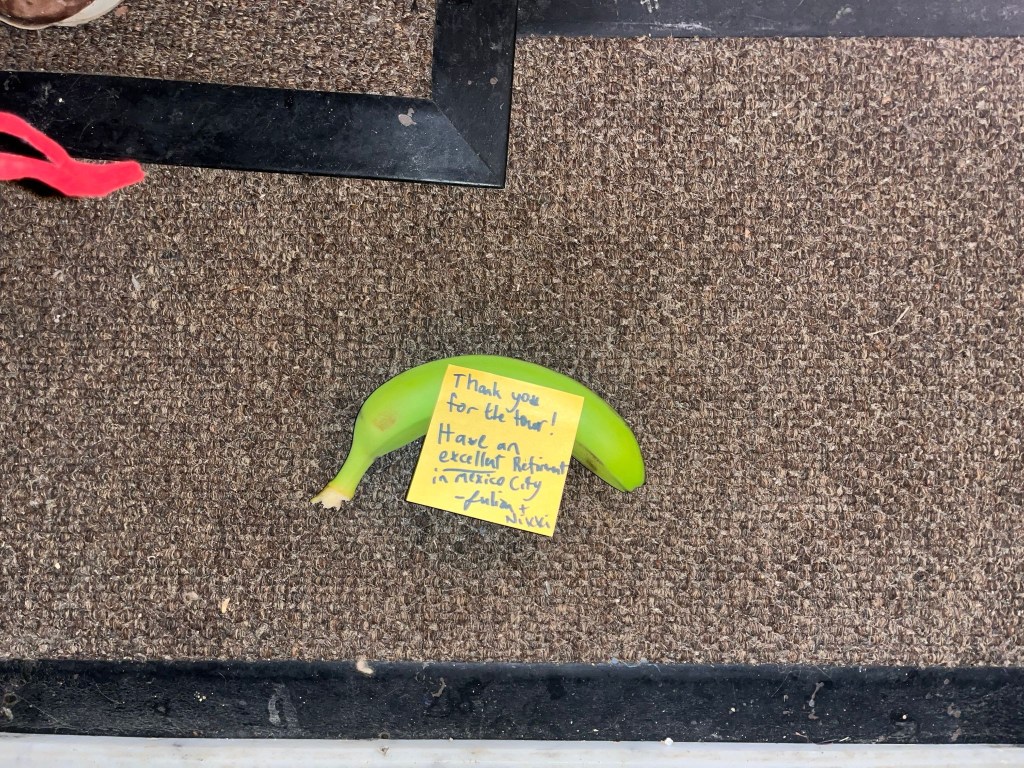
Three hours later, Partner and I leave a very green banana outside 5C door with a note: “Thank you for the tour. Have an excellent retirement!”
–
Shortly before we part ways, Raúl tells me his wife spotted me back in the lobby due to the bunch of very green bananas I was carrying. That’s the way she likes to eat them. Very green bananas can be hard to find. He jokes that she wants to buy one off of me. I offer one but she declines.
In retrospect, I wonder who befriended whom.
—
Three hours later, Partner and I leave a very green banana outside 5C door with a note: “Thank you for the tour. Have an excellent retirement!”
Pity they’re leaving. But if they weren’t, would we even have met? Tomorrow, I will knock on 5D. I want to learn more about this bathroom.
No, I did not leave the house today. No, I did not leave the living room today. Yes, I had a good day.
Ah, yes, I correct myself: I went from the bedroom into the living room into the exercise room into the bathroom and into the kitchen, in a series of loops co-overlapping and co-insiding.
How did I have a good day like this, you may ask?
Well.
Everything I need is here.
I’m a bit of a homebody. That’s why I chose to live in one of the highest rent areas of the world.
(That’s a joke.)
I’m not a homebody. I like warm weather, however. And outside is particularly cold.
I don’t like warm weather just for its warmth. I like it for its sociality. Warm weather → people outside. Bopping around, conversing this and that.
I had a good day because I got some stuff done and I had tasty food and I got exercise and my apartment gets good sun and I socialized with friends (through a screen) and I went outside and did sufficient in-person socializing yesterday and have plenty of plans for tomorrow and the weekend.
I’ve set up my life to enable having lots of good things that I like.
So what if some days I am a hermit.
(Two days out of the last week? Yeah. Two days out of the last week.)
At 8:32am, my doorbell rings three times in quick succession. I groggily roll over and tell Partner I got it. I walk to the door and flick the peephole to open. “POLICE!” says the voice on the other side. The peephole is dark as though covered by something. The something moves. I now see 3 bodies. “One sec.” I reply. The voice on the other side grunts something noncommittal. Naked, I go to the bathroom and pee for what feels like a very long time. I then toss on yesterday’s shirt and pants. I tell Partner, “What do we tell cops?” She replies something like, “The truth?” “Nothing,” I reply. “We tell cops nothing.” On the way to the door, I grab my hat. Just before opening the door, I turn on voice memo mode on my phone.
I open the door. It’s a man in front, two women standing one on either side behind him. The following is a direct transcript.
Me: Hey, good morning.
Cop: Good morning, how are you doing? My name is Austin, from the New York City Police Department. Sorry to bother you.
Me: No worries.
Cop: What’s your name?
Me: Julian.
Cop: Julian, are you the only one that lives here?
Me: Yeah.
Cop: You just moved in here?
Me: Yeah.
Cop: How long ago?
Me: End of January.
Cop: End of January. Do you know who used to live here before you?
Me: No.
Cop: Oh, okay. Do you get any, is it just you that lives here?
Me: My partner is here at the moment, but I’m the only one who lives here.
Cop: Who’s your partner then?
Me: Nikki.
Cop: Nikki. Do you get any mail, or used to, for this name?
[He holds out a piece of paper. It’s a mug shot with statistics.]
Me: [Mispronunciation of the mug shot person’s name]?
Cop: Yes.
Me: I’m not familiar with that person.
Cop: No mail?
Me: No.
Cop: She look familiar to you?
Me: No.
Cop: No.
Me: I received, maybe like two weeks ago, a letter or two in the mailbox that was not addressed to me, and clearly wasn’t for me, and so what people usually do is they put it on the thing next to it, and then when the guy comes by to deliver the mail, he’ll take it back. [I promise English is my first language.]
Cop: Do you know if it was for her?
Me: I don’t remember.
Cop: Don’t remember, yeah. Okay. All right. I’m sorry about everything.
Me: No worries.
Cop: All right.
Me: Cheers.
I close the door and return to Partner. She says in a deep voice, “NYPD, open up!”. We laugh about how cops are only mildly inconvenient in their normal duties (ringing aggressively at 8:30am, the way a child would ding-dong three times), but when they really want to get you, they’re incredibly inconvenient (like busting down your door at 5am).
Here’s what I’ve heard about the previous owner:
A mother lived here with her son. The mother owned the apartment. She died. The son didn’t make the maintenance fee payments. He kept sneaking into the apartment: breaking through the front door or climbing up the fire escape to break in. This explains the one-inch diameter deadbolt on the fire escape.
Last time the management company stopped by, the previous tenants had a big pool table in the middle of the living room. Compared to that previous state, our current state of disheveled (Amazon boxes strewn about) is what the management company describes as “very clean”.
The previous owner was foreclosed on. The court case took ~3 years.
Since this morning, here’s what I’ve since learned about [correct pronunciation of the mug shot person’s name]:
She was born in the Bronx, had a hard childhood, suffered from medical and mental health issues, was arrested multiple times for misdemeanors, and then was charged with felony robbery.
She participated in “Alternative to Incarceration” court with the Fortune Society, which provided her with therapy and an arts program. She had an art exhibition in 2022 and graduated from the program in fall of 2023.
In February 2024, she shared her success story at the State of the Judiciary program in Albany and has been featured in multiple materials since. She was proud to hold a job, have her own apartment, and was expecting her first child that spring.
She had an eviction filed against her in March of 2025 for not-my-address and is due in court next week.
It’s not clear to me why NYPD was looking for her.
I stopped by the bank earlier today. The banker talked for twenty minutes about the cruise she wants to go on. I told her the story of my morning, being awaken by NYPD. She began singing the Taylor Swift Song:
In which our hero brings a negotiation to a key fight.
After trying and failing to close my bank account at Wells Fargo, I strutted into the hardware store ready for a fight.
“Three of the big keys; four of the small. How much?” The older of the two cashiers replies, “Thees wun ees twenny. Thees wun ees fore.” $20 is standard, but I know I can get the small for $3.50. “I’ll give you $70 for all of them.” “Huh?” The older man asks his younger compatriot. The younger one says to me, “Set prices, no negotiating”. “Ok, then just three big ones.” They discuss my request in Spanish. They assume I don’t speak Spanish. They’re correct. But I do know my numbers.
The younger fellow cuts the three big keys. When he’s done, the older fellow says, “Udder wun?” I show him the small key. (I have 8 keys currently on my ring.) He takes it. I say, “I don’t know the price.” He ignores me. I think to myself: “After they’re cut, I have the leverage anyway” and look around the cash register ot see if there’s a fee for credit card.
The older fellow finishes the small keys and rings it up: $68.99 for the seven keys. I pull out my phone to pay with tap. “Ahhh, card?” The older man says. I suspected he would respond this way. But there’s no sign up-charging me for card usage.
I pay and he gives me the receipt. I feel like a winner. Then I look. $15 each for the big ones. $4 each for the small.
Did I school him, saving $7.01 over retail price? Or did he hoodwink me into thinking the $15 keys are $20 each?
At home, I tried all three of the big keys. Success. And then all five of the small keys. Also success. Wait. Five? Did they copy me five keys instead of three? Ha.
[Note: Last time Partner visited this store, they charged her $30 for a copy of the big key.
If my previous life was breadth, my now life is depth.
When friends call, I have less to share. Not because I’m doing less, but because my focus is more tailored.
I’m not flâning around Paris, happening upon big brass bands. I’m not traipsing around Rome eating lasagna. I’m not hand-over-handing chains to the top of Angels Landing.
But I am doing things I like to do:
Selecting the location of each light switch in my new home.
Optimizing the width and swing of each door.
Completing a daily Peloton workout.
Spending time with my partner, sister, brother-in-law, and nephew.
Studying and playing poker.
It’s just…
The depth of these doesn’t lend itself to sharing.
(My partner disagrees. She thinks I just don’t have practice in sharing it. I agree with her, not with me.)
My poker friend and I talk poker. But most others don’t have enough context to follow. And my poker skill doesn’t even go that deep!
What did I accomplish recently? I selected a cooktop, hood, two dishwashers, and oven. Did I enjoy it? Sure. Not earth-shattering, but sure.
How much of this change is the lowered intensity of my more-flat-than-one-year-ago hormonal state? How much is a decreased verbal fluency that seems to have come with the switch back to testosterone? How much is being in the moment more, rather than reflecting less? I’m not sure. I don’t know.
One of my dearest friends, when he had kids, shifted his entire focus to them. This is typical. I get it. Now, sometimes he calls me with nothing to say. He’ll hum or say “dum-dah-dum-dum…” I think he enjoys being with me, even if that’s all it is right now.
Outside my window, the wind swirls snowflakes. This particular alcove tends to send them upwards. My partner enjoys watching. “Snowflakes don’t go up!”, she says.
Yet here they do.
[Says Partner about these last two paragraphs:
I think this is touching and banal and worth sharing in a way you should find more about your day-to-day life.
Today you woke up to some of your favorite people at your front door.
You helped make a delicious dish you’d never made before that everyone raved about.
You wandered through the snow too far through the park because it was beautiful.
You scooted gleefully through Morningside Heights.
You snuggled and played NYT word games until you helped someone vent about their in-laws and recognized your role in soothing their worries.
All of these you could paint beautiful pictures of.
I used to do photography (*cough* also award-winning in a Ukiah competition *cough cough*) and one thing that inspired me about Ansel Adams’ work (other than the fact that they’re beautiful) is that he could see the beauty in the world and capture it to share. He didn’t photograph “interesting” things. They’re just random landscapes that tons of people could see, but he was able to recognize and capture that beauty in a stunning way.
Partner and I visited a poker friend in Queen. It’s an hour away from our home on transit. It didn’t feel like an hour. Still, that’s two hours round trip. Partner comments that this distance is roughly equivalent to training from San Francisco to Palo Alto for a party.
We did.
The party was hot sauce themed. They collect hot sauces from all over the world and sample them with friends. A great way to get people to cUsually on Valentine’s Day. This year a week late.
I met lovely people. Most work at the NYC parks department. I’m a big fan. Two canvassed for Mamdami. I asked one why she likes him. She said she likes his positivity and that he treats people like people (instead of, I gather, like numbers).
Now, 2.5hrs later, I’m ready to be in my soft snuggly bed. Ready to start the sous vide pork belly in preparation for tomorrow’s morning poutine for the hockey game.
At 32 years old, my first repetitive stress injury.
Second, after a pickleball shoulder.
But this elbow is also a pickleball injury.
Squeezing paddle, sure.
But also the orientation of my elbow as I laid on my back, my computer on my chest for too many hours: the hunched-over curl of a crone despite my then-13 years old.
I hunched today as I did then.
Now I pay.
It’s odd to grow old. To scrape off one’s vigor and exchange passion for comfort. To realize my mind may be and continue to be heading farther away from me, not nearer.
To replace exuberance with action.
Having finished most of the big explore, to replace it with exploit.
Enjoying everyday enough to select it among the infinite.
To have experienced enough to know.
How many have made pilgrimage to Seoul for the finals of your favorite childhood sport?
Ran shirtless in Indonesia?
Meditated in Thailand?
How many have eaten pasta two blocks from the Vatican?
Kayaked the arctic ocean?
Swam the Great Barrier Reef?
Negotiated for tee shirts in Mumbai?
I don’t feel like a life unlived.
I feel like the foundation; the fundamentals of everyday existence:
That those thusfar empties are slowly seeping solid.
I don’t need to see the thousand buddhas again.
I’ve seen them, snapped selfies with silly smirks, stumbled upon the graveyard, and biked home.
Share these with a future wife and children, sure.
Invite my extended family to duck and cheese at my Paris pied-à-terre.
Between 10:05am and 6:30pm, non-stop (with breaks only for bathroom; no food), I…
Rejiggered my apartment floorplan, composing a total of 32 different line-item changes, including
Selecting an oven.
This was easy because 1) we want it mounted below the cooktop, and 2) our cooktop has a list of 20 different models that could safely be mounted below the cooktop.
This was difficult because our cooktop has a list of 20 different models that could be mounted below the cooktop.
All-in-all, a combing and comparing game.
Selected two dishwashers (my apartment will have two! :D)
Did you know you’re supposed to clean your dishwasher filter regularly? Did you even know your dishwasher had a filter? Did you know they now make dishwashers that have basically garbage disposals in them so you never ever have to clean the filter again???
Removing one refrigerator, but leaving its dedicated power supply and also placing another dedicated fridge power supply elsewhere. (I suspect I will eventually want to have two fridges, maybe two fridges and a chest freezer, maybe two fridges and a chest freezer and half a cow. That is a later problem.)
Crunched through 8 different general contractor proposals with the help of Claude and ChatGPT, resulting in
Almost definitely selecting my contractor to hire.
A list of 44 open questions and contract terms to adjust with him.
After that work sprint, I…
Completed a 20min Peloton Max ride and a 5min Peloton core workout.
Played penny poker for 2.5hrs. Lost $71. Played very well, except for one call. That call cost me $45.
Played dollar poker for… I’m still playing while I write this. Lol. Currently down $37.
My Partner has a rule: She goes to Central Park every day. It’s less than a block away. I support this rule.
I do not have that rule.
Today, the farthest outside that I went was to drop trash off in our building’s bins.
 Julian Wise