Honesty in Comedy

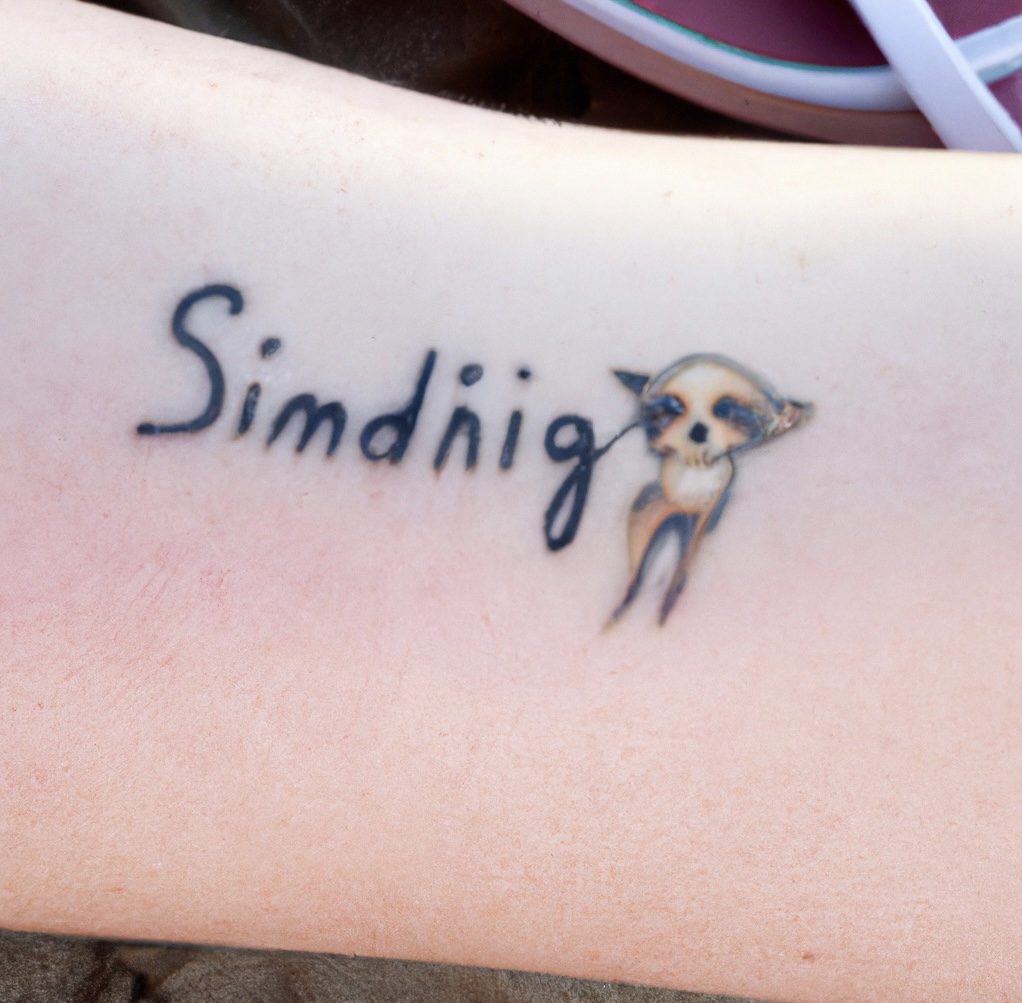
Yesterday I intentionally lied to you. I posted an AI-generated picture of a tattoo, claiming to have received this tattoo while drunk in Bali.

I have never received a tattoo, nor have I been drunk in Bali. I lied because it was April First, the only day out of the whole year when non-malicious lies are more than accepted: they’re celebrated.

I’m currently writing a personal-history one-man show that aims to be honest, to entertain, and to have impact. Honesty is tough when speaking to a diverse audience. New Yorkers will take your words at face value unless you indicate exaggeration via a clear tonal inflection. (Does this make New Yorker a tonal language? I say yes.) Brits and southerners prefer a deadpan that allows them to employ their own bullshit detector. One cannot satisfy everybody’s requirements for honesty while preserving the level of humor I desire. In my upcoming show, I will need to choose between being a comedian (entertainment) and being a journalist (honesty). I will need to have a defined stance, if only to maintain my ability to sleep well in the face of twitter criticism. John Oliver threads this needle by claiming comedy, which allows him to have the impact of a journalist without the industry’s behavioral constraints. Is this cheating? Absolutely. But it’s also an elegant way to win. So here’s how I define my stance:

These distinctions are absolute tosh. They’re like saying “a comedy ends with a marriage; a tragedy with death.” When was the last time a romcom ended with the marriage of all significant characters? Or a modern tragedy ended with a Hamlet-like bloodbath? We’ve been mixing genres over the last few years because they’ve always mixed. And April Fools is a holiday to remind us the ability to impact truth through lies. Is Amazon’s 2013 Cyber Monday claim that they’d have drone delivery in two years any more of an April Fools hoax than the 2019 April Fools joke of an Amazon delivery blimp? Many people even treated the April Fools one more seriously while ridiculing the the Cyber Monday one as a joke! Impact-wise, isn’t the main difference publication date, enabling Amazon to be the most-discussed retailer on one of the most profitable retail shopping days of 2013?

Approximately 50% of the people who received my tattoo message recognized it as an April Fools joke. The other 50% were hoodwinked. I debated over telling these hoodwinked people “April Fools!”. I’ve concluded I’m not going to. Because at some point most of them will realize that it was an April Fools joke. And doesn’t the fact that the joke lasted months or years make it even funnier?

And for those who never realize it, I’ll take solace in the fact that I’m not a journalist, nor a comedian: I’m an axolotl that regenerates its skin every few months, which is why the tattoo has already vanished. But I’m sure you already knew that.

An In-Depth Review

Airbnb reviews only permit 1000 characters. So here’s my full review of a place I stayed in Cairns, Australia 🤪:

“I’ve been a poor university student for the last four years, but staying here is the first time I’ve felt like it.” —a fellow guest at Anita’s Airbnb

Internal tension is not, generally speaking, what one seeks in an Airbnb. Yet during my 6 days at Anita’s place in Cairns, I found myself not only experiencing a profound sense of dissatisfaction, but somehow enjoying that dissatisfaction and feeling grateful for its lessons.  

Anita’s place somehow provides slightly-above-spartan accommodations at slightly-above-discount prices, but in a hodgepodge of uncanny ways. I’ll give an example: The room boasts plenty of wall outlets — at my count 6 — which is very desirable in an Airbnb room. However, the majority of these outlets are placed above the head on one’s bed, and at no point has any person said “I’d like to plug in my devices right here, above my pillow, with no location to place the device while it’s charging.” The shower, too, isn’t quite wrong but seems like it was designed by someone who had heard what people like in a shower but never used one themselves, as it boasts beautiful tiling, ample hot water, and bountiful nozzle settings, but also dampens your towel because the only place to hang it is on the inside of the shower door. The outdoor dining table is a lovely place to chat with a fellow traveler on a warm summer evening, yet this delight is diminished by the requirement that you wave at the automatic light sensor every 30 seconds to turn it back on. 

If there’s a word to describe my stay at Anita’s in Cairns, that word would be it: “uncanny”. It’s uncanny that I would find the mattress perfectly comfortable, yet also awaken with a hip pain of a sort that I’ve never before experienced. It’s uncanny that I would have a long conversation with the host about making the internet work in my room, which it definitely didn’t beforehand and after which it somehow magically does. It’s uncanny that the Airbnb listing includes twenty-three (23) rules which one must follow during tenancy, and then posters and text messages upon arrival add an additional three (3), and yet existing in this space gives you the sense that breaking the majority of them would simply be ignored. As I was leaving, I snuck a glance inside Anita’s room, and was shocked to see it resembled a security office. If she has three screens of cameras, all presumably monitoring and recording, then why are the drying rack and kitchen trash can always overflowing? I suspect the only rule that Anita enforces strictly is the “absolutely no guests” policy, but somehow also get the niggling suspicion that her uncanniness would give me the thumbs-up on updating my Airbnb reservation from 1 guest to 2 as I’m walking home with a sweetheart in real time.

Anita’s Airbnb gives the impression of an earnest person really truly trying their best but tripping in random ways. Sure, she spams you with a bunch of tour and travel options immediately after you make your reservation, but after that initial volley it’s not like she’s pushy – or even brings them up again. Yes, she’ll make a bit of huff when you’re on your phone at 8:58pm and quiet hours start at 9pm, but it’s the sort of gentle and direct huff that makes you wonder whether you actually were being too loud for even pre-quiet hours. And then, when you’re quieter, it’s somehow totally fine that you talk until 10. The place is spartan yet functional, and isn’t functional what matters? If travel is about exploring a new place, and therefore yourself, isn’t it appropriate that you finally feel like a poor university student if that’s what you are? Still, it’s not particularly pleasant to feel like a poor university student, so I give Anita’s place three stars. 

Care / Try / Worry / Do: A Psychological Framework

  • Care = believing something to be important.
  • Try = psychological effort, eg imaginative rehearsal or planning.
  • Worry = physiological/emotional arousal.
  • Do = action on the world.

These four functions are separable: each can be on or off individually. There are 22 different combinations. Some of them have names. E.g. Try + Worry + Do (without Caring) is called ‘Being triggered’”, Care + Do (without Worry or Try) is called “Being in Flow”, and “Maturity” or “Expertise” is Care + Try (with decreased Worry and Do).

I have a hunch that we exist in many or all of the 22 mental states at different times, and that one could use these mappings to intentionally move between states. (E.g. When “Practicing”, aim to be in Worry, Care, Try, and Do, but when “Playing”, exclusively Care and Do.)

I’m considering making a flowchart of the 22 different possible states, with arrows + tactical blurbs indicating when one should be in them and how to move between them. Thanks for reading this blurb – I have three quick questions for you:

  1. Is this framework interesting?
  2. Would you find such a flowchart interesting?
  3. Do any of the terms (Worry/Try/Care/Do) seem misfitting? If so, what terms would be more appropriate? (Eg I’ve considered “Act” instead of “Do”.)

Covid Currents

This article is an anonymous guest post by a brilliant writer and dear friend. Its views and opinions may or may not represent my own. They certainly represent my friend.

Remember when you weren’t a total asshole for getting all of your friends sick? You’d show up to the party with a little sniffle and say “yeah I was throwing up yesterday, it sucked, but I’m a trooper so here I am at Feb Club.” A few days later a few of the people would get sick and think “ugh, I must have gotten it from them.” It sucked for maybe 24 hours but wasn’t that big of a deal.

I remember that time, when my willpower was the only thing standing between me and my friends. I worked the long hours to make the money. I’d take the craziest flights with the craziest layovers. I would stay up all hours of the night finishing homework I should’ve done yesterday. This community. This connection. This is what matters.

I’ve looked forward to my college reunion since the day that I graduated. I remember standing in a circle with my friends in the Trumbull courtyard, pieces of smashed tobaccoless pipes scattered across the stone, and thinking “at least I’ll get to relive this moment in five years. I know it won’t be the same. I know everyone in this circle won’t be here again. But I will be here.”

Until I couldn’t. At year five, the entire event was canceled. It wasn’t safe to invite a global population to gather. At year six, the invitation was open and I was forced to decline. At any other point in history, I would’ve shrugged off my cold symptoms and carried on. In 2022, one faint pink line trapped me behind the glass watching snapshots of my friends reunite without me. 

Over two years later the pandemic still is thrashing through our lives wreaking havoc in more ways than one. We all find ourselves forced to draw a line in the sand and wage an internal battle with ourselves of when we can cross it. Each wave of new information eradicates our former boundaries and forces us to draw a new line. Even if we plant our feet firmly in the ground and refuse to move, it’s inevitable that the current pulls us as we tumble through the wave.

When we come up for air, we find we’ve drifted further apart than we ever have before. And many of us will decide it’s not worth the risk to find our way back to center. 

Weeks ago, my friends said, “we will do anything to make it happen.” Outdoors. Masks. 6ft. Not ideal but doable. A thin line where we could meet without crossing boundaries. When the day came I found myself alone in Central Park, surrounded by strangers, because no one came. Despite all of the texts filled with brief apologies I couldn’t help scanning the crowds at each turn. I knew my friends were somewhere among them, just out of reach. 

I read their promises: “we will see each other again soon.” And for the first time, I don’t believe them. We’ve changed. We have new priorities. “When my semester ends.” “When work slows down.” “Once I move into my new apartment.” … And as much as I want to recall those feelings of connection and belonging over the smashed tobaccoless pipes, the rejection I feel now is overwhelming. 

As my friends took their last maskless selfies before heading into New York City, some took the virus with them. They had spent three days dancing, drinking, kissing peers who had flown in from all around the world in blissful ignorance. 

At the end of the day, the passengers on the train, the patrons in the restaurant, and the millions of strangers in New York were worth the risk. I wasn’t. 

Maybe this is the same path taken time and time again. Friends grow up, and move on. But something today feels different. This virus has accelerated the timeline. It stole two years of our youth. It stole the days when our priority was still finding each other. It dumped us on the other side, scarred and unprepared for the conversations that lie ahead in our relationships. 

It’s no one’s fault. I’m still angry. 

Maybe we should more clearly mark our boundaries. Maybe I need to stop forcing people to draw their line in the sand.

Maybe life is just that hard and all we can do is try to keep our own heads above the water.  

For now, I continue to sit in my disbelief. Staring at a puzzle that I have no interest in completing. And just wait for all this to be over. 

Diveball: Your Next Favorite Game

Today, only dozens of people in the world know how to play this game. In 5 years, it will be massively popular (on the order of 100k or 1M+ players). I’m going to popularize it. I’m publishing this post in part to spread it wide and in part to plant my flag before it becomes huge.

How to play is linked here. (I’ll update that document as I iterate on the particularities of the rules. The basic structure, however, is solid.) I’ve also pasted the current version of the rules below:

Diveball

Materials:

  • 1 pool table
  • 1 cue ball (that’s the white one)
  • 1 7 ball

Setup: 

  • Each of the 4 players stands at a corner. 
    • Players are on a team with the person directly across from them (i.e. the player with whom they share a long side). 

Definitions: 

  • The 7 ball is “dead” if it stops moving. 
  • The 7 ball is “scored” if it enters one of the corner pockets. 
  • Each player has a “kitchen”, which is the one-forth of the table closest to them. The boundary of the kitchen (the “kitchen line”) is formed by connecting the second dots on the side of the table. (Players who share an end will share both a kitchen and a kitchen line.) 
  • A team has “possession” when it is their turn to play. 
  • A player performs a “shot” when they touch and/or release the cue ball such that it hits the 7 ball. 
  • A player performs a “pass” when they transfer the cue ball to their partner (without the cue ball touching the 7 ball). 

Play: 

  • A team wins a point in one of three ways: 
    1. Making the 7 ball dead during their opponents’ possession
    2. Scoring the 7 ball (note: scored only applies to a corner pocket). 
    3. Their opponents commit a foul. 
  • “Possession” works like this: 
    1. The serving team begins with possession. 
    2. A team passes possession to their opponents by touching the cue ball and then the cue ball touching the 7 ball. 
  • Serving works like this: 
    1. Set up for a serve by placing the 7 ball in the middle of the kitchen line opposite the server. 
    2. A legal serve is one where the cue ball hits the 7 ball, then the 7 ball hits the back wall before it stops, goes into a pocket, or hits a side wall. 
    3. A server has three attempts at a legal serve. 
      1. If they fail, the opposing team receives a point and the 
  • Note: the 7 ball is not scored if it enters one of the side pockets. Instead, if this happens, no teams score any points and the player who hit it into the side pocket chooses the next server. (They may choose any of the 4 players.)  

Illegal actions (i.e. “fouls”): 

  1. Touching the 7 ball. 
  2. Touching the cue ball when it is not your possession. 
  3. Touching the cue ball while it touches the 7 ball. 
  4. “Playing from the side” – i.e. failing to have both feet behind the horizontal line that determines the end of the table when making a shot. 
  5. “Playing in the air” – i.e. failing to have at least one foot on the ground when releasing the cue ball in a shot that prompts the cue ball to hit the 7 ball. 
  6. The cue ball contacts the 7 ball while any part of the 7 ball is in the releasing player’s Kitchen. 
    • To avoid violating this kitchen rule, you should pass the cue ball to your partner when needed. 

A game works like this: 

  • Randomize the first server. 
    • After each point, the partner of the player who last legally transferred possession serves the next point. 

A match works like this: 

  • Play “best two out of three” games (i.e. the first team to win two games wins the match).

Clarifications: 

  • If the cue ball goes in any pocket, the point continues. Whichever team has possession had better fish it out fast! 
  • If the 7 ball jumps off the table, award no points and serve afresh. 
  • The 7 ball is only scored in the corner pockets. If it’s hit into a side pocket, no points are scored and the player who hit it into that pocket chooses the next server. 
  • The 7 ball is only deemed to have “stopped moving” when it is no longer rolling nor spinning AND the cue ball is stopped or touched by a possessing player or touches a wall. 
    • Therefore, the balls do not have to collide before the 7 stops moving; a team need only release the cue ball before the 7 ball stops moving, so long as the cue ball hits the 7 ball directly thereafter. 

My Favorite Olympic Moments

As the Olympics is one of my favorite holidays, I’ve viewed many, many competitions. These are my favorites, along with my custom awards for arbitrary categories:


Men’s high jump: Best celebration. (The audio is in Italian because the announcer is Italian.)

Men’s 400m hurdles. Wins my award for best athletic performance. 

Interview with 2nd place finished in men’s 400m hurdles. This guy ran a world record… and came in second. Wins my award for greatest heartbreak. 

Women’s karate. Wins my award for coolest badass. 

Women’s speed climbing (the climber on the left). Wins my award for most impressive precisely-honed skill. 

Diving. Wins my award for most impressive child. (#14YearsOld???)

My award for best dogpile (starts at ~45secs, but the beginning provides context).

Greatest celebration (including “greatest kangaroo”, who is the gent in grey wearing flip flops).

I hated Uncut Gems; it’s one of the greatest movies I’ve seen.

(Contains spoilers.)

It’s an odd arc for a movie to follow Goodness itself. Most stories teach us lessons by showing us a person: we match the Good parts of ourselves with this protagonist in the film. The Good parts undergo trials but ultimately prevail.

In this movie, however, bad behavior is punished. It’s the sort of movie that would answer the question “Is murder a sin?” with “Depends: who are we talkin’ about?”   

In uncut gems, the protagonist is Goodness, we follow the plot arc of Right, and Right, as it should, ultimately triumphs in the end. The vehicle for this lesson, however, is a sad sack of a meatbag: Adam Sandler watches a basketball game instead of tucking his son into bed; he explodes in anger instead of listening to his girlfriend; and he gambles with borrowed money instead of paying it back.

We empathize with the people around Adam Sandler: the three kids, the wife, the loan shark, the girlfriend. We even feel sorry for Sandler sometimes: He’s compulsive, but he’s right. We think, “I’m compulsive but right.” But Uncut Gems shows us: “Here’s where those two traits can lead you…”

So we’re oddly satisfied when Sandler’s big bet finally pays off… and is punctuated by him being shot in the head. “Those who gamble with others’ lives should pay with their own.

This movie does not merely show us how the world is; it describes how the world ought to be. Good should prevail while bad gets shot in the head, even if it’s that adorable goofball who starred in Happy Gilmore.

It’s not a pleasant film. You probably won’t enjoy it. Or you’ll enjoy it the way you enjoy going to the dentist and hearing stories about The Holocaust: it hurts but it’s ultimately good for you.

So process your trauma, overcome your compulsions, and watch Uncut Gems when you want something reeeeeeally intense.

17 syllables on my most exhausting week in memory

New job + old job = tough week. I couldn’t do it, but I care.

(I started a new job this week. It’s co-founder at a startup. I’m still ghostwriting for some people & editing for others. The co-founder role is a full time gig. My former job is still a full time gig. Dear Lord [that’s you, Smidgen], How are we gonna get through this?)

(The ending “I couldn’t do it but I care” is intended as an allusion to the impossibility of stretching oneself until necessity and desire intersect. I’ve done things this week that I couldn’t have done. But must + want => can. So I do.)