Clown School Weekend 3.1: Simple Precision

In which Our Hero consumes a couple clowns

Last night I watched two excellent clowns on YouTube.

The first attempted to climb a staircase: first with one foot, then two, then using a harpoon as a pole vault, then trying a taller staircase. Always slipping backward, performing a kind of “moon-crawl,” moving backward while pretending to move forward.

The second performed built visual jokes around pop songs: a blend of clown, prop comedy, and puppetry.

Both chose a single simple game, then repeated it in increasingly heightened variations. With tight physical control, that was enough.

Stand-ups need new jokes to stay fresh. Musicians can live forever off one hit.

Clowns might belong to that latter category — one beautiful idiocy, endlessly re-played. Not note-for-note as a musician would, but a single comedic insight will take you far.

That said, if your art requires physical presence, your reach is finite.

Clown School Day 15: The Honest Audience

In which Our Hero is too tired to pretend.

One nice part about clowning is that the audience is honest.

By some biological necessity, they can’t fake it.

If the player is light, open, with pleasure — they’ll laugh.

Even if they’d hate you in real life, they’ll like you on stage.

That’s a comfort for those of us who don’t easily make friends:

who click with one in every thousand people we meet,

one in a hundred even here at clown school.

My second goal here is to make friends.

My first — learning the craft — is easier.

It has less randomness.

A good clown should be able to open themselves

and bring pleasure regardless of who’s watching.

That’s what makes it challenging.

That’s what makes it a job.


At the start of sophomore year of high school, I realized I had no friends.

Uncoincidentally, around the same time, I began to find women attractive and desirable.

I reasoned that I could either change the world or change myself.

Changing the world to fit one’s taste is the path of a supervillain

(and takes far more energy),

so I decided to learn how to be a friend.

If you try to be funny, you’ll never be funny.

If you try to be a friend, you’ll never be a friend.

Instead, to clown, you simply have to open yourself:

be kind, generous, caring.

The same is perhaps true

for friendship itself.

But what if you open yourself and discover you’re… kind of a jerk?

“Open” seems to increase attention paid to you. Charisma, one could say.

The others are the ones that keep them coming back for more.


When I’m sick, I hate everything.

My body hurts, my brain shuts down,

and I want to crawl inside the dark and stay there.

And yet, something happens on stage.

The power of giving,

the act of offering pleasure to the audience,

somehow overcomes the weakness of the flesh.

Bam! Pow! Beauty.


So now, I feel lonely, surrounded by clowns.

I’ll probably feel better in a few days,

with zinc and tea.

And then…

who knows.

Who knows.

Who knows.

If you don’t like yourself,

how can you let others love you?

Clown School Day 14: Some Days Ya Don’t Got It

In which Our Hero fails honestly.

That’s three days in a row I’ve wanted to skip clown school.

And three days I’ve gone anyway.

Three days of long, heavy sleep:

11 hours, 9 hours, nearly 10 last night.

Three mornings waking early, wishing I could stay in bed forever.

What’s up with that?

I’m tired in a way that’s not physical.

It’s the exhaustion that comes from being seen — again and again — and still not finding what works.

The ache of caring too much about doing well, and not quite getting there.

Maybe it’s just the part of me that resists growth.

The part that wants to avoid the flop.

The part that whispers: stay safe, stay small.

But the show goes on.

So I go too.


In which two pairs of clowns succeed

I have a hypothesis about clowning: there are only two good moves.

The first is doing something good.

The second is doing something bad, and admitting it.

The second is just a version of the first: both are open, honest sharings of self.

Maybe that’s what makes someone funny: the willingness to be seen, and to be laughed at.

Open, but not grasping. Honest, but not pleading.

Just human: the funny little wriggly worm that we are.


Today, I failed.

I got exactly one reasonable-sized laugh, when I shrugged and said, “Some days ya don’t got it”.

It was the opposite of calculated, and therefore perfect.

My scene partner, though, was charming. I’m not good at charming a crowd.

One person, sure: I find what they care about and give them that.

But a crowd? That feels like crafting myself into someone they’ll love…

and that’s never been my thing.

Maybe that’s why I’m drawn to bouffon: the grotesque outcast who refuses charm, making you laugh by breaking the mold.

I don’t know how to play “charming” without feeling false.

Tall, handsome, strong, masculine — all that bland, moral ideal.

Heroes just seem so… plain.

My favorite sex-work writer once said something like, “When I do the girlfriend experience, I just give guys all the parts of a date they want, and none of the parts they don’t.”

It’s the same trick as charm: shave off the edges until only the pleasant remains.


The two American clowns who are alumni from this school that I’ve seen succeed are masters of the flop (one linked here).

They do things that don’t work, then admit it, again and again.

It’s delightful. Comic. But not powerful.

The most successful recent student, though — a Norwegian — is the opposite:

he does good things, and they work.

Maybe that’s cultural.

Maybe Americans prefer the flop because it’s relatable.

Maybe our comedy is just collective self-recognition in failure.

That’s probably why I’d rather play the fool, or the villain, than the flawless hero.


Today, two pairs performed brilliantly.

One was a seasoned clown with a German partner.

The clown failed, over and over, and acknowledged it.

The German played strong, stalwart, beautiful.

We laughed at one, cheered for the other.

Together they danced between laughter and awe:

Comic and Beauty, alternating in rhythm.

After five minutes, our teacher smiled and said, “Thank you for sharing your joy.”

I wondered how long the German had been performing — possibly decades.

And the seasoned clown has ten years under his belt, with awards to show for it.

I was glad to see them.

It helped to see the two paths clearly:

the clown who fails and admits it,

and the one who succeeds by doing good things.

Maybe both are forms of giving.

Maybe both are beautiful.

Maybe the German’s beauty wasn’t in his poise,

but in his openness — his unpushed caring,

his gentle invitation:

“I’m here. This is me. Go ahead: laugh at me.”

Clown School Day 13: Who’s The Laugh For?

In which Our Hero learns to give himself away.

Is giving giving?

We created a mob on stage. One leader, fifteen followers. The leader was in Major: loud, powerful, commanding, tall. The followers were in Minor: following along with the Major’s game.

The leader’s task: move for the group. Then, if successful, speak for the group.

Here’s the kicker:

We — the audience — could easily see when the leader was playing for others and when they were playing for themselves. Too delighted by your own words? Too much for yourself. Too fast, too slow, too complicated, too boring? All of it = no good.

It was fucking cool.

It wasn’t just obvious when a leader played for themselves: we could even separate which parts they did for themselves. Some moved for themselves but spoke for the group. Others spoke for themselves but moved for the group.

Me? I moved for the group until I started speaking. Then I spoke for the group but failed to move for them.

The magnetism of a Major doing for others was inescapable. It drew us in — as the audience — as though they were playing for us, too.

I keep wondering what “giving” really is. Is it enough that someone is giving to someone? Or must they somehow give to each person? The latter seems impossible: no one can give individually to a 3,000-person crowd. But you can give, and keep giving, and keep giving…

I thought about that today when I found myself in a spat with a friend. They argued — accurately — that I’d been laughing for myself, not for them. And they found that objectionable.

At a minimum, they were fair (jury’s still out on them being right ;). Maybe I’ve found too few people laughing for me, so I learned to laugh for myself. Whatever the reason, it’s unhelpful — on stage and in friendship alike.

That’s why I’m here at clown school:

because I’m a guarded, frightened, closed, selfish, winning-focused person

trying to open up.

It’s hard to give and share and open and keep giving in this ever-present openness.

First-year classes are often “weeder” classes — designed to weed out those who aren’t a fit. In college, I lasted one day in Theater 101 before switching to philosophy. Theater 101 was dry history; philosophy had rigor and use.

I wonder if theater students who truly love it endure that drudgery because they care so much about reaching the next level — the acting classes, the real thing.

Here, too, I’m pushing through the bullshit, the trials, the endless tests: chasing skill.

The teachers keep throwing more at you, more and more, just to see who will break.

Those who break aren’t meant to be clowns.

And maybe I’m not meant to be one either.

So I’ll grab what I can from this pressure cooker,

gather the small diamonds I find,

and fuse them with other gold I’ve picked up along the way,

to form

my own

crown of jewels.

Clown School Day 11: The Joy of Gibberish

In which Our Hero finally speaks his native tongue

I did it! I clowned! Wahoo!!! !!!! !!!!

Here’s the sitch:

Our head teacher asks for five people who don’t speak Chinese. I step forward. She plays a Chinese song and we’re told to mime along. Then she turns down the music and says: keep going. Continue the song, in this language we do not speak.

I have been preparing for this my whole life.

I’ve always loved imitating sounds. Not faces, not gestures, sounds. The cadence of languages, sirens, shower water hitting my rubber duck. It’s always been a private delight.

Today I let it out. I imitated the music of a language I don’t know, and loved it. The audience loved it too.

It gets better.

On Friday I asked our teacher how to tell when something works. She said: you have to look at the audience and see.

I already knew that, but I needed to hear it from her.

So today I looked. I saw the joy light up their faces. One woman — the same who’d argued with me on Thursday — beamed with glee. My roommate was glowing, proud to see me not only succeed but to know I was succeeding.

And so I kept playing. Kept singing. Kept sharing that joy.


Good news: I have a skill people love.

Bad news: in America, this skill is considered offensive.

Five years ago at a rodeo in Wyoming, I was doing a southern accent for fun. My travel partner told me it was unacceptable. She thought I was mocking. Maybe she was right; maybe she wasn’t. Either way, I stopped.

Now, at last, I’ve found a place where the same instinct — my delight in sound and voices — brings laughter and connection instead of tension and fear.

Sometimes I wander around the house doing silly voices. Usually, people shut this down. But in clown, it’s beautiful.

Or maybe it’s always been beautiful, I just need the right place to perform.

🤡

[My travel buddy of the last two years would like to add this note about me: “I’ve also noticed when traveling that you [Julian] pick up the accent and speech pattern of folks you chat with. I often worry that folks will find it offensive, but, tbh, I think they don’t usually notice and seem to like it.”]

Clown School Weekend 2.1: The Cleverness of Simplicity

In which Our Hero dunks on century-old cinema

Charlie Chaplin is a comedy god. I saw his magnum opus today. It was… fine?

Not great. Not exciting. Not even that funny.

One or two strong laughs — the eating of the shoe, the dancing dinner rolls — but mostly, the movie made me sad. My film-buff friend assured me it was meant to. The pathos is why it’s endured, he said.

So we watch the Little Tramp suffer. The love interest betrays him. Our Hero suffers yet again. The sadness swallowed the play. I felt too much pity and fear to laugh.

I’m certainly more of a Marx Brothers fan. I like the clever. The sharp. The witty. The possible. Chaplin, by contrast, was morose. The Marx Brothers sparred with logic; Chaplin wrestled with circumstance.

I also saw three Laurel & Hardy shorts, and liked them much more. A quest to change pants, failing in ever-new ways. Elegant clownic escalation. Need a new beat: toss a crab in the pants. Simple. Repeatable. Because it was so limited, clever.

Clever comes from doing more with less. Laurel & Hardy did more with less. So did Chaplin, at his best: when dinner guests ask for a speech, he offers a dance instead (because it’s a silent film!). Cue the famous dinner rolls.

In clowning, the game is paramount. A simple, easy-to-understand game that provides boundless fun for the time allotted. Make the game simpler. Then vary it. Expand it. Loop it. Narrow it.

With clown, I don’t want a new game. I just want another well-played round of the same.

That’s what I’m learning in clown school: the joy of the repeat.

That’s what I’m learning in clown school: the joy of the repeat.

Celebrating My Hekoya Nature

A friend told me today about the Native American archetype of hekoya. He described it as, “When the crowd goes right, the hekoya goes left.”[1]

[1]: (Wikipedia’s further description: The heyókȟa is a kind of sacred clown… [that] symbolizes and portrays many aspects of the sacred beings… [their] satire presents important questions by fooling around. They ask difficult questions, and say things others are too afraid to say. Their behavior poses questions as do Zen koans. By reading between the lines, the audience is able to think about things not usually thought about, or to look at things in a different way.)

In the spirit of the hekoya, I shall now celebrate my oddness. Here are things that I did today [well, yesterday as of posting this] that are completely reasonable and yet most people might find odd. Go, verily, and lead a more satisfying life:

  1. Drove 4hrs with a dear friend who dropped me off and then immediately hightailed her way back, thinking little of the gift. (As she described it, “I have a lot of books [to listen to on the drive]”). 
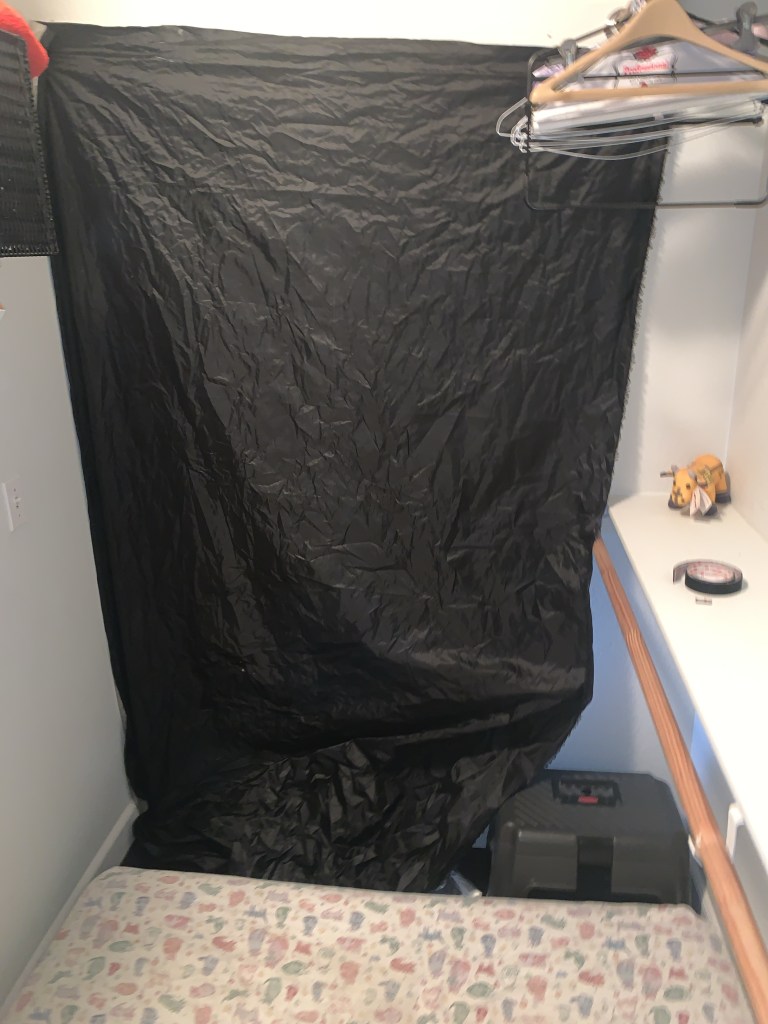
  2. Moved a bed into a closet and hung blackout curtains so I can sleep at my parents’ place in complete darkness.
  3. Bought a 65” flat-screen TV for my parents’ house, which I will only be in for ~2 months. (Gotta make your space your own!)
  4. Thought that buying a TV was weird (this thinking is perhaps more weirder than the buying… as I have never bought a TV. The only TV I have ever owned was an inherited little 15-inch doohickey installed by the guy who built out my camper van. (He used it, I assume, when he lived in the van. I used it a total of 3 times… ever… and it was… fine.). 

Pics of my new closet-room:

Now go, my children, and be the hekoya you were always meant to be.*

*: Most of you were not meant to be hekoya. Tough titties. It’s fuckin’ great.