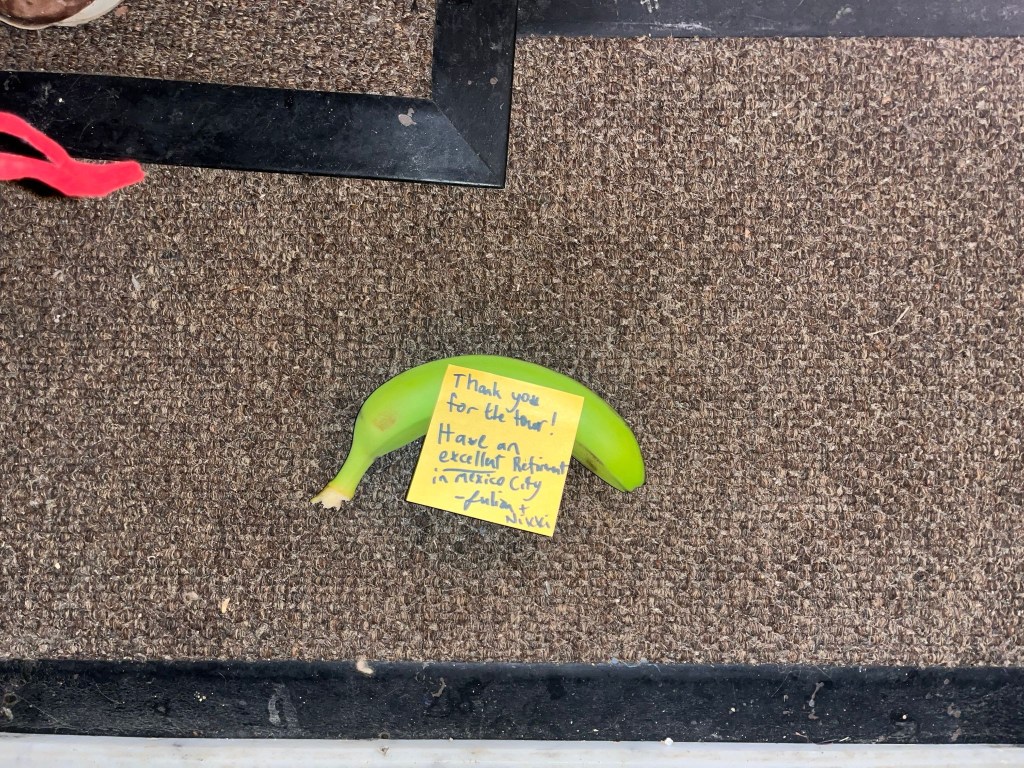
Clown School Day 23: Everybody Wants a Little Slice

In which Our Hero measures how much to give.

For a good time, bring a cake to a gathering of friends. Cut slices for each person. Ask how big they want. Invariably, they’ll say “Just a small slice,” or “Just a little one.”

Then, if you move the knife slowly and ask them to “say when,” you’ll find each person’s little slice is different. In some cases, it’s twice the size of someone else’s small slice.

When they say, “Just a small slice,” for whom are they speaking?

They’re not communicating in your language. If they were, small would mean the same thing.
Instead, they’re saying something like: “I’m signaling that I’m not greedy.”
Or: “I’m allowing myself pleasure, but a restrained version of it.”

Maybe I’ve always found moments like this confusing. Maybe because I’m autistic. Maybe because I never learned the unwritten grammar of appetite and permission. Maybe because the cultural norm to be small and not enjoy yourself is dumb.


On stage, the same puzzle repeats.
How much of myself is the right-sized slice to offer?

I have a great and powerful energy in me. I can give a lot. I have given a lot. My teammates, my teachers, and I all agree: when I was fire today, I burned.

But still—I didn’t burn for them.

Fuck.

I have so, so much pleasure. So much deep, physical intensity.
And goddamn it, how do I transmit this to you? So far, I’ve tried: 

  1. Give it directly. Too pushy.
  2. Increase my own pleasure. Too self-contained.
  3. Recommendation from friends: play with oscillation—me-pleasure, then share; me-pleasure, then share again.

Complicating factors:
(1) I can’t see on stage (I can’t wear my glasses with the neutral mask).
(2) I don’t find myself beautiful.


The teacher’s aid begrudgingly gave me her speculation today (directness like this isn’t really part of the pedagogy). She said she senses that I have beliefs about how I’m perceived, and that my behavior on stage is an attempt to offer those perceptions, then shatter them. Which isn’t the same as showing myself—it’s showing my idea of myself, or how I imagine others see me.

Maybe she’s right.
When I was beautiful, they loved me. Subtle. Gentle. Open.
I remember it dimly: tears streaming, face unguarded, giving.

I want to find that again.
Tomorrow, I’ll try.

When the Head Teacher told me I was insufficiently sensitive, she began with: “Not bad.”
And when I raised my hand to ask a question, she added:
“When you have done something good, it is better not to ask questions, no? It is better to think about what you have done.”

Maybe I’m harder on myself than they are.
Or, as a friend put it:
“It’s nice to know you’re harder on yourself than the teachers are.
It’s nice to know you’re not just failing over and over.
Or at least that you’re failing over and over—but it’s working.”

Tomorrow, instead of trying so hard to give that I push,
I’ll try so hard to open that I break.
And I’ll give that to the audience.
Maybe they’ll love it.

Clown School Day 12: If Only You Knew What Makes Me Laugh?

In which Our Hero is a total grumpypants.

You only want some of my joy. You don’t want all of it.

Not the part that finds fascination in injuries at the Olympics.

Not the part that laughs when someone fumbles at a task they’ve been doing for months.

Not the part that goes for blood in silly games.

You only want some parts.

School is cultural honing: a repeated sheening and shearing and shaping of an impressionable child into the kind of person we want.

Graduate school is self-imposed honing.

Clown school is emotional honing.

Half of this school is calibration: make it light, make it pleasant, make it generous.

Half is tactical: learn the mechanics and try them out.

And the final half (yes, I know) is experience: stage time with a real audience who loves this peculiar art.

But what if I don’t want to be calibrated?

What if I like my joy?

What if I’d miss the parts of it you call cruel?

A friend recently said something that ruined my joy at watching this video (includes a severe gymnastics injury). I used to find it fascinating. Now I can hardly watch.

Is that a loss? Once I received a fascinated joy. Now that joy is covered with a patina of sadness and pity.

Why do we do that to each other: sand the edges off one another’s laughter? Isn’t there a terrible beauty in the Olympian moment: a lifetime’s work undone in one leap? It’s comic, in the oldest sense: man plans and God laughs.

The funniest part, perhaps, is the commitment to the bit. This athlete may never walk again. That’s deathly serious. But he hurt himself with flips and spins, in a contrived game, for which the prize is mainly collective fiction (a title, which brings fame and glory). Is that not fundamentally comic? For me, it’s the same humor I saw in the nod of a hotel receptionist in Bentonville, Arkansas. I commented that the front page of their local newspaper was about high school football. She nodded solemnly, explaining, “It’s very important.”

No, it isn’t.

And yes, it is.

With the receptionist, I let her continue her joy.

While my Olympic joy is now covered with dry rot.

Now, when I rewatch, I can barely locate that joy. It’s smaller now, covered in a “But you shouldn’t…”

We choose the games we play. I’ve chosen clown school.

And yet, when peers see me on the street, when they ask what video I’m watching on my phone, I hide. I make a joke. I assume they’ll hurt me if I’m honest.

It’s hard to be honest and open.

So hard. Since it’s been so aggressively sanded away.

That’s why I’m here.

Because people don’t generally value openness, or honesty, or play.

We value these in contained scenarios. But an intensely raw emotion, honestly expressed? Best put a lid on that, missy!

I generally don’t find the world a nice place. I don’t think openness is generally rewarded. People can be vicious outside the boundaries of their games. That’s why games exist: to make behavior safe.

Within a game (religion, law, sport), there’s form. There’s play. Simplicity. Meaning.

Outside, there’s a new game:

The honest negotiation between what we’re told to laugh at

and what still makes us laugh.

I’d like to laugh at you when you’re being an idiot.

I’d like to laugh at me when I’m being an idiot.

Have you considered joining me?

It’s funnier over here.

And if not,

I’ll take

my ball

and go home.

“The child not embraced by the village will burn it down to feel its warmth” —African proverb.

New Orleans Would Agree If It Ever Came Home

On a cold Sunday night with my van heater blasting and a bit of white wine still seeping from my blood, I don’t feel misplaced. Not in the wrong place. Just alone, lonely, sad, and wanting. Maybe that’s this place.

The thing about travel? They don’t tell you it’s lonely. “An adventure of excitement and eye-opening growth.”

Yes, that’s travel. But it’s lonely, too.

It’s me and my dog, one month in our roadtrip. Atlanta, then Texas, now in New Orleans. Friends—some great friends—we met along the way. Yet still it’s just us— me and my dog.

Last night, out til 5, surrounded by parties, I made two new friends that I’m now gonna see. Interesting people with lives and opinions. Better than that, unique, fun, funny, too.

But now, when it’s late, and my sleep schedule’s fucked, I see why someone would get drunk again. Then it’s tomorrow. Who knows what could happen? Who wouldn’t have fun at a New Orleans club?

That’s not a solution. That’s open containers. Vessels transporting liquid from one place to place. People vibrating where they stand, moving forward only in time. Bleary, wide-eyed blobs drink to replace their cold sweat.

Why has this city not changed since Katrina? Why did my cabbie say there’s really no dif?

If you spend your life dancing, you’ve nothing to celebrate. That’s what this is: just an empty, wet kiss. But not one from your grandma or a dog or a lover. Just tongue from someone who, right now, like you, feels alone. Together will be great for the time that it’s lasting, but morning will come and you’ll have to go home.

Travel Log 191016 (Redacted Version)

Start: Outside E Bar Tex-Mex Restaurant, Dallas, TX 

End: Guest Room in [redacted]’s house, Austin, TX

Delicious Delectables: 

  • Shared my moscato with [redacted]. 

Real Realizations: 

  • Sex with complicated people is, well, complicated. 
  • You can live like a king in the outskirts of Austin (two-story house, 4 bedrooms, hot tub with a projector) for the same price as a solo studio apartment in San Francisco. 

Exciting Events: 

  • Walked Smidge through Dallas. Got lost, got directions from a helpful guy outside a convenience store. 
  • Hot tubbed with [redacted]. 
  • Arrived to Austin. 
  • Called the three groups I want to meet in Austin: 
    • [Redacted]
    • [Redacted]
    • [Redacted]
  • Called dad, told him about the burn and that I plan to [redacted]. He said, “be safe, whatever that means.” 
  • Called [redacted], told her stories about the burn. 
  • Spoke with [redacted] about his relationships & his life. 
  • Called [redacted]; she’s [redacted], not super happy with her life. 

Alluring Activities: 

  • [Redacted] tomorrow? 

Thanks, Dad, for an incredible day.

Thanks, Dad, for an incredible day. More connected with you than I’ve felt in memory. Your stories that weaved from place to place—about which I sometimes ask, “what was the point?”—today, the sharing was the point. Maybe that’s always true.


Am I focusing on the present because I’m having intensive surgery on Monday?

Could be…

Possibly…

Probably.


Right now, I’m afraid. Not of death, but life:

  • What if improving my breathing isn’t miraculous?
  • What if I fail?
  • What if I die?

Death I can deal with. It’s failure that’s unacceptable.


I’m donating my tomorrow to high school kids. Teaching, mentoring, engrossed in giving.


When I could die at any moment, why do I hop stepping stones?

  • “But Kid, the best stepping-stones are rock and their own right.”


I didn’t think about any of that today. Just talked with you, Dad. And I loved it.

Then I guess you won’t be pulling the plug? 

As my sister drives to Reno, I explain to her and my mother that I don’t want to be resuscitated. Nor ventilated. Nor any other life-preserving “–ated” with a low forecasted-quality-of-life.

They reject my request, which Mom communicates by saying, “I didn’t hear you…” as though pretending not to hear it will avoid it happening. I hadn’t expected that response.

Why would I rather have my plug pulled?

  1. Low quality of life for those in such a state?
  2. Comfort with the idea of death?
  3. Existence as a societal detriment?

The first and second seem unlikely: In most cases, humans adjust to our circumstances, and comfort with the idea still doesn’t make it desirable. The third seems reasonable, but assumes a low likelihood on me becoming a high-positive force again.

Perhaps the gruesome images of end-of-life patients that I saw earlier today impacted me. Perhaps in a soberer state, I’d rather live as long as possible in case medical science improves sufficiently to salvage me. If I prioritize my life, this seems the most reasonable conclusion.

In any case, my sister feels uncomfortable talking about these plans, but they’re valuable plans to have.

I was trying to prioritize them. I’ve heard tell of family members being in difficult situations because they didn’t know the patient’s wishes. A large part of this explanation was to spare them that difficulty, but they’d apparently rather have that situation than this conversation. And I don’t actually care enough to press the issue or put a legal solution in place. In case it ever comes up, whatever they choose is fine by me.

We did, however, agree on one thing: after we’re dead, dispose of us in the cheapest way possible. Now, I’d also like to add: dispose of me in a funny way. I’d like to go out doing what I love.