Hermit Crabs & Kidney Donations

A spoken-and-transcribed guest-post courtesy of Partner, who caught upwards of seven hermit crabs today: 

Hermit Crab Homes

Hermit crabs grow, but their shells don’t, because hermit crabs don’t grow their shells but find them. When a hermit crab grows too big for a shell, it will find a bigger one. If the bigger one is too big for that hermit crab, it will just hang out near the shell, in the hope that some other hermit crab will come take that bigger shell and leave behind its shell. Because of this, you can get a whole line of hermit crabs: several smaller hermit crabs are waiting to size up their shell. As soon as a bigger hermit crab comes and takes that too-big shell, it will free up a slightly smaller shell, and then another hermit crab could take that slightly smaller shell, etc., trickling down. 

It’s like the kidney donation chain. 

The Kidney Donation Chain

If I wanted to give you my kidney, but you and I are not a match, we’d be out of luck unless there were two other people, one of whom wanted to donate and the other to receive, and we were a reciprocal match so could swap. But generally, there are so many factors required for a kidney to fit that a direct swap is improbable. And they only let something like two or three people form a loop because they want to operate all at once. They’re afraid that, if they do them sequentially, the buddy of the first person to get a kidney will renege on his donation at the end of the loop because his incentive to give is gone. 

Because of this structure, someone donating the kidney without needing a kidney for a friend or family member can change that loop from a loop into a line, which is really mathematically beneficial. And the altruistic donor is just giving away the kidney, no one’s on the hook for getting a kidney back to them, so there’s no risk of someone chickening out. If you choose to donate your kidney, you can kick off a chain that doesn’t just help the one person you are donating your kidney to, but can actually help all the people who exist in that chain, which can be a dozen people or more. 

BBC Earth video on hermit crab shell swaps:
https://www.youtube.com/watch?v=f1dnocPQXDQ

Info on starting a kidney donation chain, including a way to get 5 loved ones to the top of the donation line if they ever need a kidney but you already gave yours away: https://www.kidneyregistry.com/for-donors/start-a-chain/
On Skillful Calibration (and Safely Pokin’ Gators!)

To improve, calibrate. To calibrate, employ expected value calculations (which is more fun than it sounds).

Two years ago, a friend passed on the opportunity to invest in Anthropic. He now regrets passing.

This friend prioritizes calibration. Yesterday I learned why he generally avoids risks. When viewing a risk, he considers only the magnitude, failing to also include the risk’s probability.

Expected value is one of game theory’s most powerful calculations: 

  • Probability × Magnitude = Expected Value. 

My friend is not unique: people often drop one of the two terms. Include both in your simple math; your outcomes will be better calibrated. (And it only takes a second!)

Magnitude-Only: Frozen From Fear

Considering only the downside magnitude over-biases against action. This heuristic will keep you alive but not enable you to thrive.

This example occurs whenever somebody says, “But what if it fails?” as a conversation ender. Slap a probability on that bad boy and you’ve got an EV.

Probability-Only: Missing the Magnitude

A friend once described why they don’t vote: “the likelihood I’ll have an impact is near-zero.” Ah, but tomes have been written about the enormous magnitude.

When someone says, “It probably won’t happen,” or “it’s a drop in a bucket,” check they’re also considering the size of the bucket. If the impact is large enough, the low likelihood that your single drop makes it overflow may be enough.

EV → More Fun

During my all-time favorite date, Partner and I hooted & hollered at an alligator.

Twenty minutes earlier, we strolled down a path through a Louisiana swamp. Partner meandered toward some tall grass. I said, “I wouldn’t do that.” Partner was surprised because her self-preservation instinct usually eclipses mine. I mentioned alligators, and said: in this circumstance, the magnitude is very bad (being eaten by a gator) and the probability much higher than usual (Louisiana swamps contain alligators, and Pokémon has taught me to beware tall grass).

Compare that moment to later: on a bridge 10 feet above an alligator. The magnitude is still very bad, but the likelihood de minimis. (Teehee, alligators can’t jump 10 feet!) 

Since we knew ourselves to be safe, we could poke the gator with our metaphorical stick.

When something seems scary, investigate the probability. E.g. “I can’t miss work to see my child’s school play: I could lose my job.” 

This concern is well-founded, but misses two elements: the likelihood of losing your job (probability) and the fact that you can influence that likelihood via other actions (malleable probability). (I’ll write more on malleable probability another time, especially as it relates to luck.)

Expanding your Vocabulary

Expected Value is a core step, but it is only the first step.

Error bars can make this topic tougher. The question “How likely is extra-terrestrial life to exist in our universe?” prompts wildly different outcomes whether you include the error bars.

So even if you do the EV calculation, you’ll still be wrong sometimes, you’ll still lose sometimes, and there’s still more calculation to do. (For a fun example, see Pascal’s Mugging.)

The Fiercest Chihuahua You’ve Ever Met

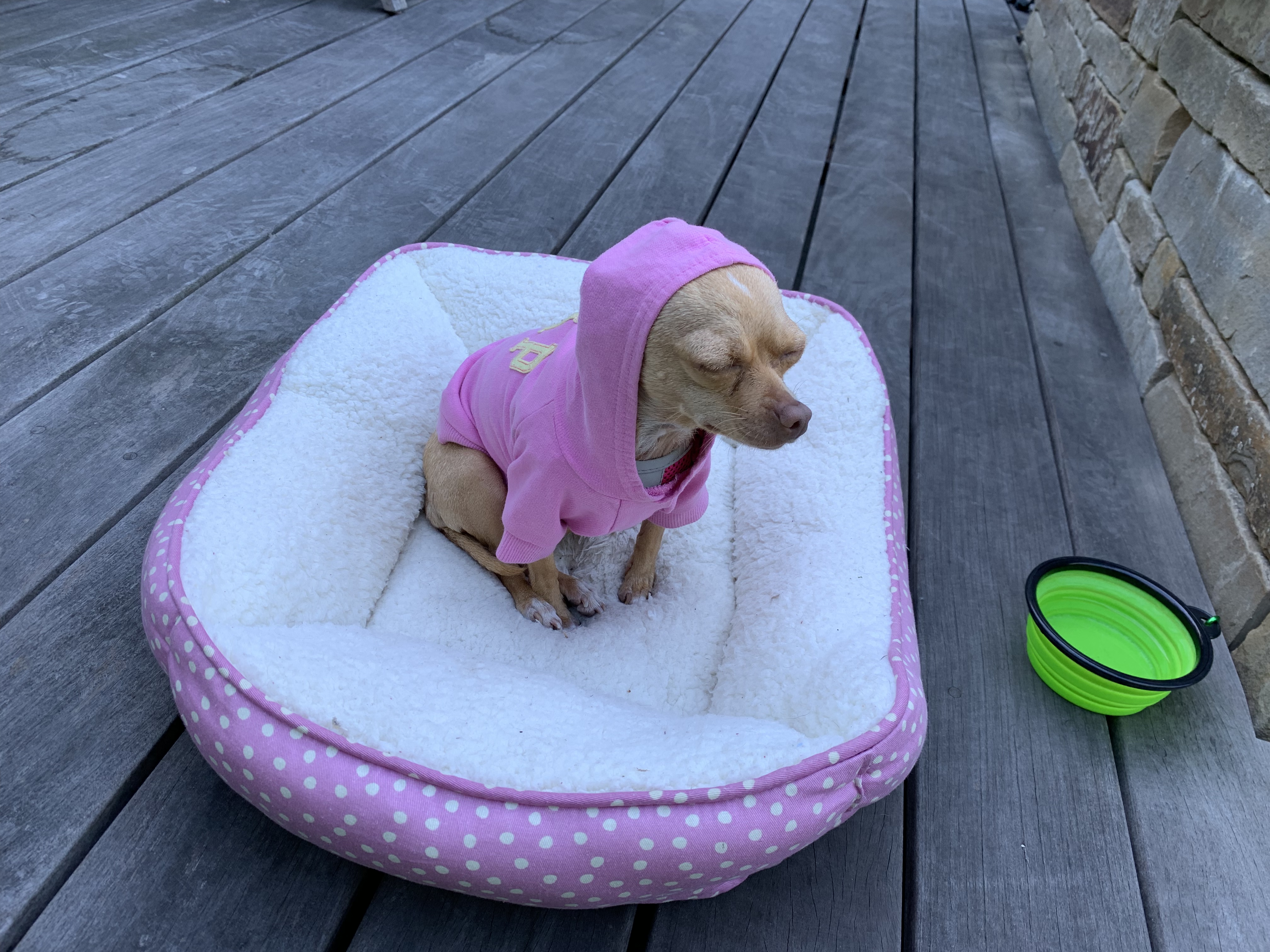
In this corner, at five-pound-four and thirty inches long, she’s the fiercest chihuahua you’ve ever met. She defends her food with the courage of a Rottweiler. She’s a fierce mama bear with six gnawed nipples to prove it. She marks giants’ territory as her own and likes her scritches… ruff.


Ladies and Gentlemen…


The one and only…


Smidge

IMG_7309


Want more Smidge? Comment with a request. 

If I wanted a Boat

The boat I would get, if I wanted a boat, would be everything that I am not.

Carefree and easy and flexing completely, withstand wind and rain and hot,

Skating along atop cresting blue waves, easing through shifting tides…


The boat I would get, if I wanted a boat, would not take me for a ride,

but summon me near, caring not if I come, chuckling and holding the ropes.

The boat I would get, if I wanted a boat, would dash dreams in favor of hopes.

“You’ll never go far with that kind of boat”

But I’m already too far, too fast.

The boat I would get, if I wanted a boat, would be one that my soul cries would last.


Days turn to weeks turn to months turn to years,

Then one day my boat turns on me

And I’d be its ears.

And it be my eyes.

Together, we’d share a mouth.


We’d turn, heading down, past the capes with a frown

To the warmest of waters due south,

Under the bridges of eyes and sand ridges, I’d sweat hard, shoveling coal

And my boat would tell me, “You’re working too hard. Where are we trying to go?”

I’d poke my head up, consumed in the clouds, and not help but utter an, “oh.”