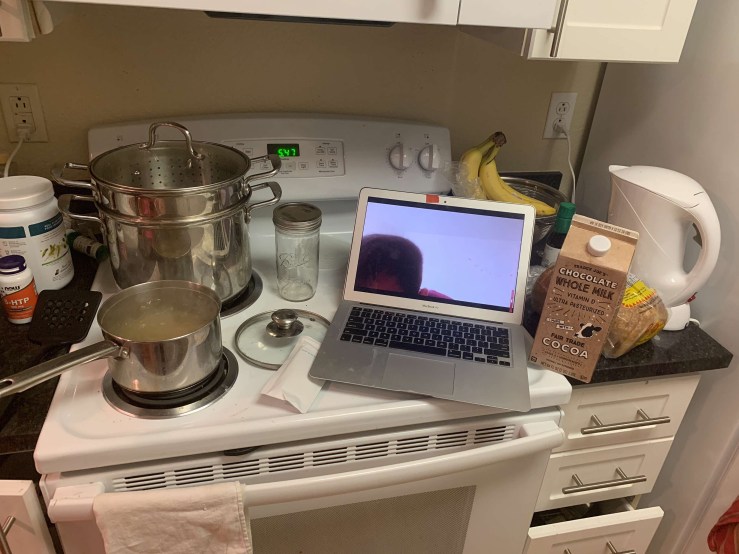
Fasting isn’t difficult, but it is trying. 

(Context: I haven’t eaten food in the last 72 hours.)

Fasting isn’t difficult, but it is trying:

  • It’s trying to get something to eat and then not.
  • It’s trying and failing to fill the void inside you that food usually patches over.
  • It’s trying to slow down and succeeding and enjoying that success.
  • It’s trying to speak French with the Uber driver from Ethiopia and not minding the embarrassment when he sticks to English.
  • It’s dancing with the devil and winning for a step or two.
  • It’s trying to wrench up gunk from within your soul but, digging deep, not even finding a soul.
  • It’s trying to find God in the man with the megaphone and instead just achieving an intense, god-like focus.
  • It’s molding yourself like a wet ball of clay.
  • It’s trying to define a self while also trying to change it.
  • It’s trying—and succeeding—to sleep peacefully, because nothing else matters when you’re hungry.

I don’t believe in “Character Alignment.”

After five years of wanting, I played my first D&D game today. Upon creating my character—Pimbleton the Great and Powerful and Mighty and Strong, a three-foot-tall gnome who rode into the world on a lightning bolt thrown by Zeus and spent twenty years enslaved by a cereal company who forced him to be their mascot before rising to monarch of a race of undersea people—I was asked what his “alignment” is. This refers to a 3×3 grid, with axes of “Lawful vs Chaotic?” and “Good vs Evil?”

  • Is he lawful-good, like Superman?
  • Chaotic-good, like Robin Hood?
  • Lawful-evil, like Senator Joseph McCarthy?
  • Chaotic-evil, like The Joker?

DD-Alignment-Chart-2.jpg

I disliked this question. It feels wrong-directional. We can describe an action as one of these, but they don’t describe the whole person.

  • What about a lawful-good character whose father was killed by an orc and therefore has developed deep-seated racism against them? If she’s lawful-good in every other instance, must she also be lawful-good toward orcs?
  • Or a chaotic-evil character with a soft spot for small, furry animals? Must he suffocate every bunny he meets, simply because he beheads every human in his way?

Actions should come from who someone is, not the easiest way to classify them. There’s no such thing as acting “out of alignment.” There’s only acting in character or not.

I intentionally don’t have a best friend. 

I intentionally don’t have a best friend. I don’t like the categorization. Or perhaps I have a best friend and just don’t know it:

  • If all my friends were in a burning building and I could only save one, who would I choose? Is that my best friend?
  • Is my best friend the person with whom I spend the most time?
  • Is it the friend I enjoy spending time with the most?
  • Is it the friend I think has the greatest impact on me? On the world?
  • Or is it just a gut feeling when I think the phrase “best friend”?

When I think the phrase “best friend”, I feel repulsed. Not from my friends, but from the concept.

So I don’t have a best friend. Not since fifth or sixth grade, when I had a best friend with whom I fought constantly. Or maybe seventh or eighth grade, when I had a best friend with whom I fought constantly. I vividly recall making my seventh grade “best friend” cry.

Since then, my life has been more of an ensemble cast. I have friends who I love. I don’t make them cry. That’s enough.

For Writing’s Sake!

What do I do when I don’t want to write?

I write about how I’m annoyed.

Dozens of writings begin with the phrase,

“I don’t want to write today.”

After a while it evolves into poem

Or into emotional quandary.

The process can feel like picking a scab

Or bleaching ratty laundry.


Sometimes I only know five minutes in

That my first few beginnings were flounders

Eventually arriving at the place in my mind

Where seconds are minutes are hours.

Time stands still and speeds along

As I’m lost in expressing myself.

I nibble at feelings, explore one of my sides

Before putting it back on the shelf.


Most of the time I write end-of-day;

It typically feels like a chore.

Why do I do it? Why write every day?

Because that’s what a writer is for.

A stabilizing force, it keeps me sane,

Reminding me life has no breaks.

Even if just one sentence: “I don’t wish to write,”

I write for writing’s sake.

Embrace and love your nerd-dom

Embrace and love your nerd-dom. All successful people geek out about stuff. Whether it’s sci-fi, sports, music, art, or math, they’re passionate and driven, and that’s a good thing.

I grew up a self-hating nerd. My interests were swayed by society’s judgments. I spent years getting over that, understanding it’s okay — desirable, even, to be passionate. I’m still struggling with it–with judging my loves.

It’s even desirable to be into super nerdy stuff? Absolutely. Sci-fi, e-sports, board games, and reading. Philosophy and sports and theater and art. All things I love. All things are great. Bill Gates is into bridge and board games. Steph Curry likes organizing his garage – how’s that for a weird nerdy hobby?

Every topic has passionate zealots and harmful stereotypes about them. It’s good to have passion. Passion moves the world forward. Do your passions, no matter how you judge them.

The band Bastille acts like a stripper

The band Bastille acts like a stripper

or

“Why you up there dancing for cash? I guess a whole lot’s changed since I’ve seen you last.”

An Open Letter to Bastille, Regarding Their Version of This Song


Bastille,

“What would you do if your son was at home, crying all alone on the bedroom floor because he’s hungry… for an emotional range and your song destroys any chance for change?”

When you make this song poppier, more direct, and clearer, why do you also eliminate the whole point of its existence? The original is impactful. It’s an empowering parable. It says the suffering of single motherhood is beatable. You cut that part. Why?

  • Do you think an audience can only process one emotion per song?
  • Would you rather have memorable repetition than impact your listeners?
  • Is empowerment off-brand?

These cuts are a cop-out. They’re the bad version of selling out—not the “selling out” that just means “making money,” but the one that means making directly harmful art. Specifically, here’s what I’m talking about:


The original version of the song’s bridge, as written by City High:

(What would you do?)

Get up on my feet and let go of every excuse

’Cause I wouldn’t want my baby to go through what I went through.

(What would you do?)

Get up on my feet and stop making tired excuses

Girl, I know if my mother can do it, baby you can do it.


Bastille’s cover version:

(What would you do?)

Get up off my feet and stop making tired excuses

Get up off my feet and stop making tired excuses

(What would you do?)

Get up off my feet and stop making tired excuses

Get up off my feet.


Sure, this is a small change, but it’s the whole point of the song. As Wikipedia describes:

“The song, along with the accompanying music video, is a motivational anthem for single parents dealing with poverty and especially acknowledging all the single mothers who feel forced into prostitution due to the need to support their children.[4] It encourages them to keep strong, and keep going on for the sake of their loved ones, and passes no judgment on their profession.”


It’s a motivational anthem. To motivate someone, you have to change their emotional state. All you’ve changed is the song, from empowering to wallowing.

… And what about “Get up OFF my feet?” Your new line doesn’t make sense! The original line is “Get up ON my feet”—as in “get up and make a change.” Do you really mean to tell the stripper, “Relax! Take a load off?” Did you cover the song without first understanding it?

Without these changes, I’d prefer your version over City High’s, but you cut the only part that made me cry. I hope this is welcome commentary–if I made such a misstep (and I believe it’s a misstep, not just a matter of taste), I’d want someone to tell me. You might have cut the track to make it more digestible or easier to play on the radio. But even through the corporate lens, if a song has no effect, why listen again?

I listen to City High’s version on repeat to feel better. It moves me. It makes me want more than their one released album. When I hear your version, I feel angry at the state of stripped-down, repetitive, surface-level mass media that would rather profit from suffering than improve lives. If you could re-record it, Bastille, what would you do? 

I feel the urge to text my exes, “Marry me?”

I feel the urge to text my exes, “Marry me?”

It’s not a serious question. I’m not a serious person. I’d text them for the same reason I took the side running path this evening to follow a guy wandering down it to pee. I wanted to see his reaction as I approached, catching him with his pants down. ‘Twas a sweet and savory surprise and amazement with impressively little (I saw no) fear. I wanted him to doubt for a moment the reality of the world around him.  I didn’t stop beside him or start up a conversation—that would make him feel unduly uncomfortable—but continued running as though our meeting were happenstance.

As long as I can remember, I’ve considered myself the Jester. Not the king or ingénue but the comic relief. The one who enthralls the world by showing people a side of themselves they forget exists. The side that compulsively touches every street sign and picks up a tree branch to smash it in half. The side that caws at women squatting across the creek and still, at 25, enjoys high-pitched “ting” sounds. The side we all share that’s exhilarated by destruction.

I’ve had this notion—text “Marriage?”—more than once. I’ve never done it, because it would hurt a person and ruin a relationship.

My relationships with exes have recently lost their importance. What if I picked a small one—one of my many lesbians, like the woman who wanted my babies at eighteen and has now been married to another woman for the past three years? What if I tried it–just a little, you know, to see how it feels? It’s mean, yes, but also I’m curious. Great art often ruffles the comfortable and comforts the ruffled, and I’m clearly quite ruffled in this here mood. Some people simply want to fluff the world. 

I pranked a friend last year, setting him up for a surprise lunch with Mormon missionaries. I thought he’d enjoy it. I never lied to either party, but also didn’t tell each who was coming. My friend was minorly annoyed that I’d wasted his time and majorly peeved I’d been rude to the Mormons—as he put it, “by using them in a prank.” I’m sure the Mormons were fine—we remain friends to this day. They received a free lunch and a warmer lead than their typical method of knocking on random doors. Still, I miscalculated. The friend didn’t appreciate it. I miss my former image of that friendship. I miss the friendship I thought we had. I miss feeling less alone, less one-of, less off.

In college, a friend turned my room into its mirror image. He moved every item to its exact opposite location. Clever prank. Great friend. I had to move each item back. Every prank comes with a cost. I wish I had more friends who played pranks on me.

When life feels like today, I’d even take an engaging negative: the loss of a beloved pet or someone breaking my heart. But those take investment—devoting enough love to something that losing it hurts. I’ve had trouble doing that since my most recent breakup. I’ve claimed it’s because I haven’t found a new someone. It’s really because I haven’t been looking.

Most ideas are bad ideas

Don’t jump at once-in-a-lifetime opportunities. Time-constrained doesn’t mean high-quality. Top-of-mind doesn’t mean you should say it. Most ideas are bad ideas, even scarce, enticing ones.

Prioritization and patience are a pair of twins: prioritization is the concept, patience the implementation. Priorities are a rank-order of your values consistent across situations. Patience allows you to align your behavior with those values whenever a new idea arises or an opportunity presents itself.

When someone makes me angry, I often implicitly prioritize that anger, but I don’t have to. Some people channel their anger into achieving their goals instead of letting the anger steer them. The same can be true for other emotions.

An effective marriage between priorities and patience is part of why people with singular focuses are more likely to succeed. If your whole life serves the purpose of creating great literature, each thought, moment, and event slots somewhere under that heading. Every moment could be a story; every word becomes fascinating. If your life serves a purpose, each perception does, too.

Reading isn’t doing. It’s barely even reading. 

The wiry man I thought was homeless

Too quickly suggests he can help sell my book,

With phrases like “sales funnel” and “affiliate links”

And name-drops of famous cult leaders.


His face shape and speech pattern

Conjure images of the family friend

Whose emotional problems

Prompted expulsion from school for threatening another student.


I emailed this man, thinking, “Eh, what’s the harm?”

He hasn’t set off alarm bells—

Only over-bold signs of earnest devotion,

And who am I to punish him for that?